Key Takeaways for Mobile Reverse Logistics Programs
The following points summarize the core practices that drive value recovery and compliance in mobile reverse logistics.
- Mobile reverse logistics covers the full post-sale lifecycle from RMA intake through certified recycling, and fragmented vendor relationships suppress recovery rates while increasing compliance exposure.
- Automation in triage, grading and repair compresses cycle times and removes subjectivity, which supports throughput that manual facilities cannot match.
- Standardized grading combined with NIST-aligned data sanitization converts returned devices into predictable secondary-market inventory while meeting enterprise and government requirements.
- Next-day exchange programs rely on pre-positioned inventory, IMEI-level tracking and a 120+ carrier LTL network to reduce churn risk and close visibility gaps in corporate device fleets.
- Premier Logitech consolidates triage, repair, sanitization, grading and remarketing under one partner; talk to a lifecycle expert to design a program that recovers more value and scales with demand.
Automation and Robotics in Mobile Reverse Logistics
Automation sustains throughput at carrier and OEM scale. Automated triage systems sort incoming devices by condition, model and repair path without manual intervention at every station. Robotic grading platforms apply consistent cosmetic and functional assessments, which protects secondary-market value.
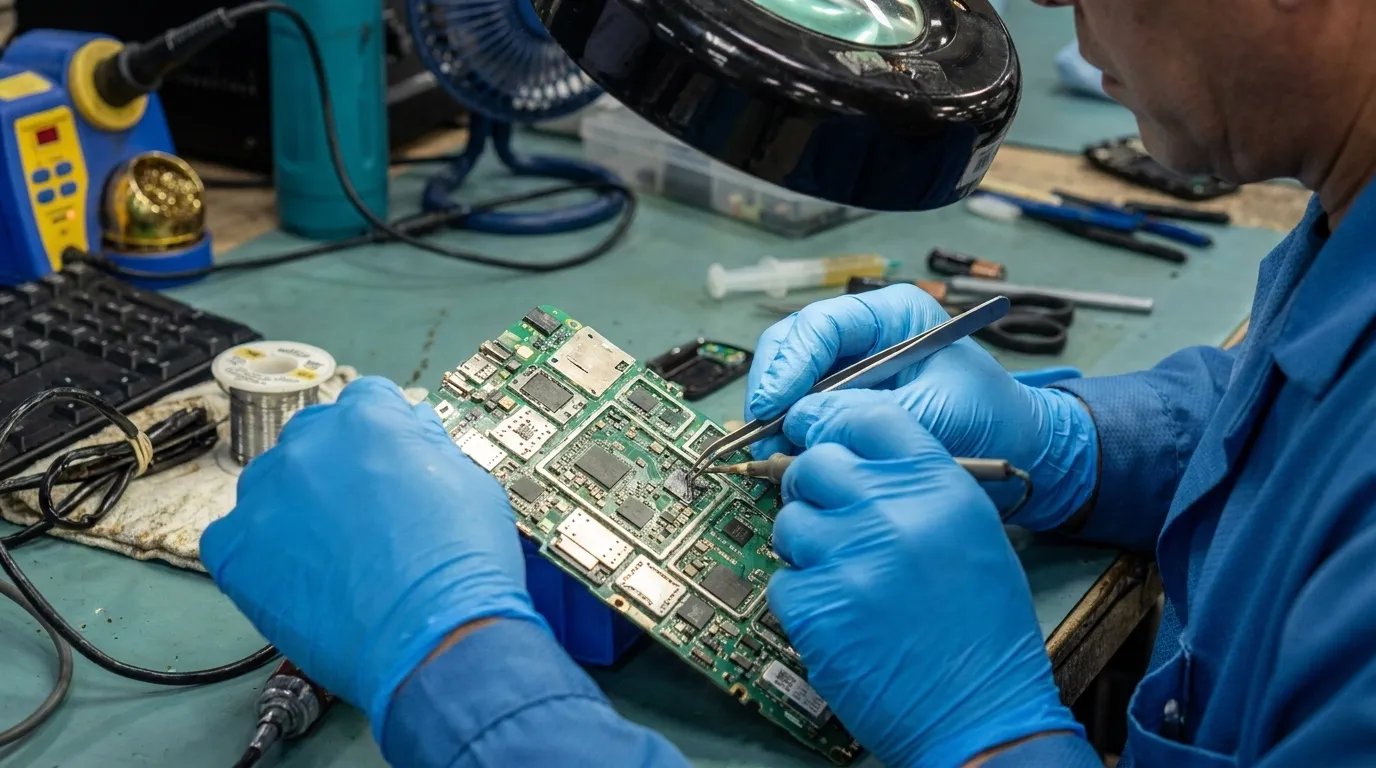
Repair automation covers functional testing, board-level diagnostics and robotic component placement. These systems compress cycle times and reduce labor variability. Operations that integrate these tools into a unified workflow process returns at a pace that manual-only facilities cannot match.
Premier Logitech operates DFW facilities and nearshore operations in Laredo and Nuevo Laredo, which provides a footprint for domestic and cross-border workflows. This infrastructure, combined with extensive OEM Authorized Service Center authorizations, positions Premier Logitech to absorb volume spikes without degrading quality or turnaround performance.
Data Wiping Standards and Secure Sanitization
Data sanitization protects against costly data breaches during device returns. IBM’s 2025 Cost of a Data Breach Report placed the global average cost of a data breach at $4.4 million, which highlights the financial risk of weak sanitization controls.
A controlled retirement process includes serial-level tracking, certificates of data sanitization or destruction, audit trails and exception reports to satisfy enterprise and government requirements. Automated offboarding platforms log every action, including wipe confirmation, return shipping and SIM cancellation, which creates records that support HIPAA, GDPR, SOC 2 and internal IT governance.
Blancco’s 2025 State of Data Sanitization report found that up to 47% of devices destroyed for data security reasons were still functional, which shows how over-destruction without sanitization options destroys recoverable asset value. This gap between security requirements and value recovery is the problem that proper sanitization protocols address.
Premier Logitech’s sanitization processes align with NIST, CMMC and SOC 2 requirements. Chain-of-custody documentation and audit-ready reporting sit at the core of every program, not as optional extras.
Grading Practices That Protect Resale Value
Standardized grading converts returned devices into secondary-market inventory with predictable value. Inconsistent grading criteria push refurbished devices into remarketing channels at uneven price points, which reduces buyer confidence and suppresses recovery rates.
Leading programs apply cosmetic grading scales, often A through C or equivalent, alongside functional test results to assign disposition paths. These paths include redeployment, refurbishment, parts harvesting and certified recycling. The U.S. EPA’s electronics stewardship guidance supports a lifecycle approach that prioritizes reuse, refurbishment and value recovery before recycling, which reinforces grading as both an economic and environmental best practice.
Premier Logitech’s certified refurbishment and grading programs serve OEMs and carriers that seek to maximize secondary-market recovery. Cosmetic refurbishment, parts reclamation and remarketing support operate as standalone services or as components of an end-to-end program.
Compliance Frameworks for Mobile Returns
Mobile reverse logistics in tech and telecom must navigate five core compliance areas: lithium battery regulations, e-waste handling rules, customs documentation for cross-border returns, disposition rules for electronic components and privacy and data sanitization requirements. Gaps in any of these areas create operational delays, financial penalties and reputational risk.
New Basel Convention requirements that took effect January 1, 2025 apply to international shipments of e-waste and e-scrap for recycling or disposal, covering both hazardous and non-hazardous materials. These rules increase documentation obligations for U.S. companies that manage cross-border reverse logistics. The U.S. EPA recommends that businesses use certified electronics recyclers holding R2 or e-Stewards certifications to support compliant handling of retired devices.
Premier Logitech holds certifications and authorizations across TAA, TAPA, ISO quality frameworks, NIST, CMMC and SOC 2. Its CAGE Code 4WAJ9 identifies it as a pre-vetted partner for U.S. federal government programs. These credentials reduce client compliance burden and provide audit-ready documentation at every stage of the return cycle.
Rapid Exchange Programs and Turnaround Speed
Turnaround speed defines the success of carrier and OEM exchange programs. A customer waiting for a replacement device becomes a churn risk. An enterprise employee without a functioning device represents a productivity loss. Next-day replacement models depend on pre-positioned inventory, automated RMA intake and logistics infrastructure that supports same-day outbound fulfillment.
Research indicates that up to 15% of corporate mobile devices go unaccounted for during their lifecycle, which creates lost hardware value, unused licenses and unmanaged security risk. Rapid exchange programs with IMEI-level tracking close that gap. Public IMEI lookup services decode the Type Allocation Code to identify device model and provide blacklisting details, which allows reverse logistics teams to confirm that a phone has not been reported lost or stolen before refurbishment and resale.
Premier Logitech delivers rapid exchange capabilities through a logistics architecture built for speed. OEM ASC authorizations support brand-compliant repairs without external handoffs, while a 120+ carrier LTL network supports same-day outbound reach across North America. The DFW hub and nearshore Mexico operations add geographic coverage that supports domestic and cross-border exchange workflows.
Talk to a lifecycle expert to design a rapid exchange program aligned with specific return volumes and SLA requirements.
Case Studies: How Leading Programs Recover Value
The following examples show how carriers, OEMs and logistics operators structure mobile reverse logistics programs to recover value, meet compliance requirements and scale operations.
T-Mobile — High-Volume Trade-In Processing
T-Mobile operates one of the largest device trade-in programs in the U.S. telecom market. The program processes millions of returned handsets each year, routing devices through automated triage, IMEI validation, grading and disposition. Devices that meet refurbishment thresholds enter secondary-market channels, while others move to certified recycling. The program’s scale requires a logistics partner that can absorb volume spikes during promotional trade-in events without degrading processing quality.
Apple — Certified Refurbishment and Remarketing
Apple’s certified refurbished program applies strict grading and functional testing standards to returned iPhones and iPads. Devices that pass inspection are resold through Apple’s channels with a warranty, which protects brand equity in the secondary market. The program’s compliance requirements, including data sanitization to Apple’s internal standards, set a benchmark for OEM-controlled reverse logistics.
Samsung — Warranty and Out-of-Warranty Repair Integration
Samsung’s U.S. reverse logistics operations integrate warranty claim management with depot repair and refurbishment. ASC-authorized repair centers handle L1 through L4 repairs, and graded devices move to Samsung’s certified refurbished channel or parts reclamation. The program’s compliance posture aligns with Samsung SDS’s automated offboarding and data sanitization standards, which protects chain-of-custody integrity across every returned unit.
GXO — 3PL-Integrated Returns Processing
GXO’s reverse logistics operations for consumer electronics clients show the value of 3PL integration in high-volume return environments. By embedding triage, grading and disposition workflows within the same facility that handles forward logistics, GXO reduces handling steps and compresses cycle times. This model shows how 3PL partners with reverse logistics depth can remove handoff delays that fragment value recovery.
Encore — Carrier-Grade Refurbishment at Scale
Encore’s refurbishment operations serve U.S. carriers that manage large volumes of off-lease and trade-in devices. The program applies standardized grading and cosmetic refurbishment to protect secondary-market yield. Compliance documentation, including data sanitization certificates and chain-of-custody records, is generated at the device level to support carrier audit requirements.
Premier Logitech — Single-Vendor Consolidation for a Large Enterprise
A large enterprise that managed device returns across multiple business units engaged Premier Logitech to replace a fragmented vendor roster that covered repair, fulfillment and recycling. Premier Logitech consolidated those functions under a single program that provided unified RMA intake, L1 through L4 depot repair, certified data sanitization, grading and remarketing. This consolidation reduced vendor management overhead and established a single audit trail for compliance reporting.
Premier Logitech — High-Volume OEM Repair Program
An OEM with ASC compliance requirements and growing warranty return volumes engaged Premier Logitech to absorb repair capacity that internal facilities could not handle. Premier Logitech’s weekly repair capacity and broad OEM authorizations allowed the OEM to maintain brand-compliant repair standards while scaling throughput. The program covered in-warranty and out-of-warranty claim support, cosmetic refurbishment and parts reclamation.
Premier Logitech — DFW and Nearshore Compliance Program
A telecom carrier with cross-border return flows engaged Premier Logitech to manage compliance documentation and logistics for devices that moved between U.S. and Mexico operations. Premier Logitech’s Laredo and Nuevo Laredo nearshore infrastructure and TAA-compliant sourcing capabilities provided a compliant, cost-effective processing path that met updated Basel Convention documentation requirements for cross-border e-waste shipments.
2026 Updates: Automation and Regulatory Changes
Two developments are reshaping mobile reverse logistics operations in 2025 and 2026. Automation adoption is accelerating across triage and grading functions. AI-assisted visual inspection systems now classify cosmetic condition at throughput rates that manual grading cannot match, and integration with warehouse management systems supports real-time disposition routing without manual data entry.
The regulatory environment for cross-border e-waste has also tightened. The Basel Convention changes discussed earlier affect U.S. operators with nearshore or offshore processing operations and increase documentation burden. Companies without established compliance infrastructure face higher risk of shipment delays.
Data sanitization standards continue to evolve. NIST and CMMC frameworks update guidance on acceptable sanitization methods for mobile devices, with greater emphasis on software-based wiping with verifiable audit trails instead of physical destruction. This over-destruction trend is driving enterprise buyers to demand sanitization-first disposition policies that preserve asset value while meeting security requirements.
Frequently Asked Questions
What is the difference between depot repair and field exchange in mobile reverse logistics?
Depot repair routes returned devices to a centralized facility for L1 through L4 repair, refurbishment and testing before redeployment or remarketing. Field exchange delivers a replacement device to the end user at the point of failure, and the defective unit returns to the depot afterward. Most enterprise and carrier programs use both, with field exchange supporting speed-sensitive replacements and depot repair supporting cost-effective recovery of returned inventory. Premier Logitech supports both models, with rapid exchange programs and full depot repair capabilities that operate from its DFW facilities.
How does IMEI tracking support compliance in mobile reverse logistics?
IMEI tracking provides serial-level visibility across every returned device from RMA intake through disposition. It allows reverse logistics teams to verify that a device has not been reported lost or stolen before refurbishment and resale, confirm warranty eligibility and generate chain-of-custody records for compliance audits. U.S. carriers AT&T and T-Mobile participate in shared IMEI blocklisting databases, which makes IMEI validation a standard step before any returned device enters a remarketing channel. Premier Logitech’s asset tagging and inventory reporting systems support IMEI-level traceability throughout the reverse logistics workflow.
What certifications should a mobile reverse logistics partner hold?
Enterprise and carrier programs typically require partners to hold OEM Authorized Service Center status for the brands being repaired, data sanitization certifications aligned with NIST or equivalent standards and environmental compliance credentials such as R2 or e-Stewards for recycling operations. Government and regulated-industry programs add requirements for TAA compliance, CMMC, SOC 2 and ISO quality frameworks. Premier Logitech holds certifications across TAA, TAPA, ISO, NIST, CMMC and SOC 2 and maintains ASC authorizations with more than 20 OEM brands.
How do enterprises manage data security risk during high-volume device returns?
High-volume return programs create data security risk when devices move through multiple handlers without verified sanitization at each stage. Best practice uses automated wipe processes triggered at intake, serial-level certificates of sanitization and audit trails that capture every action from return receipt through final disposition. Platforms that automate unenrollment from UEM and EPP systems at the point of return, before the device reaches a depot, reduce the window of exposure. Premier Logitech’s sanitization processes generate the chain-of-custody documentation and audit records that enterprise compliance teams require.
What are the primary drivers of secondary-market value for refurbished mobile devices?
Secondary-market value for refurbished devices depends on cosmetic grade, functional test results, model age, storage capacity, carrier lock status and demand in the target resale channel. Standardized grading applied consistently across a high-volume program produces predictable inventory that buyers in B2B and B2C channels can price with confidence. Devices that arrive at remarketing with verified data sanitization certificates and clean IMEI status command higher prices than those without documentation. Premier Logitech’s grading, refurbishment and remarketing programs focus on maximizing recovery value at each of these decision points.
Next Steps: Partner with Premier Logitech
Mobile reverse logistics programs that rely on fragmented vendors leave asset recovery value unrealized and create compliance gaps that grow with volume. Premier Logitech delivers end-to-end reverse logistics services, including triage, depot repair, data sanitization, grading, refurbishment, remarketing and certified recycling, from a single partner with the certifications, OEM authorizations and operational infrastructure to support carrier and enterprise scale.
Premier Logitech’s DFW hub, nearshore Mexico operations, weekly repair capacity and broad OEM authorizations are available as a complete program or as modular services that integrate with existing operations.
Talk to a lifecycle expert and build a reverse logistics program that recovers more value, meets every compliance requirement and scales with demand.
