Key Takeaways
- Depot repair turnaround time (RTAT) measures the full cycle from device receipt through diagnosis, repair, QA and outbound shipment. It serves as the primary SLA metric for reverse logistics programs.
- RTAT varies by device type and repair complexity. Simple fixes often complete in a few business days, while complex repairs that need parts sourcing can extend to several weeks.
- Four main factors drive RTAT variance: parts availability, device complexity, warranty or authorization status and inbound logistics quality. Parts delays are the most common cause of extended bench time.
- Organizations can shorten RTAT by pre-positioning high-runner parts, standardizing RMA intake, using rapid exchange programs, consolidating to ASC-authorized partners and requiring real-time status visibility.
- Premier Logitech holds ASC authorization for more than 20 OEM brands and provides the certifications and operational scale needed to meet enterprise depot repair SLAs get started today.
RTAT Ranges by Device Type and Repair Complexity
RTAT shifts with device type and repair complexity. Simple repairs often resolve in a few business days, while complex work that needs parts sourcing can extend to several weeks. Manufacturer depot repairs for major enterprise laptop brands typically run several business days, subject to parts availability. Authorized service center (ASC) networks with pre-positioned parts inventory can compress those ranges, particularly for high-runner device categories.
When standard depot timelines do not meet operational requirements, advanced exchange programs offer an alternative approach. These programs typically deliver a replacement unit within a few business days, compared with the longer timelines associated with standard depot repair cycles. The service model should align with device criticality, volume and compliance requirements.
Talk to a lifecycle expert about depot repair RTAT benchmarks for a specific device portfolio.
Depot Level Repair Scope and Operating Environment
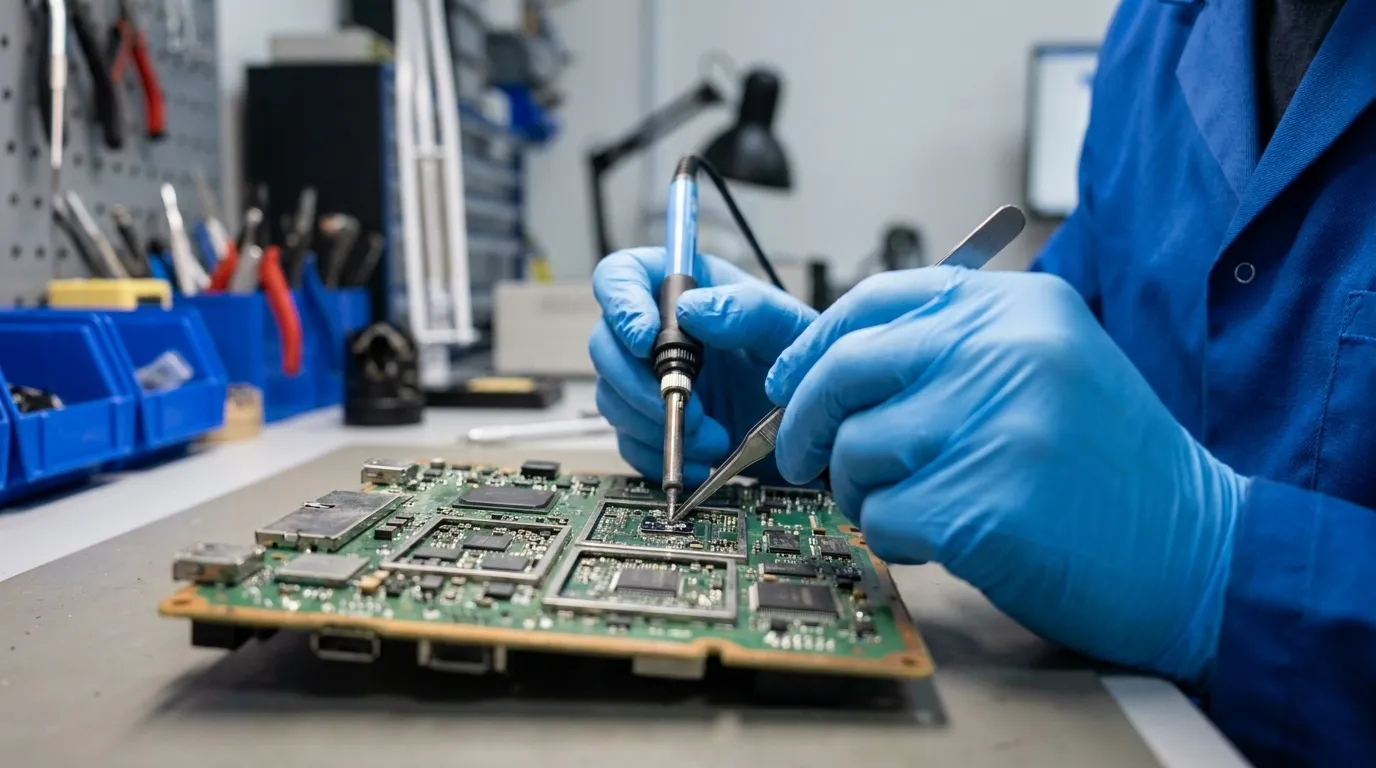
Depot level repair uses centralized, facility-based repair performed by trained technicians with specialized tools, test fixtures and controlled environments. This centralized approach supports Level 1 through Level 4 repair depth, from software reloads and cosmetic refurbishment to board-level component replacement. Several variables shape whether depot repair is required and how long it takes.
- Parts availability: Parts delays are a primary factor extending depot repair cycle times. Facilities that analyze repair history and pre-stock high-runner components reduce wait time at the bench.
- Brand authorization: Warranty status drives depot repair usage because manufacturers often require centralized depot service for warranty claims. Only ASC-authorized facilities can perform warranty-valid repairs for many OEM brands.
- Triage complexity: Depot repair delays most often result from accumulated small operational gaps such as incomplete RMA detail, unclear complaint descriptions, missing accessories and no-fault-found loops.
- Compliance checks: Government and regulated-industry programs require documented chain of custody, secure data handling and compliance verification before disposition. These steps add process time but remain mandatory for TAA, NIST, CMMC and SOC 2 programs.
How Long Depot Repair Typically Takes
Total RTAT has two distinct components: transit time and bench repair time. Both components must appear in SLA design.
Transit time often receives less attention than it deserves. Remote and hybrid workforces extend effective RTAT because a device that fails off-site requires round-trip shipping before diagnosis begins. For geographically dispersed fleets, inbound and outbound transit can represent a significant share of total cycle time.
The second component, bench repair time, depends on issue complexity and parts readiness. Simple repairs take a few business days. Complex repairs that need parts can take several weeks. Best-in-class depot operations commit to short turnaround from receipt to return shipment across device categories such as laptops, tablets and servers. As noted earlier, manufacturer timelines for standard laptop repairs typically run several business days.
The practical industry range for depot repair, excluding transit, sits between a few and several business days for standard repairs at well-resourced facilities. Programs with advance exchange or rapid-exchange capabilities can reduce effective downtime to a few days by shipping a replacement unit before the defective device is repaired.
Key Drivers of Depot Repair Turnaround Time
Four categories of variables drive RTAT variance across enterprise depot programs.
- Parts availability: Specialized or low-volume components are often not stocked in large quantities and can take weeks to source, which directly extends device downtime. Fragmented inventory visibility across multiple sites makes it difficult to quickly locate available parts.
- Device complexity: Repairs needing specialized tools, clean rooms, calibration equipment or extensive parts inventory are best performed at a centralized depot. Higher complexity correlates with longer bench time.
- Warranty and authorization status: Out-of-warranty devices may require additional approval steps or alternative parts sourcing. In-warranty repairs at non-authorized facilities void coverage, which forces rework through authorized channels and adds cycle time.
- Inbound logistics and intake quality: Incomplete RMA detail, missing accessories and unclear disposition rules extend overall depot cycle time beyond the physical repair work itself. Standardized intake processes and clear RMA documentation reduce triage delays at the front end of the cycle.
When Depot Repair Beats Field Repair
Field repair and depot repair support different operational needs. Field repair, performed on-site by a technician, fits simple modular fixes where device criticality demands fast resolution and the repair does not require specialized equipment. Local in-house repair can reduce turnaround time to a few days compared with manufacturer depot timelines.
Depot repair becomes essential when warranty compliance, device complexity, data security or regulatory documentation standards apply. Manufacturers often require centralized depot service for warranty claims to maintain control over parts usage, documentation and batch processing efficiency. For government agencies and regulated enterprises, depot repair at a certified facility often serves as the only compliant option.
The tradeoff centers on speed versus compliance and repair depth. Field repair moves faster for simple issues. Depot repair delivers higher first-time fix rates, documented chain of custody and warranty-valid outcomes. Best-in-class depot operations maintain strong first-time fix performance.
Practical Ways to Shorten Depot Repair RTAT
Reducing RTAT requires attention to delay drivers at each stage of the cycle. The following mitigation strategies target the most common sources of that variance.
- Pre-position high-runner parts: Analyze repair history, stock high-runner parts and set expedited ordering procedures to remove the most common cause of bench delays.
- Standardize RMA intake: Use structured intake forms, complete accessory checklists and defined triage rules to prevent no-fault-found loops and handoff delays that extend depot cycle time.
- Deploy rapid exchange programs: Use advanced exchange programs that ship replacements shortly after authorization, which decouples end-user downtime from bench repair time. This approach works well for mission-critical device fleets.
- Consolidate to an ASC-authorized partner: Fragmented vendor relationships create handoff delays, inconsistent documentation and compliance gaps. A single authorized partner with multi-OEM ASC status handles warranty-valid repairs across device categories without routing devices through multiple facilities.
- Require real-time visibility: Operational visibility into device status, parts staging and outbound logistics allows program managers to intervene before delays compound. Transportation management systems and lifecycle analytics support proactive management.
- Use geographic positioning: Depot proximity to major logistics hubs reduces inbound and outbound transit time. Facilities near major air freight hubs with nearshore overflow capacity support volume spikes without extending cycle time.
Premier Logitech holds ASC authorization for more than 20 OEM brands, a repair capacity of thousands of units per week across three DFW facilities and nearshore operations in Laredo and Nuevo Laredo. The company maintains TAA, NIST, CMMC, SOC 2 and ISO certifications that satisfy compliance requirements for government agencies and regulated enterprises. Real-time tracking and lifecycle analytics provide the operational visibility program directors need to manage SLAs at scale.
Talk to a lifecycle expert about compressing depot repair cycle time for a specific program.
Vendor-Selection Checklist for Depot Repair Partners
The following criteria support evaluation of depot repair partners for enterprise or government programs.
- Service scope: Confirm that the partner supports L1 through L4 repair depth, cosmetic refurbishment and end-of-life disposition under one program.
- OEM authorization: Confirm ASC status for the OEM brands in the device portfolio. Unauthorized repair voids warranties and creates compliance exposure.
- Compliance certifications: For government and regulated programs, confirm TAA compliance, CAGE code registration, NIST alignment, CMMC certification and SOC 2 attestation.
- Repair capacity and scalability: Assess whether the partner can absorb volume spikes such as seasonal returns, product recalls or fleet refreshes without extending standard RTAT commitments.
- Rapid exchange capability: Confirm that the partner offers advance exchange or rapid replacement programs that decouple end-user downtime from bench repair time.
- Real-time visibility: Require device-level tracking, inventory reporting and lifecycle analytics integrated into program management.
- Geographic footprint: Check whether facilities sit near major logistics hubs to minimize inbound and outbound transit time across a national device fleet.
- Vendor consolidation potential: Determine whether the partner can replace fragmented repair, fulfillment and recycling relationships with a single-source program that reduces administrative overhead and improves SLA consistency.
- Total cost of ownership: Evaluate whether the pricing model accounts for asset recovery value, refurbishment and remarketing revenue and reduced spare-pool requirements, not just per-unit repair cost.
Frequently Asked Questions
What is depot level repair?
Depot level repair uses centralized, facility-based repair performed by trained technicians with specialized tools, test fixtures and controlled environments. It covers repair depths from software reloads and cosmetic refurbishment through board-level component replacement. Depot repair supports warranty-valid service, compliance-documented disposition and repairs that exceed field technician capability or tool availability.
How long does depot repair take?
Depot repair turnaround time ranges from a few business days for simple repairs to several weeks for complex repairs that require parts sourcing. The total elapsed time from a user perspective includes inbound and outbound transit, which can add several days for remote or distributed device fleets. Programs with advance exchange capabilities can reduce effective downtime to a few days by shipping a replacement unit before the defective device completes the repair cycle.
What factors affect depot repair turnaround time?
The primary factors are parts availability, device complexity, warranty and authorization status and intake quality. Parts delays are the most common cause of extended bench time. Incomplete RMA documentation, missing accessories and undefined triage rules create front-end delays that compound throughout the cycle. Device complexity determines whether specialized tools, clean rooms or calibration equipment are required, and each requirement adds process time.
When is depot repair required instead of field repair?
Depot repair becomes required when warranty compliance mandates centralized service, when the repair needs specialized equipment not available in the field, when data security and chain-of-custody documentation are contractually or regulatorily required or when device complexity exceeds field technician capability. Government agencies and regulated enterprises typically require depot repair at a certified facility for all warranty and compliance-sensitive assets.
How does vendor consolidation affect depot repair RTAT?
Fragmented vendor relationships introduce handoff delays, inconsistent documentation and compliance gaps that extend effective RTAT beyond what any single facility’s bench time would suggest. Consolidating to a single authorized partner with multi-OEM ASC status, integrated logistics and real-time visibility removes inter-vendor coordination delays, standardizes intake and disposition processes and provides a single SLA accountable across the full repair cycle.
Conclusion: Selecting a Depot Repair Partner That Meets SLAs
Depot repair turnaround time functions as a product of parts readiness, repair authorization, intake quality, device complexity and logistics positioning. The industry range for bench repair runs from three to five days for simple repairs to several weeks for complex, parts-constrained work. Transit adds to that window for distributed fleets.
The evaluation framework follows a clear sequence. Start by confirming ASC authorization for the OEM brands in the portfolio, then verify that compliance certifications match the regulatory environment. With those foundational requirements met, assess whether the partner’s capacity can handle peak return volumes and require real-time visibility as a baseline capability for managing those volumes. Rapid exchange programs should appear in SLA design for mission-critical devices.
Premier Logitech provides ASC authorization for more than 20 OEM brands, L1 through L4 repair depth, TAA, NIST, CMMC and SOC 2 certifications and the operational scale to support high-volume programs without extending cycle time. The DFW logistics hub and nearshore operations provide geographic positioning that reduces transit time across national fleets.
