Key Takeaways
- A high volume IT repair depot consolidates L1–L4 repair, RMA workflows and compliance-certified processes in one facility that handles enterprise-scale return volumes.
- Depot-level repair is structured into four tiers, from functional testing to engineering-level board repair, and each tier requires specific certifications and tooling.
- Enterprise depot programs must meet strict compliance standards such as NIST SP 800-171, CMMC and SOC 2 Type II to support government and OEM contracts.
- Outsourced depot models reduce capital costs, certification workload and capacity risk while supporting scalable throughput and secondary-market recovery value.
- Premier Logitech delivers ASC-authorized L1–L4 repair, full compliance coverage and end-to-end RMA management from a single partner; talk to a lifecycle expert to start a program.
High Volume IT Repair Depots for Enterprise Returns
High volume IT repair depots support growing enterprise return volumes driven by larger device fleets, complex warranties and sustainability mandates. Depot returns represent a defined channel in reverse logistics networks, distinct from parcel, store, field and bulk return paths. A high volume IT repair depot consolidates intake, diagnosis, repair, grading and redeployment in one operation, which replaces fragmented vendor relationships with a single auditable workflow.
That consolidation requires both physical capacity and technical authorization. Premier Logitech operates as an ASC-authorized enterprise depot repair provider with capacity to process high volumes of repairs per week across three DFW facilities and nearshore operations in Laredo and Nuevo Laredo, Mexico.
Depot Level Repair and Compliance Requirements
Depot level repair uses structured service tiers that define scope, tooling and certification requirements for each class of repair work. Level of repair analysis frameworks categorize maintenance actions by complexity and required resources, from basic diagnostics to component-level board work.
These repair tiers connect directly to compliance expectations. Each level triggers different controls based on the systems and data involved. In a 2026 enterprise depot context, facilities handling government assets must align with NIST SP 800-171, which mandates protection of Controlled Unclassified Information through secure cryptographic protocols, regular risk assessments and data integrity plans. CMMC applies to Department of Defense contractors and subcontractors and measures cybersecurity maturity, with requirements that scale to information sensitivity. SOC 2 Type II evaluates how service organizations manage customer data across five Trust Services Criteria over a 12-month period and functions as a common enterprise procurement requirement.
Four Repair Levels in a High Volume IT Depot
The four depot repair levels define the work performed and the authorizations required to perform it.
- L1 — Functional Testing and Triage: Intake inspection, power-on testing, cosmetic grading and sort-to-disposition. No disassembly occurs at this level, so turnaround is fastest.
- L2 — Module Replacement: Swap of field-replaceable units such as batteries, screens, keyboards and storage drives. This level requires OEM-approved parts and documented chain of custody for data-bearing components.
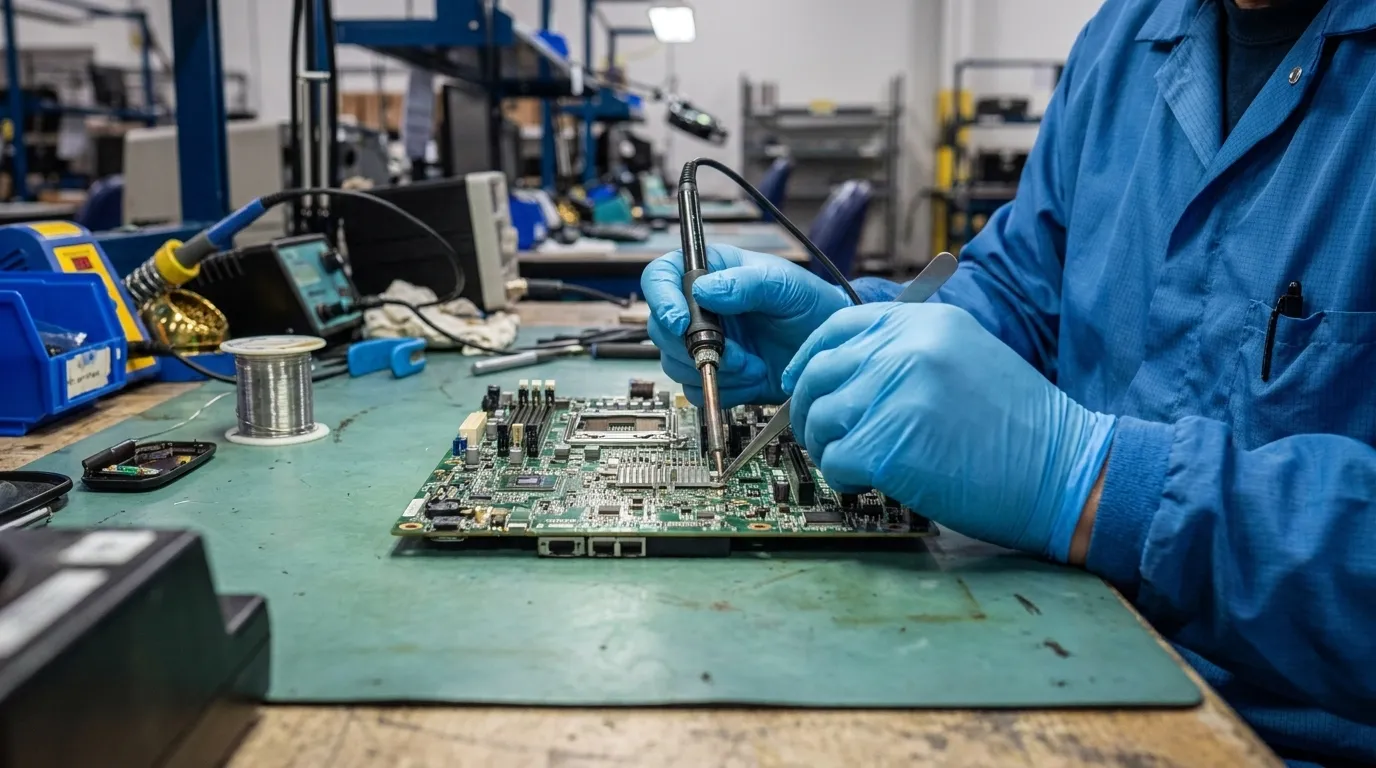
- L3 — Board and Component Repair: Subassembly-level diagnosis and repair, including logic board work, BGA reballing and electromechanical assembly. This level requires certified technicians and OEM Authorized Service Center status.
- L4 — Deep Depot and Engineering-Level Repair: Full system teardown, PCBA-level repair, firmware recovery and engineering disposition. This level requires advanced tooling, OEM technical documentation access and the highest compliance controls.
Premier Logitech holds ASC authorizations for multiple OEM brands, which enables L1–L4 repair across a broad device portfolio that includes mobile, computing and peripheral categories. That authorization depth creates a structural advantage because depots without OEM ASC status cannot perform warranty-valid L3 or L4 repairs on major brands.
Talk to a lifecycle expert about L1–L4 depot repair capacity for a specific program.
End-to-End RMA Workflow in Enterprise Depot Repair
A structured RMA workflow forms the operational backbone of any high volume RMA repair partner relationship. The following steps outline a standard enterprise depot repair flow.
- RMA Authorization: The client submits a return request through a portal or EDI integration, and the depot issues an RMA number and routing label.
- Inbound Logistics: Devices ship to the depot through a carrier network. Premier Logitech’s TMS integrates with multiple vetted North American LTL carriers for inbound freight management.
- Receiving and Intake: Assets are logged, serialized and matched to RMA records. Chain-of-custody documentation begins at this step.
- Triage and Diagnosis: L1 technicians perform functional testing and cosmetic grading, then route devices to the appropriate repair level or flag them for disposition.
- Repair Execution: L2–L4 technicians perform authorized repairs using OEM-approved parts and documented procedures.
- Data Sanitization: All data-bearing devices undergo certified erasure aligned with NIST SP 800-88 guidelines before redeployment or disposition.
- Quality Assurance: Repaired units pass functional and cosmetic QA before grading for redeployment, refurbishment or recycling.
- Outbound Fulfillment: Units ship to the client, end user or secondary market channel with full serialization and reporting.
- Reporting and Visibility: Real-time tracking and lifecycle analytics remain available throughout the workflow and support inventory control and compliance reporting.
Cost and Turnaround Benchmarks for High Volume RMA Partners
Cost and turnaround performance in enterprise depot repair depend on device type, repair level, volume commitments and program structure. 2026 IT benchmark data shows continued pressure on service organizations to reduce per-incident costs while maintaining resolution quality.
In-house depot models carry capital costs for facility, tooling, staffing and OEM certification maintenance. These expenses remain fixed regardless of return volume. Outsourced models convert those fixed costs into per-unit or program fees, and the depot partner absorbs capacity risk. For organizations with seasonal or irregular return spikes, outsourced models provide elasticity that in-house operations cannot match without significant investment.
Those cost advantages increase when the depot partner invests in automation. North America accounts for 38.9% of incremental global growth in reverse logistics automation during 2026–2030, driven by labor costs that favor automation adoption. Depots that use automation and AI-assisted dispositioning deliver more consistent throughput and lower per-unit handling costs over time, which directly affects repair yield rate, parts cost management, labor efficiency and secondary market recovery value.
The primary cost levers in a high volume IT repair depot program are repair yield rate, parts cost management, labor efficiency and secondary market recovery value. A depot that returns more units to resalable condition offsets program costs through remarketing revenue.
Volume Tiers for Selecting an Enterprise Depot Partner
Return volume tiers provide a practical framework for selecting a depot repair model. Mid-market programs often process 500 to 2,000 units per month and benefit from shared capacity with modular service selection. Enterprise programs typically handle 2,000 to 10,000 units per month and require dedicated account management, custom SLAs and integrated reporting.
Federal and OEM-scale programs can exceed 10,000 units per month and demand full compliance stacks, ASC authorizations across multiple brands and the ability to manage controlled or classified information. Premier Logitech supports programs across these tiers with modular or dedicated service options that align with volume and compliance needs.
Compliance Requirements for Government and OEM Depot Programs
Government and OEM depot programs rely on specific compliance certifications that match contract type and data sensitivity. Premier Logitech maintains the full compliance stack described in the depot repair section, plus TAA, ISO 9001 and R2v3-aligned practices for responsible recycling. The company holds a CAGE Code (4WAJ9) as a pre-vetted federal government partner.
In-House and Outsourced Mobile Device Depot Models
High volume mobile device repair programs face a build-versus-buy decision with significant capital and operational impact. In-house depot operations require facility investment, specialized tooling, OEM certification maintenance, staffing for multiple repair tiers and compliance infrastructure. OEM ASC authorizations are not transferable and require ongoing audits, so maintaining ASC status across many OEM brands rarely proves practical for most enterprises.
Outsourced depot models transfer capacity risk, certification workload and compliance overhead to the partner. Retailer-led consolidation of return processing operations to improve cost control and turnaround time drives growth in reverse logistics platforms through 2036. The same consolidation logic applies to enterprise and OEM programs.
Volatile supply chains and rising hardware costs push large organizations to prioritize reuse, refurbishment and recovery of IT assets over new purchases. An outsourced depot partner with secondary market remarketing capabilities converts repaired inventory into recovered asset value and helps offset program costs.
Premier Logitech operates as a single-source lifecycle partner that replaces fragmented repair, fulfillment and recycling vendors with one integrated program. Clients engage Premier Logitech for end-to-end management or select individual services on a modular basis, depending on program maturity and internal capabilities.
Schedule a Call with Premier Logitech
Directors of reverse logistics and VP-level supply chain leaders managing high return volumes benefit from a partner with ASC authorizations, compliance certifications and operational scale that match program requirements. Premier Logitech delivers all three from a single point of contact.
Talk to a lifecycle expert and request a customized depot repair program proposal.
Frequently Asked Questions
What return volume supports a move to an outsourced depot model?
Organizations that manage return volumes which strain internal triage capacity, require multiple OEM ASC authorizations or involve government compliance requirements often find outsourced depot models more cost-effective. Premier Logitech works with clients across mid-market and enterprise volume tiers and structures programs to match current volume with room to scale.
How does Premier Logitech maintain OEM ASC authorization across many brands?
Premier Logitech holds ASC authorizations for more than 20 OEM brands and maintains them through ongoing compliance with each OEM’s certification requirements. These requirements include technician training, tooling standards, parts sourcing and audit participation. Each authorization is earned and maintained independently, which makes ASC depth a meaningful differentiator when evaluating enterprise depot repair partners.
What compliance frameworks support government depot repair programs?
Premier Logitech’s compliance certifications, detailed in the compliance requirements section, cover the full range of government and enterprise needs. The company supports TAA, NIST, CMMC, SOC 2, TAPA and ISO quality frameworks and holds a CAGE Code (4WAJ9) as a pre-vetted federal government partner. For programs involving Controlled Unclassified Information, NIST SP 800-171 and CMMC certifications provide the required baseline.
Can Premier Logitech support both mobile device repair and traditional IT hardware?
Premier Logitech’s depot repair capabilities span mobile devices, laptops, desktops, peripherals and connected hardware. Clients with mixed-device fleets can consolidate repair, refurbishment and disposition in a single program instead of managing separate vendors for each device category.
What happens to devices that cannot be repaired to redeployment standard?
Devices that do not meet repair or refurbishment thresholds move to grading, parts reclamation or responsible recycling. Premier Logitech operates e-waste reduction programs and secure data destruction services that ensure end-of-life assets meet environmental and data security requirements. Asset recovery and remarketing programs capture residual value from devices that qualify for secondary market channels.
Next Steps for High Volume IT Repair Depot Strategy
High return volumes managed through fragmented vendors create compliance gaps, missed asset recovery and operational bottlenecks. A single ASC-authorized high volume IT repair depot partner consolidates L1–L4 repair, RMA workflow management, compliance reporting and secondary market recovery in one accountable program.
Global e-waste is projected to reach 82 million tonnes by 2030 and North America leads incremental growth in reverse logistics automation through 2026–2030. These trends strengthen the operational and regulatory case for a structured enterprise depot repair program.
Premier Logitech brings 20-plus OEM ASC authorizations, the compliance certifications required for government and enterprise programs and the operational scale to support programs from mid-market to federal enterprise. The next step involves a direct conversation about program requirements, volume tiers and integration timelines.
Talk to a lifecycle expert and start building an enterprise depot repair program today.
