Key Takeaways for Reverse Logistics IT Repair
- Reverse logistics IT repair follows five stages (Return, Repair, Refurbish, Repackage, Recover) that move assets from end users back through the supply chain for triage, repair, refurbishment, data sanitization, redeployment or responsible disposal.
- A structured process reduces asset write-offs, shortens replacement cycles and creates an auditable chain of custody from intake to final disposition.
- Effective IT asset reverse logistics requires serialized tracking, NIST SP 800-88-aligned data sanitization, grading standards and documentation for CMMC 2.0, TAA, SOC 2 and state privacy laws.
- Depot repair follows a tiered L1–L4 structure, and routing assets to the correct level preserves warranty eligibility, controls cost and maintains OEM-quality outcomes.
- Premier Logitech delivers end-to-end reverse logistics IT repair through its ASC-authorized network, NIST and CMMC-aligned data sanitization and real-time asset visibility get started today.
Six-Step Reverse Logistics IT Repair Workflow
A defined reverse logistics IT repair workflow protects asset value and supports compliance from intake through disposition.
- Intake and logging: Teams receive assets, record serials and enter them into an asset management system with full chain-of-custody documentation.
- Triage and diagnosis: Technicians assess functional, cosmetic and data-security status to determine the repair path.
- Repair routing: Teams assign units to the correct repair level based on fault complexity and OEM authorization requirements.
- Quality assurance: Repaired units undergo functional testing and inspection before release.
- Disposition decision: Units route to redeployment, secondary market, parts reclamation or certified recycling.
- Reporting and analytics: Program data feeds procurement and lifecycle planning to reduce future return volumes.
Each step without a defined owner or documented output creates a gap where assets lose value and compliance exposure grows.
IT Asset Reverse Logistics Across the Full Lifecycle
The six-step process above operates within a broader IT asset reverse logistics framework that covers the full lifecycle of a returned device, including data security, regulatory compliance and residual value recovery.
- Serialized asset tracking from return authorization through final disposition
- Defined data sanitization protocols aligned to NIST SP 800-88 Rev. 1
- Grading and refurbishment standards for secondary market eligibility
- Compliance documentation for CMMC 2.0, TAA, SOC 2 and applicable state privacy laws
- Integration with ITAD workflows for assets that cannot be repaired or redeployed
- ESG and e-waste reporting aligned to R2 and e-Stewards certification standards
Fragmented asset tracking across multiple vendors produces gaps in chain-of-custody documentation that regulators and auditors flag quickly.
Depot Repair Levels in Reverse Logistics
Depot repair centralizes IT hardware work that requires specialized tooling, parts inventory or OEM-authorized procedures that field teams cannot perform.
- L1 (organizational): Basic diagnostics, software resets and remove-and-replace tasks performed with standard tools.
- L2 (intermediate): Component-level fault isolation and repair using specialized test equipment.
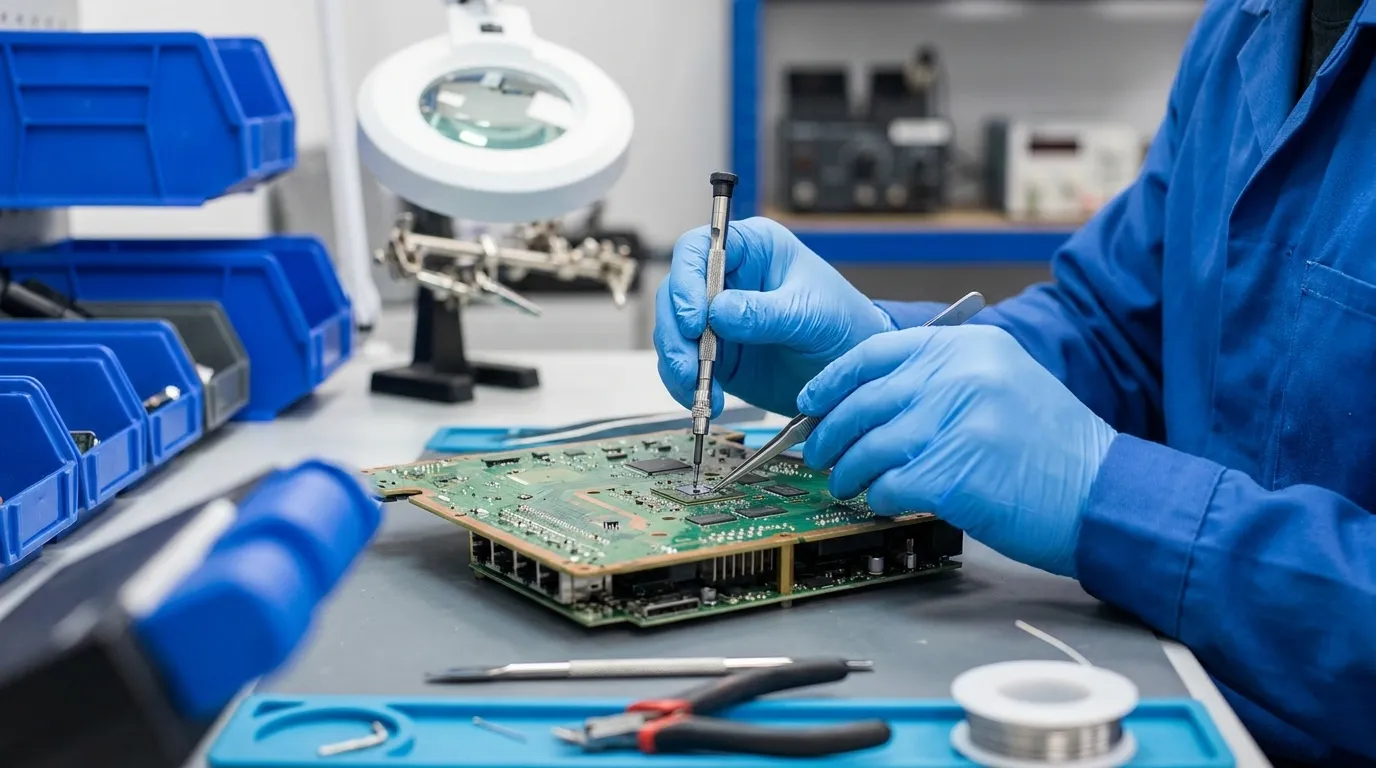
- L3 (depot): Board-level repair, BGA rework and complex subassembly overhaul in a controlled facility.
- L4 (manufacturer/OEM): Full overhaul or engineering-level repair that requires OEM authorization and proprietary tooling.
Routing assets to the wrong repair level wastes labor, voids warranties and delays redeployment.
Structured RMA Process for IT Hardware
A structured RMA process controls return volume, enforces eligibility rules and generates documentation for warranty recovery and compliance reporting.
- End users or IT teams submit a repair or return request through a self-service portal or service desk.
- Teams verify eligibility against warranty status, asset record and program policy.
- The system issues an RMA number with shipping instructions and a prepaid label where applicable.
- The depot receives the asset, logs it against the RMA record and completes an inspection.
- Teams determine disposition: repair, advance exchange, refurbishment or ITAD.
- Status updates flow to the requester throughout the workflow.
- Closed RMA data feeds supplier recovery and warranty analytics.
Automated workflows with defined routing rules reduce cycle time and improve first-time fix rates.
OEM Authorized Repair Network Advantages
OEM Authorized Service Center status grants repair providers access to proprietary diagnostics, genuine parts, firmware tools and warranty reimbursement programs that unauthorized shops cannot access.
- Warranty preservation on repaired units, which protects asset resale value
- Access to OEM technical bulletins and engineering change orders
- Eligibility for OEM warranty reimbursement that offsets depot labor and parts costs
- Audit-ready documentation that satisfies OEM quality and compliance requirements
- Reduced risk of voided warranties from unauthorized component substitution
Organizations that route warranty-eligible assets to non-authorized repair providers forfeit reimbursement and increase the risk of OEM audit findings.
Learn how Premier Logitech’s multi-brand authorization supports complex fleets.
Integrating ITAD with Reverse Logistics
Integrated ITAD and reverse logistics workflows run more efficiently than sequential handoffs between separate vendors.
- Assets enter the reverse logistics intake process with a disposition flag set at triage.
- Repairable units route to depot repair, and unrepairable units route to ITAD.
- ITAD-bound assets receive data sanitization before any physical disposition action.
- Graded and refurbished units clear for redeployment or secondary market resale.
- Residual assets enter certified recycling with R2 or e-Stewards documentation.
- Teams record all disposition outcomes in a unified asset management system for ESG and compliance reporting.
The average data breach now costs more than $4.4 million, and retired devices containing credentials or proprietary configurations represent avoidable exposure when ITAD operates as a separate downstream process.
Secure Data Erasure in Reverse Logistics Programs
NIST SP 800-88 Rev. 1 defines the accepted framework for media sanitization in regulated IT asset disposition.
- Classify the asset by data sensitivity and post-sanitization use, then select Clear, Purge or Destroy.
- Apply the selected method: software overwrite for Clear, cryptographic erase or degaussing for Purge, physical shredding or disassembly for Destroy.
- Verify the outcome using software verification, random sampling or independent third-party validation in regulated environments.
- Generate a certificate of data destruction that includes device serial number, media type, sanitization method, timestamp, technician identity and verification outcome.
- Log the event in a tamper-resistant, centralized system linked to the asset record.
- Retain chain-of-custody documentation to satisfy audit requirements under ISO 27001 Controls 8.10 and 8.11, HIPAA, CCPA and applicable state privacy laws.
Regulatory frameworks including GDPR, HIPAA and CCPA require demonstrable chain of custody and proof of secure disposal tied directly to the asset lifecycle record, not stored as standalone certificates.
Reverse Logistics IT Repair Cost Drivers
Cost recovery in reverse logistics IT repair depends on capturing value at each stage of the return cycle rather than treating returns as a pure expense.
- Repair versus replace decisions: Evaluating L1 and L2 repairs on in-warranty assets against advance exchange options manages immediate costs through a structured LORA process that identifies the right repair level for each asset class.
- OEM warranty reimbursement: When ASC-authorized providers complete repairs, organizations qualify for OEM reimbursement programs that offset the depot labor and parts costs identified in the repair-versus-replace analysis.
- Secondary market resale: Assets that complete the repair process can be graded and refurbished for secondary market channels, which recovers residual value that write-offs remove.
- Supplier recovery: Integrating supplier recovery programs with the RMA process captures an additional share of total warranty costs beyond direct OEM reimbursement.
- Vendor consolidation: Consolidating these activities under a single reverse logistics partner reduces coordination costs and overhead that fragment the value captured through the previous levers.
- E-waste diversion: For assets that cannot be repaired or resold, certified recycling and parts reclamation reduce landfill disposal costs and support ESG reporting obligations.
Without visibility into per-unit repair costs, reimbursement capture rates and secondary market yields, organizations cannot measure the true economic performance of a reverse logistics program.
2026 Compliance Checklist for IT Reverse Logistics
The 2026 regulatory environment imposes overlapping obligations on organizations that manage IT asset returns, repair and disposition.
- TAA (Trade Agreements Act): Federal procurement requires sourcing and repair with TAA-compliant components and facilities.
- NIST SP 800-88 Rev. 1: The sanitization framework described earlier requires Clear, Purge or Destroy methods with verifiable documentation.
- CMMC 2.0: Defense Industrial Base contractors must align device intake, media sanitization, incident reporting and records management to certified maturity level.
- SOC 2 Type II: Enterprise service providers must audit and report security, availability and confidentiality controls for asset handling workflows.
- ISO 9001 / ISO 14001: Quality and environmental management standards require defined repair processes and e-waste handling.
- DOJ Data Security Program: Cross-border data transactions require reverse logistics involving foreign processing or entities from countries of concern to comply with bulk-data transfer restrictions effective October 2025.
- State privacy laws: State-level consumer data protection in 20 states as of 2026 requires data on retired devices to be sanitized in line with applicable deletion, access and breach-notification obligations.
Civil penalties for missed breach notification windows can reach substantial amounts in some states, and inaccurate CMMC certifications carry heightened False Claims Act exposure even without a cyber incident.
Vendor-Evaluation Framework for Reverse Logistics Partners
Vendor selection for reverse logistics IT repair should follow six evaluation dimensions that together determine whether a partner can deliver secure, compliant and scalable outcomes.
1. Service scope: The vendor should cover the full reverse logistics lifecycle, including RMA intake, triage, L1–L4 depot repair, data sanitization, refurbishment, grading, redeployment and certified recycling. Gaps in scope push organizations back into multi-vendor coordination.
- Single-source program management from return to disposition
- Modular service options for organizations with partial in-house capability
2. Technical capabilities: ASC authorization for OEM brands in the asset fleet is a nonnegotiable requirement for warranty-eligible repairs. Teams should also evaluate repair capacity, tooling and controlled-environment availability.
- OEM ASC status across relevant brands
- L1–L4 repair capability under one roof
- Certified data sanitization aligned to NIST SP 800-88 Rev. 1
3. Quality and compliance: The vendor must hold certifications that match the organization’s regulatory obligations. Audit readiness is essential for federal, defense and enterprise programs.
- TAA, NIST, CMMC, SOC 2, ISO 9001/14001 certifications
- Chain-of-custody documentation and certificates of data destruction
- Compliance reporting capabilities for state privacy law obligations
4. Scalability and flexibility: Return volumes fluctuate with refresh cycles, recalls and seasonal demand, so the vendor must absorb volume spikes without service degradation.
- Demonstrated high-volume repair and processing capacity
- Rapid exchange and advance replacement program support
- Nearshore and domestic facility options for cost and speed balance
5. Visibility and data: Real-time asset tracking, repair status reporting and lifecycle analytics support program management and compliance documentation.
- Transportation management system integration
- Real-time inventory and repair status visibility
- Lifecycle analytics for cost recovery and ESG reporting
6. Total cost and value: Evaluation should consider total cost of ownership across repair, logistics, compliance overhead and asset recovery yield. A consolidated single-vendor model simplifies management and strengthens accountability because one partner owns the full workflow.
- OEM warranty reimbursement capture rates
- Secondary market recovery yield
- Vendor consolidation savings versus multi-vendor coordination costs
Evaluate how Premier Logitech’s capabilities align to these six dimensions.
Common Reverse Logistics IT Repair Failures
Enterprise reverse logistics programs tend to fail in predictable ways that map to clear root causes and mitigations.
RMA bottlenecks: Manual eligibility checks, missing asset records and unclear routing rules create backlogs that delay repair and extend device downtime. Mitigation: implement automated RMA intake with eligibility verification, defined disposition rules and real-time status visibility.
Data-security gaps: Devices moving through repair or refurbishment without verified sanitization create regulatory exposure under NIST, CMMC and state privacy laws. Mitigation: embed NIST SP 800-88-aligned erasure as a mandatory intake step with automated certificate generation and chain-of-custody logging.
Fragmented vendor networks: Separate providers for repair, logistics and recycling create handoff failures, inconsistent documentation and accountability gaps. Multiple IT vendors increase complexity and coordination costs, and execution slows because several parties must communicate. Mitigation: consolidate to a single-source partner with end-to-end program ownership.
Missed asset recovery value: Assets written off without grading or secondary market evaluation remove recoverable value. Mitigation: integrate grading and remarketing into the disposition workflow before any asset routes to recycling.
Compliance documentation failures: Incomplete or inconsistent records for sanitization, chain of custody and repair authorization create audit findings and regulatory penalties. Mitigation: require standardized documentation outputs at every process stage, linked to the asset record in a centralized system.
Best Practices for Reverse Logistics IT Repair Programs
Organizations that build or restructure reverse logistics IT repair programs benefit from a clear set of operational priorities.
- Map the current return flow end to end, and identify every handoff, system and vendor involved before selecting a new program structure.
- Establish a single asset record that follows the device from RMA issuance through final disposition, and capture repair, sanitization and chain-of-custody data in one system.
- Require NIST SP 800-88 Rev. 1-aligned sanitization at intake for all devices, regardless of intended disposition path.
- Select an ASC-authorized repair partner for every OEM brand in the asset fleet to preserve warranty eligibility and reimbursement.
- Integrate ITAD into the reverse logistics workflow rather than treating it as a downstream handoff to a separate vendor.
- Build compliance reporting into the program from day one, with documentation outputs mapped to TAA, CMMC, SOC 2, ISO and applicable state privacy law requirements.
- Review the program against updated regulatory requirements at least annually, given the pace of change in U.S. state privacy law and federal frameworks such as CMMC and the DOJ Data Security Program.
Build a reverse logistics structure aligned to these best practices with Premier Logitech.
Conclusion: Turning Reverse Logistics into a Strategic Function
Reverse logistics IT repair operates as a compliance-critical, value-generating function that deserves the same operational rigor as forward supply chain management.
The six-dimension vendor-evaluation framework of service scope, technical capabilities, quality and compliance, scalability, visibility and total cost provides a structured basis for selecting a partner that delivers secure, compliant and scalable outcomes.
Next steps include mapping current reverse logistics flows, gathering performance data on RMA cycle times, first-time fix rates and asset recovery yields, and identifying compliance gaps created by the 2026 regulatory environment. Premier Logitech’s ASC-authorized depot repair network, NIST and CMMC-aligned data sanitization, real-time asset visibility and single-source program management support these improvements at enterprise and government scale.
Frequently Asked Questions
What is the difference between L1, L2, L3 and L4 depot repair in IT reverse logistics?
Depot repair levels define the complexity and location of repair work. L1 covers basic diagnostics, software resets and remove-and-replace tasks using standard tools, typically performed at or near the point of use. L2 involves component-level fault isolation and repair using specialized test equipment at an intermediate workshop. L3 is centralized depot repair that requires board-level work, BGA rework and controlled-environment facilities. L4 is manufacturer or OEM-level repair that requires proprietary tooling, engineering access and formal ASC authorization. Routing assets to the correct level preserves warranty eligibility, controls cost and ensures the repair meets OEM quality standards.
How does NIST SP 800-88 Rev. 1 apply to IT hardware returned through a reverse logistics program?
NIST SP 800-88 Rev. 1 defines three sanitization methods, Clear, Purge and Destroy, selected based on data sensitivity and the intended post-sanitization use of the device. Clear applies software overwrite for devices that remain in a controlled environment. Purge uses cryptographic erasure or degaussing for devices that leave the organization. Destroy applies physical methods such as shredding for assets that contain highly sensitive data. In a reverse logistics program, teams classify and sanitize every returned device before repair, refurbishment, redeployment or recycling. The sanitization event must be documented with the asset serial number, method applied, technician identity, timestamp and verification outcome to satisfy audit requirements under CMMC, ISO 27001, HIPAA, CCPA and applicable state privacy laws.
What compliance frameworks must a reverse logistics IT repair vendor support for federal and defense customers?
Federal and defense customers require vendors to demonstrate compliance with the Trade Agreements Act for sourcing and repair, NIST SP 800-88 Rev. 1 for media sanitization, CMMC 2.0 for cybersecurity maturity across device intake, sanitization, incident reporting and records management, and SOC 2 Type II for security and availability controls. ISO 9001 and ISO 14001 certifications address quality management and environmental handling. The DOJ Data Security Program imposes additional obligations on any cross-border movement of IT hardware that may involve bulk sensitive personal data or U.S. government-related data. Vendors that support government programs should also hold a CAGE Code as evidence of pre-vetting for federal engagement.
Why is vendor consolidation in IT reverse logistics preferable to a multi-vendor model?
A multi-vendor model distributes accountability across separate providers for repair, logistics, data sanitization and recycling. Each handoff between vendors creates a potential gap in chain-of-custody documentation, a point of failure in compliance reporting and a coordination cost that compounds with program volume. A single-source partner owns the full workflow, which simplifies audit documentation, removes handoff failures and provides a single point of accountability for service performance and regulatory compliance. For organizations that manage high return volumes across multiple OEM brands and compliance frameworks, consolidation reduces operational overhead and supports consistent program execution at scale.
How does Premier Logitech support both enterprise and government reverse logistics programs?
Premier Logitech operates as a single-source IT lifecycle and reverse logistics partner with the authorizations and certifications described throughout this guide, including ASC status for multiple OEM brands, L1–L4 depot repair capability, NIST and CMMC-aligned data sanitization and compliance coverage across TAA, TAPA, ISO 9001/14001, SOC 2 and CMMC. The company holds CAGE Code 4WAJ9, which identifies it as a pre-vetted partner for U.S. federal government programs. Enterprise and government clients can engage Premier Logitech for end-to-end program management across the full technology lifecycle or select individual services such as depot repair, RMA management, secure data erasure or certified recycling on a standalone basis. Real-time asset visibility, lifecycle analytics and compliance reporting are built into program delivery rather than offered as add-ons.
