Key Takeaways for Enterprise RMA Leaders
- Enterprise RMA programs work best with a structured seven-step process that supports high return volumes, OEM authorizations and government mandates.
- Each step, from request initiation through compliance close-out, needs clear inputs, outputs, trade-offs and compliance checkpoints that consumer workflows lack.
- Key compliance frameworks such as TAA, NIST SP 800-88, CMMC 2.0 and SOC 2 must appear at every stage to prevent audit findings and SLA breaches.
- Accurate diagnostics, disciplined parts management and authorized service-center status drive first-pass repair success and protect OEM warranty coverage.
- Premier Logitech serves as the authorized single-source partner that executes this end-to-end process at scale; request an RMA program assessment to evaluate the current RMA program against this framework.
Core RMA Terms and Federal Supply Chain Context
An RMA (Return Merchandise Authorization) is the formal approval that starts the return of a defective or end-of-life asset for repair, replacement or disposition. Depot repair is categorized by level of intervention:
- Level 1: Field-level swap or basic reset requiring no disassembly
- Level 2: Module or component replacement at a depot facility
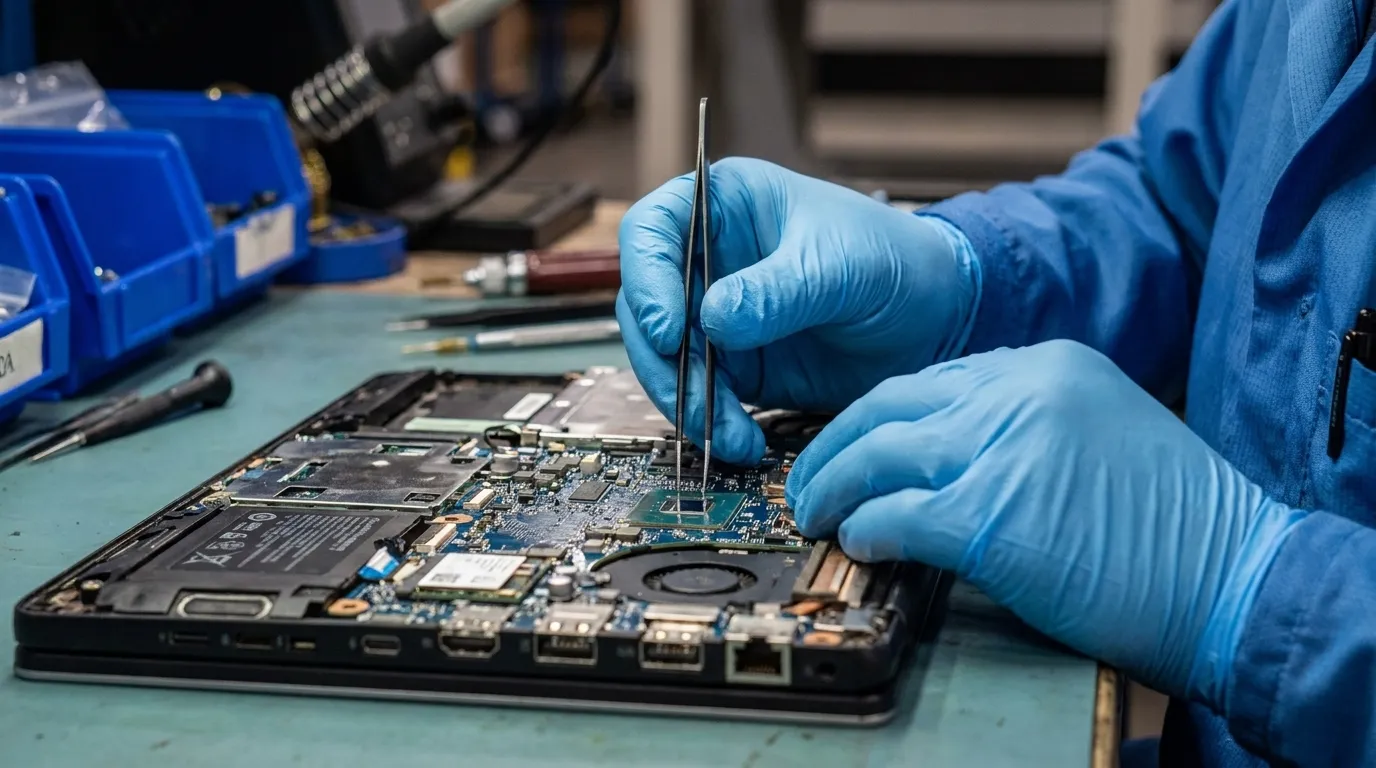
- Level 3: Board-level repair and diagnostics
- Level 4: Full teardown, component-level repair and remanufacture
A service level agreement (SLA) defines the contractual turnaround commitment for each repair tier. ITAD (IT Asset Disposition) governs secure retirement of assets that cannot be repaired or redeployed. Asset tagging and serialization create the chain-of-custody record that compliance audits require. Forward logistics moves product from origin to end user, while reverse logistics moves it back through the supply chain for repair, refurbishment or recycling.
U.S. enterprise and government programs add compliance layers that consumer RMA guides omit. The Trade Agreements Act (TAA) restricts sourcing to designated countries for federal procurement. NIST SP 800-88 defines three sanitization levels, Clear, Purge and Destroy, for media containing sensitive data. CMMC 2.0 requires certificates of destruction as part of cybersecurity audits for contractors handling Controlled Unclassified Information. SOC 2 governs the security controls of service providers processing enterprise data. OEM warranty constraints further limit which service centers can perform authorized repairs without voiding coverage.
Step 1: Request Initiation and Documentation Capture
Inputs: End-user fault report, asset serial number, purchase or warranty record, failure description.
Outputs: Validated RMA ticket, asset record in the tracking system, initial routing flag.
Key decisions: Is the asset in warranty? Does it contain CUI or other regulated data? Which OEM authorization applies?
Incomplete documentation at this stage is the single most common cause of downstream delays. To prevent these delays, standardized intake templates should include mandatory fields for serial number, failure code and data classification, the data points that triage and routing decisions depend on.
Trade-offs: Faster intake with minimal fields reduces friction but increases triage errors. Thorough intake adds time upfront and reduces rework downstream.
Cross-functional touchpoints: IT helpdesk or end user, procurement for warranty verification, compliance for data-classification flag.
Step 2: Authorization and Routing Decision
Inputs: Validated RMA ticket, warranty status, asset classification, OEM authorization matrix.
Outputs: Approved RMA number, routing instruction (depot, OEM, field swap or ITAD), prepaid label or shipping instruction.
Key decisions: Which repair tier is appropriate? Does the asset require an OEM-authorized service center? Is export compliance review required before dispatch?
RMA dispatch for regulated hardware occurs only after export compliance review is complete, and certain cross-border shipments require import permits or routing through an authorized distributor. Enterprise programs that pre-clear routing rules and maintain active Importer of Record relationships avoid the delays that reactive compliance review creates.
Trade-offs: Centralized routing decisions improve compliance but require a routing logic engine or experienced coordinator. Decentralized routing is faster but inconsistent.
Cross-functional touchpoints: Logistics, legal or trade compliance, OEM partner management.
Step 3: Inbound Logistics and Receiving Inspection
Inputs: Shipped asset, RMA number, packing documentation, chain-of-custody record.
Outputs: Received and logged asset, condition-on-arrival record, discrepancy report if applicable.
Key decisions: Does the physical condition match the reported fault? Is packaging sufficient to avoid damage claims? Is the asset flagged for data sanitization before any further handling?
For government and enterprise assets, data must be destroyed per NIST 800-88 media sanitization guidelines before any device is evaluated, moved or processed for any other purpose. This sequencing requirement makes data sanitization a receiving-gate requirement for regulated assets, not a post-repair step. This front-loading of sanitization creates operational tension between compliance protection and resource efficiency.
Trade-offs: Immediate sanitization on receipt protects compliance but requires sanitization capacity at the receiving dock. Batching sanitization reduces labor cost but creates a compliance gap window.
Cross-functional touchpoints: Warehouse receiving, data security, logistics carrier management.
Step 4: Triage, Diagnostics and Repair-Level Assignment
Inputs: Received asset, fault description from intake, diagnostic toolset, OEM repair matrix.
Outputs: Confirmed failure mode, assigned repair level (L1–L4), repair estimate, disposition recommendation.
Key decisions: Is the reported fault confirmed? Is repair economically justified versus replacement or ITAD? Which technician skill tier and parts inventory are required?
Diagnostics quality directly determines first-pass repair success. If the failure mode is misidentified, the repair fails and the asset cycles back through the process. Accurate triage supported by pre-diagnosis data and complete intake documentation is the primary lever for reaching best-in-class rates because it confirms the correct failure mode before repair work begins.
Trade-offs: Deeper diagnostics increase triage time but reduce rework. Shallow triage accelerates throughput but raises callback rates and total cost per repair.
Cross-functional touchpoints: Depot technicians, parts inventory, OEM technical support, customer service for quote approval on out-of-warranty assets.
Step 5: Repair Execution and Parts Management Discipline
Inputs: Repair-level assignment, approved work order, parts pick list, technician assignment.
Outputs: Repaired unit, parts consumption record, labor time log, updated asset record.
Key decisions: Are OEM-authorized parts available? Does the repair require ASC-level authorization? Are substitute parts TAA-compliant for government assets?
Parts availability is a primary driver of repair cycle variance. Programs that maintain strategic parts buffers tied to failure-mode frequency data reduce cycle time variance and protect SLA performance. However, parts inventory alone does not ensure warranty compliance because OEM warranty repairs require ASC-authorized centers that can use OEM parts without voiding coverage. Premier Logitech holds ASC authorization for more than 20 OEM brands, which eliminates the coverage gap that non-authorized repair creates.
Trade-offs: Larger parts inventory reduces wait time but increases carrying cost. Lean parts stocking reduces cost but increases exposure to parts-driven SLA misses.
Cross-functional touchpoints: Parts procurement, OEM partner management, warehouse inventory, finance for out-of-warranty cost approval.
Step 6: Quality Assurance, Sanitization Proof and Grading
Inputs: Repaired unit, work order, OEM functional test specification, data sanitization requirement flag.
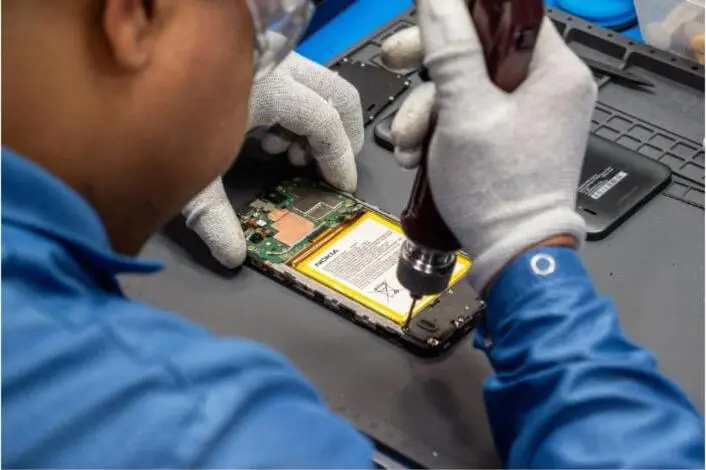
Outputs: QA-passed unit, sanitization certificate, cosmetic grade, updated asset record with disposition recommendation.
Key decisions: Does the unit pass functional and cosmetic standards for its intended next use, such as redeployment, secondary market or ITAD? Is sanitization documentation sufficient for compliance audit?
Data sanitization at this stage applies to any asset that was not sanitized at receiving or requires a second-pass verification. CMMC 2.0 expectations require certificates of destruction as part of cybersecurity audits for government contractors handling CUI. Certificates must reference the specific NIST 800-88 sanitization level applied.
Cosmetic grading at this step determines secondary-market value. Accurate grading protects remarketing revenue and prevents downstream buyer disputes.
Trade-offs: Rigorous QA and grading increase labor cost per unit but protect asset recovery value and reduce return rates from secondary buyers. Minimal QA reduces cost but increases downstream risk.
Cross-functional touchpoints: QA technicians, data security, remarketing or ITAD team, compliance documentation.
Step 7: Outbound Logistics, Redeployment and Compliance Close-Out
Inputs: QA-passed unit, disposition instruction, outbound shipping order, compliance documentation package.
Outputs: Shipped unit, closed RMA record, compliance close-out package (chain of custody, sanitization certificate, disposition report), asset recovery credit or redeployment confirmation.
Key decisions: Does the unit return to the original owner, enter a rapid exchange pool, route to secondary market or proceed to certified recycling? Is the compliance documentation package complete for audit?
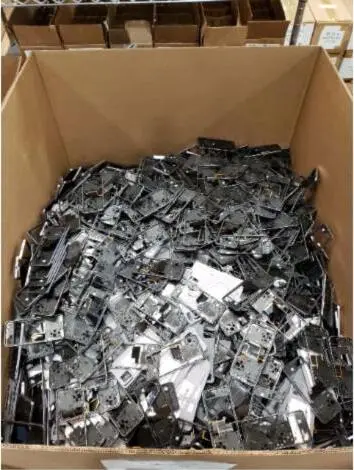
RMA flows for enterprise hardware are subject to repeated trade compliance obligations, including the need for an Exporter of Record and an Importer of Record. Cross-border outbound shipments require the same export compliance review as inbound returns. Compliance close-out documentation, including chain-of-custody records, sanitization certificates and downstream disposition reports, must be formatted for inspector general, GAO or state auditor review for government programs.
Trade-offs: Routing assets to secondary market maximizes recovery value but requires grading accuracy and channel relationships. Direct redeployment is faster but foregoes potential remarketing revenue on assets not needed by the original owner.
Cross-functional touchpoints: Outbound logistics, trade compliance, finance for asset recovery accounting, compliance documentation team.
Discuss compliance documentation and remarketing options for returned asset inventory.
Frameworks That Keep RMA Programs Scalable
Three structural frameworks improve consistency and throughput at enterprise scale.
RACI matrices assign Responsible, Accountable, Consulted and Informed roles to each of the seven steps. Without a RACI, ownership gaps at authorization and compliance close-out steps often cause SLA misses and audit findings.
Workflow segmentation by failure class routes assets through differentiated tracks, such as rapid exchange for common low-complexity failures, full depot repair for board-level faults and ITAD for assets past economic repair. Segmentation prevents high-complexity repairs from blocking high-volume, low-complexity throughput.
Closed-loop lifecycle models feed disposition data from Step 7 back into procurement and product design. Failure-mode frequency data from triage informs parts stocking decisions. Grading data from QA informs secondary-market pricing. Programs that close this loop reduce total cost of ownership over time and improve first-pass repair rates as parts availability and technician training align to actual failure patterns.
Inventory disposition rules, which define the conditions under which an asset is repaired, refurbished, redeployed, remarketed or recycled, should be documented and version-controlled. Undocumented disposition decisions create audit exposure and inconsistent asset recovery outcomes.
Common RMA Challenges and How to Prevent Them
The following challenges appear consistently in high-volume enterprise RMA programs:
- Inaccurate asset data: Missing or mismatched serial numbers cause routing errors and warranty disputes. Prevention requires serialization at intake and validation against the asset management system before the RMA is approved.
- Unclear ownership: Assets shared across departments or leased from third parties create authorization delays. Prevention requires a documented asset ownership matrix updated at each lifecycle transition.
- Missed SLAs: Queue time at triage and parts wait are leading indicators of SLA risk. Monitoring these daily, not weekly, enables intervention before the SLA window closes.
- Non-compliant disposition: Prevention requires sanitization as a gate, not a final step, with certificate generation tied to the asset record.
- Warranty disputes: Repairs performed by non-authorized centers void OEM coverage. Prevention requires routing logic that checks ASC authorization status before assigning a repair work order.
Measuring RMA Success With Leading and Lagging Indicators
Effective RMA measurement separates leading indicators, which signal future performance, from lagging indicators, which confirm past outcomes.
Leading indicators include queue time at each step, process adherence rate, parts fill rate and documentation completeness at intake. These metrics are actionable in real time.
Lagging indicators include total repair cycle time, first-pass fix rate, asset recovery value per unit, compliance findings per audit cycle and disposition mix. These confirm whether the process works but cannot be acted on until after the outcome.
Programs that track both leading and lagging indicators can intervene before SLA breaches occur rather than analyzing failures after the fact. Programs that measure asset recovery value as a KPI, not just cost, capture financial upside that unstructured RMA programs leave unrealized.
Advanced RMA Capabilities for Mature Programs
Programs that have stabilized the seven-step process can pursue several advanced capabilities.
Automation and dynamic routing apply rule-based logic to Step 2 authorization decisions, reducing manual coordinator time and improving routing consistency at high volume. Readiness criteria include a clean asset data foundation and documented routing rules that can be translated into system logic.
Partner integration connects the RMA management system to OEM warranty portals, carrier tracking systems and secondary-market platforms. Integration removes manual data re-entry, which is a primary source of serialization errors and compliance documentation gaps.
Circular-economy practices extend the closed-loop model by designing return programs that maximize the percentage of assets reaching redeployment or certified refurbishment rather than recycling. Major trends in reverse logistics include wider adoption of repair and refurbishment operations and a rising focus on value recovery from returned goods. Programs that track and improve disposition mix capture both financial and sustainability value.
Piloting advanced capabilities on a single product line or failure class before full deployment reduces implementation risk and generates performance data that supports broader rollout.
Frequently Asked Questions
How long does a complete enterprise RMA repair cycle typically take?
Cycle time varies by repair level, parts availability and compliance requirements. Simple swap or Level 1 repairs resolve faster than board-level or Level 3-4 repairs, which depend on diagnostic complexity and parts lead time. Government and regulated-data assets add sanitization and documentation steps that extend the cycle. Programs that standardize intake documentation, maintain strategic parts inventory and pre-clear routing decisions achieve shorter and more predictable cycle times than those that handle each RMA reactively.
What compliance frameworks apply to enterprise and government RMA programs?
The applicable frameworks depend on the asset type and end-user classification. Government and contractor programs handling Controlled Unclassified Information must follow NIST SP 800-88 for media sanitization, NIST SP 800-171 for CUI handling and CMMC 2.0 for cybersecurity audit requirements. Federal agencies also operate under FISMA and GSA disposal rules. Trade compliance requirements, including TAA for federal procurement, apply to both inbound and outbound shipments. Enterprise programs with SOC 2 obligations must maintain chain-of-custody and sanitization documentation that satisfies SOC 2 Type II audit review. Premier Logitech holds certifications across TAA, NIST, CMMC, SOC 2, ISO 9001 and ISO 14001 frameworks.
What skills and roles does an enterprise RMA program require internally?
A functional enterprise RMA program requires coordination across operations, IT asset management, logistics, compliance and finance. Key roles include an RMA program manager who owns SLA performance, a compliance lead who maintains sanitization and disposition documentation, a logistics coordinator who manages carrier relationships and trade compliance, and depot technicians with OEM-authorized training for the relevant product categories. Organizations that lack ASC-authorized technicians internally must partner with an authorized service center to avoid voiding OEM warranty coverage.
When should an organization revisit its RMA process design or partner mix?
Common triggers include a significant increase in return volume that exceeds current depot capacity, entry into a new regulated market such as federal government that adds compliance requirements, a pattern of SLA misses or compliance audit findings, OEM authorization changes that affect repair eligibility and M&A activity that introduces new product lines or geographies. Organizations also revisit partner mix when fragmented vendor relationships across repair, fulfillment and recycling create visibility gaps or prevent consistent compliance documentation. Consolidating to a single authorized partner typically resolves those gaps faster than renegotiating multiple vendor contracts.
How does depot repair level affect asset recovery value?
Higher repair levels recover more functional value from damaged assets but carry higher labor and parts cost. The economic decision depends on the asset’s residual market value relative to repair cost, the availability of OEM-authorized parts and the intended disposition path. Assets destined for secondary-market resale require accurate cosmetic grading in addition to functional repair, which adds a QA step. Programs that track asset recovery value per unit, segmented by repair level and disposition path, can refine the repair-versus-retire decision over time and improve the overall return on reverse logistics investment.
Conclusion: Building a Repeatable, Compliant RMA Engine
A seven-step RMA repair process, from request initiation through compliance close-out, gives operations and supply-chain leaders a repeatable, auditable framework that scales with volume and satisfies TAA, NIST, CMMC and SOC 2 requirements. Each step has defined inputs, outputs, trade-off decisions and compliance checkpoints that generic RMA guides omit.
Premier Logitech operationalizes this process as an authorized, single-source partner. With ASC authorization for more than 20 OEM brands, depot repair capacity across L1–L4, certified compliance across major government and enterprise frameworks and end-to-end lifecycle services from receiving through remarketing and recycling, Premier Logitech replaces fragmented vendor networks with a single accountable program.
Assess your RMA process to identify where a structured, compliance-ready program can reduce cost and recover more asset value.
