Key Takeaways for Enterprise Hardware Teams
- IT lifecycle configuration enforces consistent hardware and software settings across procurement, deployment, maintenance and decommissioning stages.
- Four interdependent stages, planning, deployment, maintenance and decommissioning, each require documented baselines and CMDB integration to prevent drift and compliance gaps.
- Key deliverables include approved hardware standards, quarterly refresh policies, automated drift detection, NIST 800-88 data sanitization and chain-of-custody documentation.
- Structured lifecycle configuration reduces technology costs, eliminates ghost assets and supports regulatory frameworks such as TAA, CMMC, SOC 2 and NIST SP 800-128.
- Premier Logitech delivers end-to-end IT lifecycle configuration services; talk to a lifecycle expert to scope a compliant program for an enterprise fleet.
Four Stages of the IT Asset Life Cycle
Enterprise hardware programs follow four primary stages. Each stage builds on the last and requires clear configuration controls to prevent drift, compliance gaps and lost recovery value.
- Planning – Establish configuration baselines, refresh policies and CMDB standards before procurement begins.
- Deployment – Image, kit and provision devices to a documented standard before they reach end users.
- Maintenance – Monitor for configuration drift, manage depot repair and enforce continuous compliance.
- Decommissioning – Sanitize data, document chain of custody and recover or recycle asset value responsibly.
Planning Baselines and CMDB Standards for Enterprise Fleets
Effective planning starts with a standards catalog, a defined list of approved models per device class, paired with a refresh policy. Industry guidance recommends reviewing quarterly signals such as hiring plans, the asset register age profile, warranty expiry dates and project-driven demand.
A CMDB baseline formally records each configuration item approved state. It serves as the basis for control and comparison, a concept that applies equally to federal agencies and large enterprises. Establishing this baseline requires core planning deliverables that together define the approved state for the fleet.
Planning deliverables for a hardware program include:
- An approved hardware standards catalog with multiple models per device class
- A refresh schedule aligned to asset age and warranty expiry
- A CMDB record structure that captures serial number, model, location, warranty end date and assigned baseline
- A compliance mapping that links each baseline to applicable frameworks such as TAA, NIST SP 800-128, CMMC or SOC 2
Deployment: Imaging, Kitting and Secure Provisioning at Scale
Deployment converts a planned baseline into a physical, ready-to-use device. Devices must be imaged with the standard operating system and security configuration, then receive endpoint protection, encryption and MDM enrollment before issue to a user.
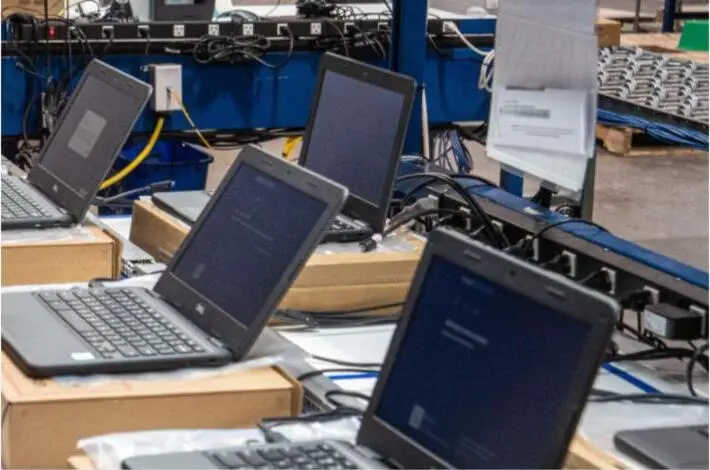
Two provisioning methods serve different program needs.
- Zero-touch provisioning – Devices ship directly from the staging facility to the end user and self-configure on first boot using tools such as Microsoft Autopilot or Apple Business Manager. This method suits distributed workforces and high-volume rollouts.
- Pre-staged deployment – Devices are received, imaged in batch and delivered ready for use. This method provides direct control over every device before it reaches the end user.
BOM-based kitting assembles hardware, peripherals, cables and documentation into a single shipment matched to a specific role or project. Asset tagging and serialization at this stage, before devices leave the staging area, prevent register drift and simplify later warranty, repair and disposal planning.

BIOS configuration is applied during staging to enforce boot order, disable unused ports and set firmware passwords consistent with the approved baseline. ISO 27001 Control 8.9 requires that systems operate in a known, hardened state and that any deviation is detected and corrected. Applying BIOS settings at deployment is the first enforcement point in that requirement. Once devices leave staging with approved baselines, the maintenance stage focuses on preserving those configurations over time.
Maintenance: Managing Drift, Repair and Continuous Compliance
Configuration drift occurs when a live asset deviates from its approved baseline. Industry reports link many cybersecurity incidents to configuration drift rather than zero-day exploits or advanced persistent threats.
Organizations employ automated tools to perform real-time monitoring, scheduled scans and compliance checks that identify drift against defined baselines or regulatory frameworks. Integrating those scan results with a CMDB creates a closed loop. Drift is detected, a ticket is generated and the repair or remediation is recorded against the asset record.
Depot repair supports maintenance at the hardware level. A structured L1–L4 repair program handles everything from basic diagnostics and part replacement to board-level repair, which keeps assets in service longer. Industry studies show older PCs require more frequent repairs, so proactive depot repair becomes a cost-control measure as fleets age.
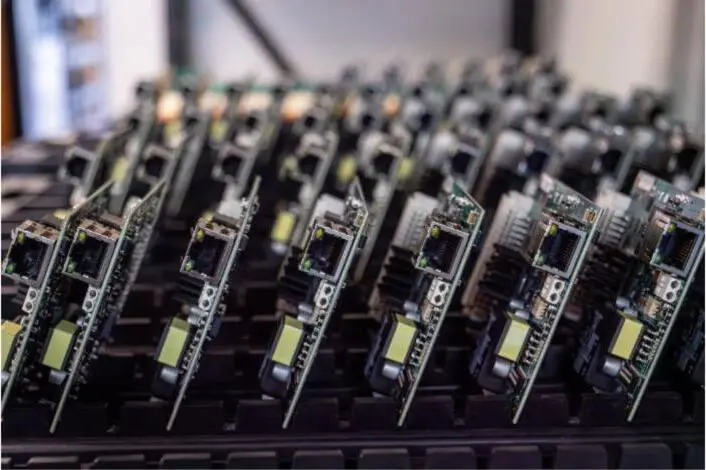
Patch management and warranty tracking are maintenance functions that feed directly back into the CMDB. Assets approaching warranty expiry or end-of-support dates trigger refresh planning and reconnect the program to the planning stage.
Decommissioning: Secure Data Handling and Asset Value Recovery
Decommissioning begins with a full inventory of devices slated for retirement, including hardware specifications, purchase dates, warranty status and current location. This inventory helps prioritize high-risk equipment containing sensitive data.
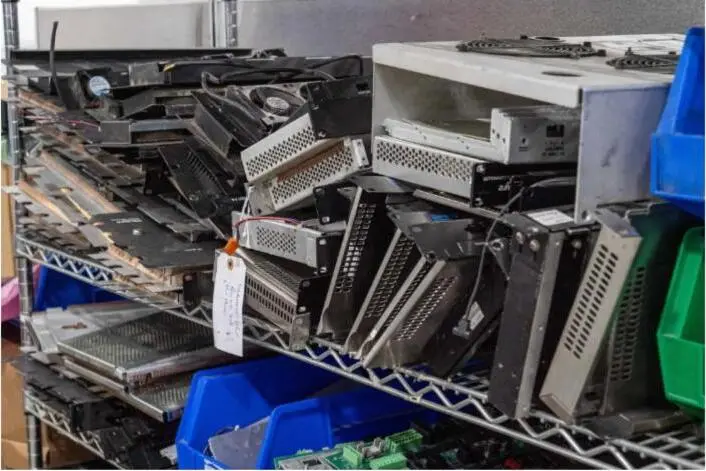
Data sanitization follows NIST 800-88 compliant wiping or physical destruction, with a Certificate of Data Destruction issued per device to support HIPAA, SOX, GLBA and ESG audit requirements. Chain-of-custody documentation, including transfer logs with dates, handler names, asset IDs and locations, runs from collection through final disposition.
After sanitization, assets are graded and routed to the appropriate recovery channel.
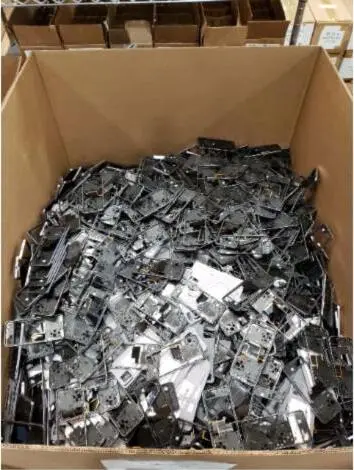
- Refurbish and resell – Business-grade laptops, desktops and monitors with market value are refurbished and sold through secondary market channels, which recovers residual financial return.
- Internal reuse – Devices with remaining utility are redeployed with updated configurations.
- Responsible recycling – End-of-life hardware is processed through certified recyclers. Industry reports indicate a significant portion of global e-waste is not properly recycled, so certified recycling becomes a compliance and sustainability requirement.
Involving an ITAD partner early enables organizations to flag customs restrictions, spot collection constraints and steer assets toward better recovery routes before dates lock.
Configuration, Compliance and Measurable Program Outcomes
A consistent configuration baseline maps directly to multiple regulatory frameworks. ISO 27001 Control 8.9 maps to SOC 2 CC8.1, which enables organizations to satisfy multiple frameworks through a single configuration management program.
Key compliance checkpoints across the four stages include:
- TAA-compliant sourcing – Hardware procured from approved countries of origin for federal and government programs
- NIST SP 800-128 baseline documentation – Security-focused configuration management tied to change control and continuous monitoring
- CMMC configuration controls – Required for DoD contractors handling controlled unclassified information
- SOC 2 drift detection evidence – Automated scan results and change records supporting Type II audits
- NIST 800-88 data destruction records – Per-device certificates supporting regulated decommissioning
The business case for structured lifecycle configuration is measurable. Industry analysts report that organizations with mature lifecycle management programs can reduce technology costs through improved planning, utilization and procurement strategies. Ghost assets, hardware reported in financial records that no longer physically exists, account for a notable share of fixed assets in many organizations, a figure that structured CMDB baselines directly reduce.
Why Premier Logitech Serves as a Single-Source Lifecycle Partner
Premier Logitech delivers IT lifecycle configuration as an end-to-end program, not a collection of disconnected services. Founded in 2007, the company serves large enterprises, OEMs and government agencies across all four lifecycle stages from three DFW facilities with nearshore operations in Laredo and Nuevo Laredo.
Program capabilities span the full lifecycle.
- TAA-compliant hardware sourcing and vendor-consolidated procurement
- Device imaging, BIOS configuration, BOM-based kitting and asset tagging at scale
- ASC-authorized depot repair across multiple OEM brands at L1–L4 depth
- Real-time inventory tracking and CMDB-integrated lifecycle analytics
- NIST 800-88 data sanitization, certified refurbishment, grading and responsible recycling
Certifications include TAA, TAPA, ISO quality frameworks, NIST, CMMC and SOC 2. Premier Logitech holds CAGE Code 4WAJ9 as a pre-vetted partner for U.S. federal government programs. Clients engage Premier Logitech as a single lifecycle partner or select individual services such as configuration and fulfillment, depot repair or transportation on a standalone basis.
Talk to a lifecycle expert to scope an end-to-end configuration program for an enterprise fleet.
Evaluation Framework for IT Lifecycle Configuration Providers
Operations and supply chain leaders evaluating lifecycle configuration partners can apply five core checks to any candidate.
- Lifecycle coverage – Sourcing, deployment, maintenance and decommissioning should be available from one partner to reduce handoff gaps.
- Compliance certifications – TAA, NIST, CMMC and SOC 2 coverage should be current and verifiable, not self-reported.
- CMDB integration – Real-time asset tracking and baseline comparison require system-level integration, not manual reporting.
- OEM authorization scope – ASC status for the brands in the fleet determines whether depot repair preserves warranty and OEM support agreements.
- Data destruction documentation – Per-device certificates of destruction with chain-of-custody logs form the minimum standard for regulated decommissioning.
Frequently Asked Questions
What does IT lifecycle configuration include beyond imaging and deployment
IT lifecycle configuration covers the full arc of an asset life. It begins at planning, where configuration baselines and CMDB records are established before procurement. It continues through deployment, including imaging, BIOS settings, kitting and asset tagging, and into maintenance, where drift detection, depot repair and patch management keep assets aligned to their approved baseline. It concludes at decommissioning, where data sanitization, chain-of-custody documentation and asset recovery decisions are all governed by the same baseline records created at the start. A complete program treats configuration as a continuous control, not a one-time setup task.
What certifications should an IT lifecycle configuration partner hold for government and enterprise programs
For U.S. government programs, TAA compliance for hardware sourcing forms a baseline requirement. CAGE Code registration identifies a provider as pre-vetted for federal engagement. CMMC certification is required for programs involving controlled unclassified information under DoD contracts. NIST SP 800-128 alignment governs security-focused configuration management across the system lifecycle. For enterprise programs, SOC 2 Type II audit evidence, ISO 9001 quality management and ISO 14001 environmental management certifications demonstrate operational discipline across configuration, repair and recycling functions. Premier Logitech holds these credentials.
How is data wiping handled during decommissioning, and what documentation is provided
Data sanitization during decommissioning follows NIST SP 800-88 guidelines, which specify overwrite-based erasure for standard storage media, degaussing for magnetic media and physical destruction for highly sensitive or non-erasable devices. Each device receives individual treatment based on its media type and data classification. Documentation includes a Certificate of Data Destruction issued per device, a serialized chain-of-custody log recording every handler and transfer point from collection through final disposition and a disposition report that maps each asset to its recovery outcome, refurbished, recycled or destroyed. This documentation supports HIPAA, SOX, GLBA and ESG audit requirements.
Can Premier Logitech support high-volume programs with nearshore operations
Premier Logitech operates from three DFW-area facilities with nearshore operations in Laredo and Nuevo Laredo, Mexico. This hub-and-nearshore model supports programs that require cost-effective, high-volume configuration, kitting and repair capacity with proximity to one of North America largest logistics corridors. The company repair and kitting operations are designed to scale with program demand, and clients can engage Premier Logitech for end-to-end lifecycle management or for specific services such as configuration and fulfillment or depot repair on a standalone basis.
Conclusion: Building a Connected Lifecycle Configuration Program
IT lifecycle configuration that is planned, deployed, maintained and decommissioned under a single set of baselines reduces compliance risk, supports asset recovery value and gives operations leaders the visibility they need to manage large, distributed fleets. Each stage depends on the others, as baselines established during planning enable drift detection in maintenance, while decommissioning data feeds back into refresh planning. Gaps in any one stage create risk across the entire program.
Premier Logitech delivers this end-to-end, from TAA-compliant sourcing through certified refurbishment and responsible recycling, with the OEM authorizations, compliance certifications and real-time tracking infrastructure that enterprise, OEM and government programs require.
