Last updated: August 10, 2026
Key Takeaways for Complex PCB Assembly Buyers
-
Complex PCB assembly in 2026 requires IPC-qualified HDI structures, microvias, fine-pitch BGA support and high-mix production for aerospace, defense, medical and industrial programs.
-
A seven-criteria evaluation framework covering service scope, technical capability, quality and compliance, scalability, visibility, network coverage and total cost helps buyers select reliable domestic EMS partners.
-
ITAR registration, TAA compliance, CMMC attestation and NIST SP 800-171 alignment are mandatory for defense and federal programs, while AS9100 and ISO 13485 certifications are required for aerospace and medical applications.
-
Domestic manufacturing reduces total cost of ownership for high-mix programs by cutting inventory carrying costs, expedite premiums and quality escapes while enabling faster design iterations.
-
Premier Logitech delivers certifications, traceability and authorized repair capabilities for complex PCB programs, and a lifecycle expert can map program requirements to those capabilities.
Decision Framework for Evaluating Domestic EMS Partners
A structured evaluation across seven criteria reduces the risk of selecting a provider whose capabilities fall short after program launch. The criteria are:
-
Service scope: Prototype through production, box-build and post-sale repair within a single program structure
-
Technical capability: Layer count range, minimum component size, BGA pitch limits and HDI process support
-
Quality and compliance: Certification stack aligned to the target industry and applicable government standards
-
Scalability: Ability to absorb volume changes without sacrificing quality or traceability continuity
-
Visibility: Real-time inventory tracking, serialized component controls and lifecycle analytics
-
Network coverage: Geographic footprint, nearshore options and logistics integration
-
Total cost and risk: Full TCO accounting that includes carrying costs, quality escapes and compliance exposure, not unit price alone
Run a structured gap analysis against these seven criteria with a lifecycle expert before issuing an RFI.
ITAR and TAA Requirements for Aerospace and Defense Programs
The third criterion in the evaluation framework, quality and compliance, demands particular attention for defense and aerospace programs. ITAR registration requires an EMS provider to implement restricted facility access, personnel screening, controlled document handling and project segregation to protect defense-related articles and technical data from unauthorized foreign access. Providers without active ITAR registration cannot legally handle controlled hardware or documentation for defense programs.
The Trade Agreements Act adds a country-of-origin layer. TAA compliance requires that finished goods be manufactured or substantially transformed in a TAA-designated country, which effectively mandates domestic or approved-country production for federal procurement programs. Providers serving defense and public-sector OEMs must document TAA compliance at the component and assembly level.
CMMC and NIST SP 800-171 extend compliance requirements into the cybersecurity domain. CMMC demonstrates that a provider has formally implemented controls covering access management, data protection, incident response and risk management to protect Controlled Unclassified Information on defense contracts. Programs involving weapons systems, avionics and mission-critical electronics increasingly require CMMC attestation from EMS partners, not just prime contractors.
High-Mix Economics and Domestic Manufacturing in 2026
A widely used TCO framework for electronics manufacturing captures acquisition costs, operating costs, supply-chain costs, quality and warranty costs, end-of-life costs and risk-related costs. For high-mix, lower-volume programs, offshore suppliers with lower unit prices can generate higher total costs when inventory carrying charges, expedite premiums and quality escapes are included.
The CHIPS and Science Act of 2022 has created structural demand for domestic PCB capacity through defense procurement requirements, Buy-American provisions and trusted-supply-chain mandates in federal contracting. A significant share of North American EMS production is now high-mix low-volume, and that segment is projected to grow at a faster rate than mass production through 2032. Medical, aerospace and industrial customers drive that growth because their compliance requirements conflict with statistical quality controls used in commodity manufacturing.
Domestic providers also enable faster design iteration. Prototype turnaround measured in days rather than weeks compresses concept-to-production cycles and reduces the cost of engineering change orders.
BGA Pitch Limits and Fine-Pitch Assembly Capabilities to Confirm
Beyond economics and compliance, technical capability separates qualified providers from those that cannot execute complex assemblies. BGA pitch capability is a practical differentiator among US EMS providers. Standard SMT processes handle ball pitches at 0.5 mm for CSP and BGA packages, while advanced processes extend support to smaller pitches. Programs specifying fine-pitch BGAs must confirm that a provider’s equipment, stencil design and inspection infrastructure are validated for those geometries before award.
Inspection capability holds equal importance. X-ray inspection is the standard method for verifying hidden solder joints on BGAs and QFNs that cannot be fully assessed by AOI alone. Providers serving regulated industries should offer 3D X-ray with data logging tied to serialized board identifiers to support traceability and root-cause analysis.
Minimum passive component size is a related threshold. Advanced SMT lines support small components alongside fine-pitch BGA placement. Programs with dense mixed-technology layouts should verify that a provider’s placement accuracy and stencil aperture capability are validated for the smallest components on the BOM.
Aligning EMS Capabilities to Defense, Medical and Industrial Needs
Each regulated sector carries a distinct certification and traceability profile. AS9100 is considered a minimum qualification requirement for aerospace EMS providers because it addresses product safety, risk management, configuration management, traceability, counterfeit parts prevention and supplier oversight at a level that ISO 9001 alone does not reach.
ISO 13485 governs medical device manufacturing and requires strict process controls, documentation and traceability to support FDA and international regulatory compliance. Medical OEMs should confirm that a provider’s quality system is actively certified to ISO 13485, not ISO 9001 with a medical addendum.
Industrial programs subject to vibration above 20 g and wide temperature cycling benefit from mixed-technology assembly lines that combine SMT with through-hole robustness. Mixed-technology PCB assembly is forecast to grow at a faster rate than the overall market through 2031 as aerospace and industrial customers specify through-hole components for harsh-environment reliability.
Capability Matrix for Certifications, Traceability and Volume Ranges
Before issuing an RFI, operations and compliance teams should verify the following capabilities in writing from any candidate EMS provider:
-
Quality certifications: AS9100 for aerospace and defense, ISO 13485 for medical devices and ISO 9001 as the baseline for all programs
-
Regulatory compliance: Active ITAR registration, TAA-compliant sourcing and manufacturing and the CMMC and NIST alignment described above for defense CUI programs
-
Workmanship standards: IPC-A-610 Class 3 acceptability criteria and J-STD-001 soldering process compliance
-
Layer count range: Production support for standard layer counts with prototype extension to higher-layer builds for HDI programs
-
Component capability: Validated support for small passives and BGA pitch support at fine pitches
-
Traceability: Full material and lot traceability from component receiving through shipment, with serialized board-level records available for audit
-
Inspection infrastructure: 3D AOI, automated X-ray for BGA and QFN and in-circuit or functional test tied to serialized records
-
Authorized repair: OEM Authorized Service Center status for the brands present in the program’s BOM
Providers that cannot produce current certificates and documented procedures for each item above represent a compliance and traceability risk that unit pricing does not offset.
How Premier Logitech Closes Common Capability Gaps
Premier Logitech is a US-based technology lifecycle and EMS partner operating from three DFW facilities with nearshore operations in Laredo and Nuevo Laredo, Mexico. The company holds TAA compliance, CMMC attestation, SOC 2 certification, NIST SP 800-171 alignment and a CAGE Code (4WAJ9) that qualifies it as a pre-vetted partner for US federal government programs.
On the authorized repair side, Premier Logitech holds Authorized Service Center status with multiple OEM brands. The repair infrastructure supports high-volume repairs and enables rapid exchange and end-user replacement programs at scale for OEMs managing high return volumes or warranty obligations.
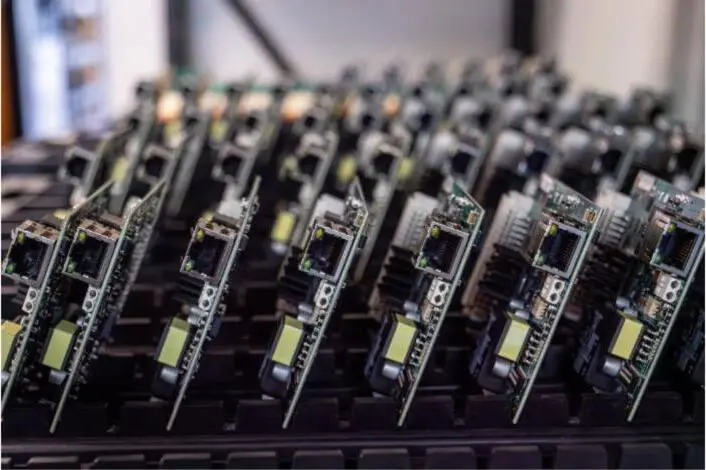
Premier Logitech’s manufacturing services span PCBA, including single and double-side SMT and through-hole, flex circuit assembly, BGA reballing, burn-in and functional testing and full box-build. Lifecycle services extend from sourcing and configuration through depot repair, asset recovery and responsible recycling.
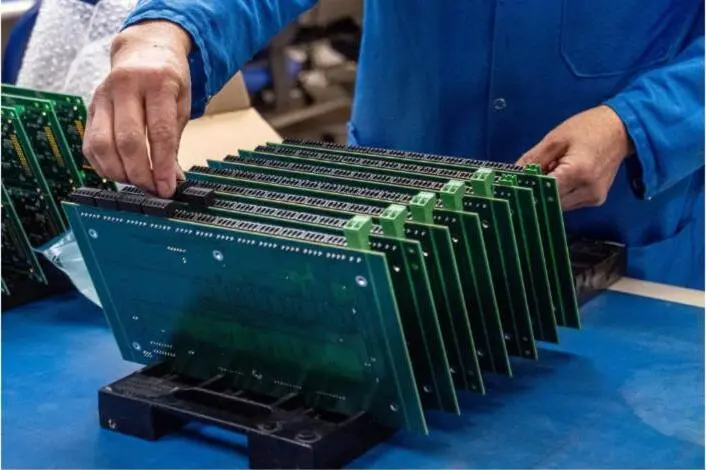
The DFW hub provides proximity to one of North America’s busiest air cargo corridors, and the nearshore Mexico operation supports cost-competitive production for programs where maquiladora manufacturing is appropriate. Both locations operate under the same compliance and traceability framework.
Review how Premier Logitech’s certification stack and authorized repair network align to a specific program’s requirements with a lifecycle expert.
Frequently Asked Questions
Which certifications are mandatory for defense PCB assembly?
Defense PCB assembly programs typically require ITAR registration as a baseline, with AS9100 certification for aerospace and flight-critical hardware. Programs involving Controlled Unclassified Information require CMMC attestation and NIST SP 800-171 alignment. IPC-A-610 Class 3 workmanship and J-STD-001 soldering compliance are standard quality requirements. TAA compliance is required for federal procurement programs subject to Buy-American provisions.
What traceability features should an EMS provider maintain for medical devices?
Medical device programs require ISO 13485-certified quality systems with full material and lot traceability from component receiving through finished-board shipment. Providers should maintain serialized board-level records, documented process parameters at each production stage and controlled storage conditions for moisture-sensitive and shelf-life-limited components. Traceability records must support FDA audit requirements and facilitate rapid root-cause analysis in the event of a field issue.
How does CMMC differ from ITAR for EMS providers?
ITAR is an export-control regulation that governs physical access, personnel screening and document handling for defense articles and technical data. CMMC is a cybersecurity maturity framework that governs how a provider protects digital information, including design files, BOMs and program data, on systems connected to defense contracts. Both apply simultaneously to EMS providers handling hardware and data for DoD programs, and they address different risk vectors.
What is the difference between an Authorized Service Center and a general repair depot?
An OEM Authorized Service Center holds a formal authorization from the original equipment manufacturer to perform warranty and out-of-warranty repairs using approved parts, processes and tooling. General repair depots operate without that authorization and may use non-OEM parts or undocumented processes. For programs where OEM warranty continuity or certified repair documentation is required, ASC status is a contractual and compliance requirement, not a preference.
Why does total cost of ownership matter more than unit price for high-mix PCB programs?
High-mix programs carry costs that unit price does not capture, including inventory carrying charges from extended lead times, expedite premiums for urgent builds, quality escape costs, compliance remediation expenses and the revenue impact of delayed product launches. A domestic or nearshore EMS partner with higher unit prices can produce lower total program costs when those factors are included in the analysis. Operations and finance teams should build a full TCO model before comparing domestic and offshore options on price alone.
Work through a TCO comparison for a specific program or product line with a lifecycle expert.
Next Steps for Internal Discovery Before an RFI
Before issuing an RFI, three internal teams must align on program requirements. Engineering teams should document the full certification and workmanship standard requirements for each active program, including layer count, minimum component size, BGA pitch and inspection requirements.
Those technical specifications guide the work of compliance teams. Compliance teams should confirm which regulatory frameworks, including ITAR, TAA, CMMC, ISO 13485 and AS9100, apply to each program and verify that current vendor certificates are active and in scope.
Finance teams then use both the technical and compliance requirements to build a TCO model that captures carrying costs, quality risk and compliance exposure alongside unit pricing. With that internal alignment complete, an RFI can be structured around verifiable criteria rather than capability claims, and provider responses can be evaluated against a consistent standard.
