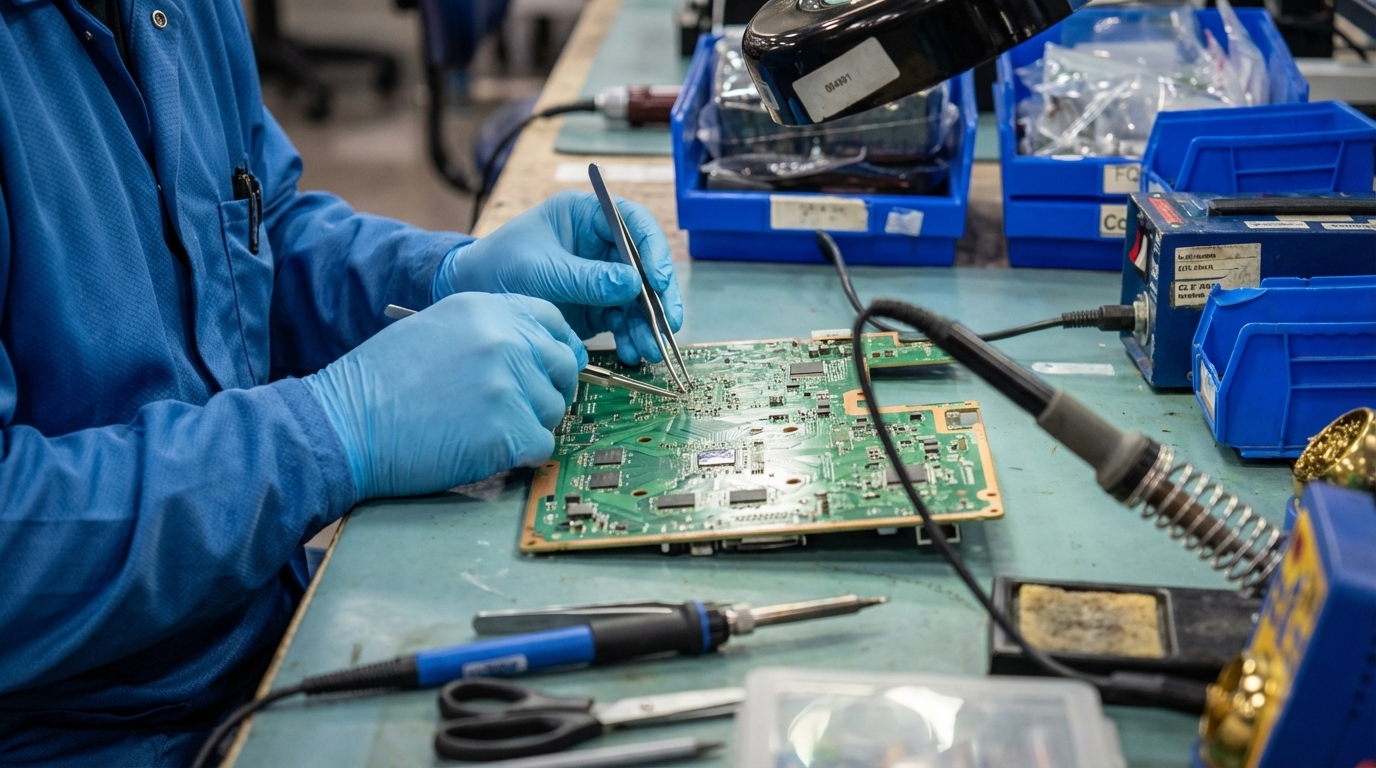
Last updated: August 7, 2026
Key Takeaways
- Fragmented lifecycle management and limited OEM-CM visibility increase costs and slow recovery. The 90-day roadmap sequences seven strategies that close those gaps.
- Standardized shared KPIs, real-time OEE monitoring, and DFMA and SMED practices deliver the fastest compounding efficiency gains within the first 90 days.
- Digital-thread traceability, AI-assisted AOI, and adaptive testing reduce defect escapes, shorten test cycles, and improve first-pass yield across electronics lines.
- Connected reverse logistics and depot-repair data feed production with field-failure patterns that drive upstream yield improvements and shorter return cycles.
- Premier Logitech supplies single-source lifecycle infrastructure and a shared data layer that convert these strategies into measurable throughput, yield and asset-recovery gains. Talk to a lifecycle expert to start a program.
90-Day Roadmap to Higher Throughput and Visibility
The table below sequences seven strategies in the order that delivers the fastest compounding gains. Each phase builds on the one before it and targets a cumulative OEE improvement toward world-class levels for electronics SMT within 90 days.
| Phase | Strategy | Weeks | Key Outcome |
|---|---|---|---|
| 1 | Standardize OEM-CM KPIs | 1–2 | Baseline established |
| 2 | Deploy real-time OEE monitoring | 2–4 | OEE improvement vs. baseline |
| 3 | Apply DFMA to active BOMs | 3–6 | Part-count and assembly-time reduction |
| 4 | Implement SMED setup reduction | 4–7 | Changeover time reduction |
| 5 | Activate digital-thread traceability | 5–9 | Component-level visibility across all active lines |
| 6 | Integrate AI-assisted AOI and adaptive testing | 7–11 | First-pass yield improvement |
| 7 | Connect reverse logistics and depot repair loop | 9–13 | End-to-end lifecycle visibility and shorter return cycle time |
This roadmap becomes more effective when guided by an experienced lifecycle partner. Talk to a lifecycle expert about building a 90-day roadmap for contract manufacturing efficiency.
Seven Proven Strategies to Improve Production Efficiency
-
Standardize OEM-CM KPIs before any other initiative. Shared definitions close measurement gaps that hide real performance. Prioritize on-time delivery, incoming quality rate and corrective action responsiveness first because these link directly to operational decisions.
- Define a single source of record, timestamp logic and allowed exclusions for each KPI to eliminate measurement ambiguity.
- Align on one definition of on-time delivery, such as requested date, promise date or receipt date, to avoid disputes.
- Set a review cadence and change-control process before rollout to prevent definition drift over time.
Leading KPI: KPI definition coverage rate. Lagging KPI: Supplier nonconformance rate. 2026 example: Manufacturers with formal KPI programs achieve higher OEE and better on-time delivery than those without structured measurement.
Deploy real-time OEE monitoring aligned to ISO 22400-2. Manual logs overstate true OEE compared with automatic measurement. Accurate baselines support every downstream improvement.
- Install automated data collection at each production line to capture availability, performance and quality events.
- Weight OEE tracking by contract value for high-value OEM programs to focus attention on critical lines.
- Set internal targets at 75% and world-class targets at 85% to guide improvement pacing.
Leading KPI: Data-capture automation rate per line. Lagging KPI: OEE per line, weighted by contract value. 2026 example: Hutchinson raised OEE across 40 sites using real-time OEE monitoring.
Apply DFMA to active BOMs. Approximately 70% of a product’s manufacturing or lifecycle cost is commonly estimated to be determined by design decisions. Design changes after tooling commitments cost more than the same changes made during concept or detail design. DFMA benchmarking on mature products can deliver part-count reduction and assembly-time reduction.
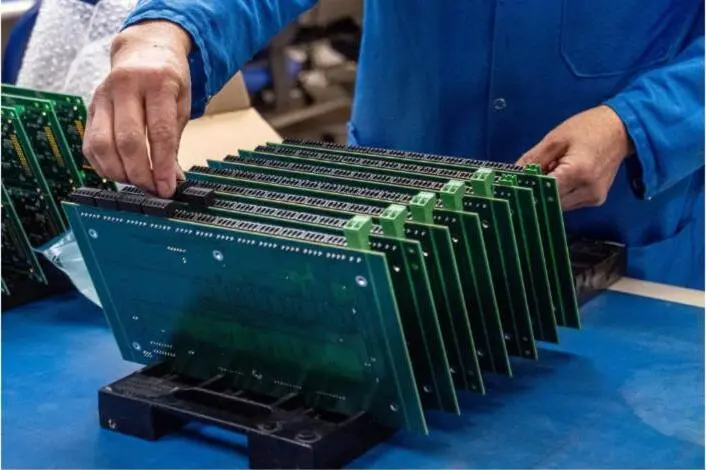
Contract manufacturing under one roof — PCBA, box-build, integration, flashing, and functional testing — with TAA-compliant sourcing and the traceability government and enterprise programs require. - Run DFMA benchmarking on the highest-volume active assemblies first to capture the largest impact.
- Target fastener count and separate-part count as the primary reduction levers for assembly simplification.
- Feed redesign outputs back into the CM process planning before the next production run to lock in gains.
Leading KPI: Parts per assembly. Lagging KPI: Assembly time per unit. 2026 example: Finding and reusing an existing part can cut BOM costs, with lifecycle cost locked in at the design stage.
Reduce setup times with SMED. Applying SMED concepts has enabled manufacturers to cut setup times by 50–75% or more. Shorter changeovers make small-lot production economical and directly reduce overproduction waste.
- Film each changeover, time every step and separate internal from external tasks to reveal conversion opportunities.
- Convert internal elements to external wherever possible and pre-stage tools and materials while the machine still runs.
- Build a setup matrix into finite-capacity scheduling software to sequence jobs and group similar setups, which reduces total changeover time.
Leading KPI: Changeover time as a percentage of available time. Lagging KPI: Schedule adherence rate. 2026 example: Nutriset reduced changeover time and raised packaging OEE using real-time OEE tools and SMED.
Activate digital-thread traceability to component level. Downstream traceability to board serial numbers is impossible without lot tracking on all incoming materials. IPC-1782 defines risk-based traceability levels that are often used in automotive and medical electronics programs.
- Connect SMT feeder scanning to board serial numbers and record reel ID, feeder position and placement timestamp.
- Integrate AOI, ICT and functional test data into the ERP to link inspection results to specific component lots.
- Use a single primary key, such as serial number or lot number, across ERP, MES and inspection systems.
Leading KPI: Percentage of active lines with automated data capture. Lagging KPI: Mean time to complete a mock recall. 2026 example: Component-level traceability at a mid-size EMS provider yields an estimated annual ROI through reduced recall scope, counterfeit prevention and first-pass yield improvement.
Integrate AI-assisted AOI and adaptive testing. An adaptive test-selection framework evaluated on 28,000 PCB assembly runs cut Functional Circuit Test time and End-of-Line test time while reducing escapes to zero under real concept drift. AI-assisted inspection catches defects earlier and at lower cost per defect.
- Deploy ATE at multiple production stages, not only end-of-line, to enable early-stage defect detection and closed-loop feedback.
- Integrate ATE data with the MES platform to support predictive maintenance and root-cause analysis.
- Use a rolling process-stability signal to switch between full and reduced test plans as failure patterns evolve.
Leading KPI: Defect escape rate per test stage. Lagging KPI: First-pass yield. 2026 example: At Siemens Electronics Works Amberg, AI applied to IoT sensor data cut X-ray testing effort and avoided a capital equipment purchase.
Close the loop with reverse logistics and depot repair integration. Lifecycle visibility often ends at the point of sale in OEM-CM partnerships. Connected depot repair data feeds production with field failure patterns that drive upstream yield improvements and stronger asset recovery.

ASC-authorized depot repair at scale — 40,000+ repairs a week. L1–L4 diagnostics and functional testing on racks of boards keep enterprise and OEM electronics in service, not in landfill. - Establish a shared returns data feed between the CM and the depot repair operation to centralize information.
- Map field failure codes to production lot numbers to identify systemic process issues and chronic defects.
- Use asset recovery and remarketing data to quantify the cost of unresolved yield problems and missed repair opportunities.
Leading KPI: Return rate by production lot. Lagging KPI: Asset recovery value per returned unit. 2026 example: McKinsey’s Supply Chain 4.0 research shows connected supply chains can reduce operational costs and reduce forecasting errors, which supports the value of a closed-loop reverse logistics and production system.
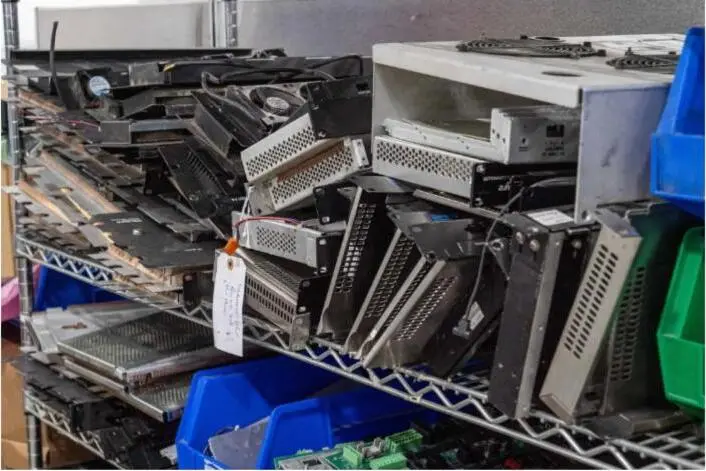
Reverse logistics turns returns into recovery. Retired IT assets are received, tagged, and triaged with secure chain-of-custody — the first step from end-of-life to resale, reuse, or responsible recycling. Lean 4.0 Cost Impact in Electronics Contract Manufacturing
Lean 4.0 combines traditional lean principles with Industry 4.0 tools such as IoT sensors, cyber-physical systems and digital twins. This combination achieves efficiency gains that neither approach delivers alone.
A 2026 comparative study at a mid-sized manufacturer found that lean implementation alone reduced cycle time, lead time and defect rate. Adding Industry 4.0 tools pushed those figures higher and improved OEE.
A 2026 analysis of 12 manufacturing plants found that Intelligent Lean Production System adoption increased OEE, reduced defect rates and cut unplanned downtime. High-precision electronics manufacturing recorded the greatest quality improvements in that study.
These improvements translate into direct cost reductions. Fewer defects mean less rework labor and material. Lower unplanned downtime means more output from the same asset base. Shorter lead times reduce work-in-process inventory carrying costs. Manufacturers deploying IIoT solutions report efficiency improvements and energy savings.
Communication and Data Sharing Across the OEM-CM Lifecycle
Real-time OEM-CM dashboards act as the connective tissue of a high-efficiency program. Without a shared data layer, KPI standardization and traceability investments create siloed reports that do not support coordinated decisions.
A functional OEM-CM data-sharing architecture includes several core elements.
- A unified dashboard that surfaces OEE, first-pass yield, on-time delivery and inventory levels in real time for both parties.
- Demand-forecast sharing that gives the CM visibility into order changes before they become expedite requests.
- Inventory and component-availability feeds that reduce the gap between planned and actual production schedules.
- Lifecycle integration language that extends the data thread from sourcing through depot repair and asset recovery, not only through shipment.
Despite the clear value of these capabilities, many manufacturers are still developing IoT-enabled supply chain infrastructure. This adoption gap creates an opportunity for OEMs that move first.
Premier Logitech operational visibility infrastructure, including a Transportation Management System, real-time tracking and lifecycle analytics, provides the data layer that connects sourcing, contract manufacturing, configuration, fulfillment and reverse logistics into a single program view. Operations leaders gain one point of contact and one source of truth across the full technology lifecycle.
Frequently Asked Questions
How long does it take to see measurable efficiency gains from these strategies?
Timelines depend on starting conditions and strategy selection. KPI standardization and real-time OEE monitoring typically produce measurable baseline improvements within the first four weeks. SMED and DFMA initiatives show results within one to two production cycles. Digital-thread traceability and AI-assisted AOI integrations generally require six to twelve weeks to reach full operational coverage. The 90-day roadmap above sequences these initiatives so each phase reinforces the next.
What are the most important contract manufacturing efficiency KPIs for tech OEMs in 2026?
The core set for electronics OEM-CM programs includes OEE, first-pass yield, on-time delivery, schedule adherence, changeover time as a percentage of available time and supplier nonconformance rate. These KPIs should be standardized with shared definitions, agreed timestamps and a single system of record before any reporting begins.
What regulatory and compliance considerations affect traceability in electronics contract manufacturing?
IPC-1782 defines risk-based levels of traceability that are utilized in automotive and medical electronics programs. IATF 16949 includes requirements related to traceability for safety-critical parts. The EU Product Liability Directive addresses product liability rules that detailed record keeping can support. Defense programs have unique identification and valuation requirements under DFARS 252.211-7003. RoHS and REACH substance tracking with automated alerts for expiring declarations represents a baseline requirement for hardware exported to regulated markets. Premier Logitech supports TAA, ISO, NIST, CMMC and SOC II frameworks across its lifecycle services.
When should an OEM revisit its contract manufacturing partner strategy?
A partner strategy review is warranted when OEE on high-value lines falls below 75% for two or more consecutive quarters. A review also becomes necessary when return rates by production lot indicate systemic yield problems that the CM has not resolved. Additional triggers include an inability to provide component-level traceability data on demand or a lack of reverse logistics and depot repair data feeding back into production planning. Fragmented vendor relationships across repair, fulfillment and recycling also signal that consolidation to a single-source partner could reduce coordination costs and improve visibility.
How does Premier Logitech support contract manufacturing efficiency from DFM through depot repair?
Premier Logitech operates as a single-source lifecycle partner covering sourcing, contract manufacturing such as PCBA, box-build, sub-assembly, burn-in and functional testing, configuration and fulfillment, warehousing, transportation and reverse logistics including depot repair at Levels 1–4. The company holds ASC authorization for more than 20 OEM brands and operates repair capacity and kitting capacity at scale across DFW facilities and nearshore operations. OEMs can engage Premier Logitech for end-to-end program management or select individual services on a modular basis.
Conclusion: Partner with Premier Logitech for End-to-End Efficiency
Improving contract manufacturing efficiency for tech manufacturers in 2026 requires more than isolated process fixes. The strategies above, from KPI standardization and real-time OEE monitoring through Lean 4.0, digital-thread traceability, AI-assisted AOI and reverse logistics integration, compound when implemented in sequence and supported by a shared data layer between OEM and CM.
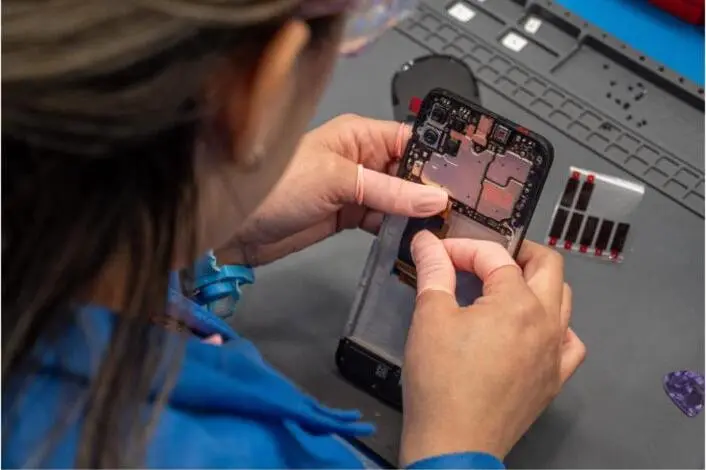
Device lifecycle management across the full arc — deploy, support, repair, and recover — with secure data wipe and NIST-compliant handling protecting every asset from first login to disposition. Premier Logitech implements this roadmap through integrated operations spanning sourcing, manufacturing, fulfillment and reverse logistics. These operations are supported by compliance certifications and real-time visibility infrastructure that operations leaders need to execute the strategies above and capture throughput, yield and asset-recovery gains.
