Last updated: July 26, 2026
Key Takeaways for Enterprise Depot Programs
- Enterprise depot repair services manage the full workflow from RMA intake through diagnostics, multi-level repair, refurbishment and compliant end-of-life processing for high-volume OEM and government fleets.
- Modern depot programs combine L1-L4 repair, secure data destruction, chain-of-custody documentation and asset recovery to support compliance mandates and sustainability goals.
- Fragmented vendor networks create visibility gaps and compliance risk, so a single authorized lifecycle partner becomes essential for cost control and audit readiness.
- Premier Logitech operates as an ASC-authorized provider across more than 20 OEM brands with ISO, NIST, CMMC and SOC 2 certifications plus CAGE Code 4WAJ9 for federal programs.
- Talk to a lifecycle expert at Premier Logitech to design a scalable depot repair program that aligns with specific compliance requirements and volume profiles.
Scope of Enterprise-Grade Depot Repair Services
Enterprise depot repair starts at RMA intake, where teams log, label and triage units before a structured repair workflow begins. Triage separates units by fault type and assigns each device to the appropriate repair level.
- L1 (Level 1): Software resets, configuration corrections and no-fault-found screening without opening the device
- L2 (Level 2): Modular component replacement such as screens, batteries and keyboards
- L3 (Level 3): Board-level diagnostics, sub-assembly repair and firmware restoration
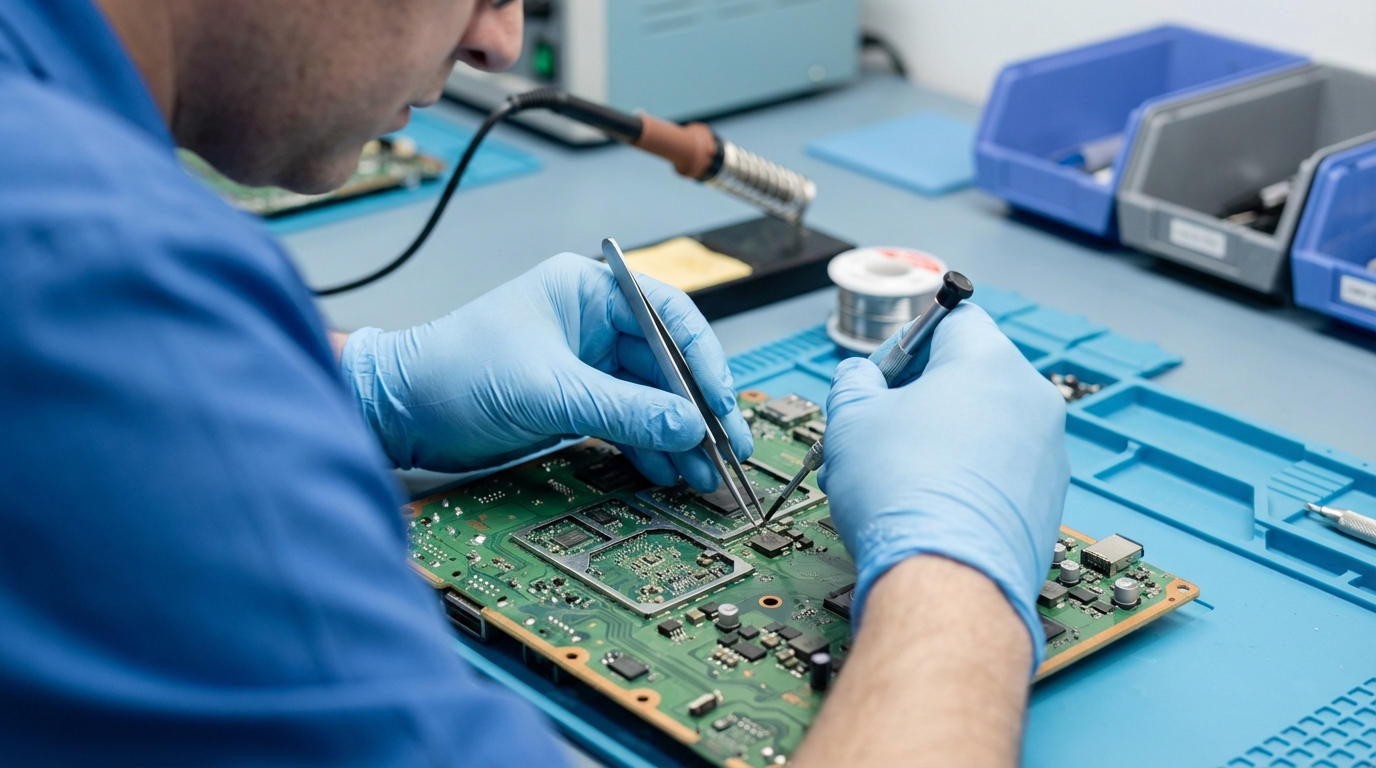
- L4 (Level 4): Component-level repair including BGA rework, PCB trace repair and precision soldering
After repair, units move through cosmetic refurbishment, functional testing and grading before redeployment or certified end-of-life processing. Secure data wipe and chain-of-custody documentation run in parallel at every stage. Programs operate as end-to-end engagements or as modular services that cover specific stages of the lifecycle.
Why Large Organizations Choose Structured Depot Partners
Return volumes, compliance mandates and visibility gaps push large organizations toward structured depot partners. Market growth reflects longer device ownership cycles, enterprise asset management needs and telecom infrastructure demands.
North America holds a significant share of the global industrial electronics repair and refurbishment services market, with the United States leading the region. This regional concentration creates economies of scale for depot providers that support large U.S. enterprises. Rising e-waste volumes in these markets also increase regulatory pressure for certified repair and refurbishment programs, which makes compliance capability a central selection criterion.
Fragmented vendor networks compound these pressures. When repair, fulfillment and recycling sit with multiple providers, visibility gaps widen, compliance documentation becomes inconsistent and cost control erodes. A single authorized partner resolves these gaps at scale and restores unified oversight.
How Enterprise Depot Repair Evolved
Depot repair began as a warranty break-fix function where technicians replaced failed parts and shipped units back. That model supported low-volume, single-OEM programs but could not absorb the complexity of modern enterprise fleets.
Over the past decade, providers have added data destruction, asset recovery, sustainability reporting and reverse logistics orchestration to depot programs. Leading depot providers now connect repair services to circular-economy objectives through flexible supply chain models, OEM returns management and compliant e-cycling. Market expansion reflects how central platform-driven depot management has become for OEM service organizations.
An Accenture study found that 68% of consumer electronics returns are classified as no fault found. Most returned units therefore retain recoverable value when processed through integrated reverse logistics. That data point supports the shift from break-fix to lifecycle-integrated depot programs.
Core Capability Pillars in Modern Depot Repair
Modern enterprise depot repair programs rely on several interconnected capability pillars.
- Intake and diagnostics: Serialized RMA logging, condition assessment and triage routing
- Multi-level repair: L1 through L4 coverage across software, modular, board and component levels
- Cosmetic refurbishment: Surface restoration and repackaging to graded specifications
- Grading and remarketing: Condition-based classification for secondary market or redeployment channels
- Secure data wipe: NIST 800-88-aligned sanitization with certificates of destruction
- Compliance documentation: Chain-of-custody records, audit-ready reports and regulatory certifications
These pillars connect sourcing, deployment, returns and end-of-life into a single managed program rather than isolated transactions. Delivering these capabilities at enterprise scale requires specific operational infrastructure and clear governance.
Operating Model and Governance for Enterprise Depots
Enterprise depot programs run from geographically distributed facilities that reduce transit time and support regional compliance requirements. Transportation management systems provide real-time unit tracking from RMA initiation through return shipment. Leading providers maintain compliance stacks that include ISO 9001 quality management, ISO 14001 environmental management and NIST 800-88 media sanitization to support audit-ready reporting.
SLA-based governance defines turnaround expectations by repair level, escalation paths for complex faults and reporting cadences. Best-in-class depot operations achieve strong first-time fix rates, with key performance indicators that track turnaround time, cost per repair, parts utilization and technician productivity.
Buyer Roles and Selection Priorities
Three roles typically drive depot repair vendor selection at large OEMs and government agencies.
- VP of supply chain: Focuses on vendor consolidation, cost efficiency and end-to-end lifecycle visibility
- Director of reverse logistics: Prioritizes throughput capacity, turnaround consistency and returns workflow integration
- Compliance officer: Requires documented certifications, data destruction records and regulatory alignment with TAA, NIST, CMMC and ISO frameworks
OEM buyers evaluating third-party service providers should assess provider expertise with specific equipment, geographic scale, SLA coverage and availability of dedicated program support. Authorization status, especially ASC credentials from the OEMs represented in the fleet, functions as a nonnegotiable filter for programs that include warranty repair.
Comparing Common Depot Repair Models
Organizations usually evaluate three primary models before selecting a depot partner.
In-house programs deliver maximum control but require capital investment in facilities, tooling and certified technicians. Skilled labor scarcity makes staffing difficult. Recruiting qualified technicians strains OEM resources and diverts attention from core product development.
Traditional 3PLs handle returns logistics but rarely hold OEM repair authorizations or the compliance certifications required for data-bearing government devices. They introduce handoff risk when repair work is subcontracted, which recreates the fragmentation problems that internal programs often face.
Specialized repair firms solve the authorization gap that many 3PLs leave open, since they may hold ASC status for one or two OEMs. These firms often lack the geographic footprint, compliance stack or lifecycle breadth needed for mixed-fleet enterprise programs. The strongest depot repair partners combine big-shop capacity with small-shop agility, pairing scale, systems and inventory with direct communication and targeted problem solving.
Integrated lifecycle partners consolidate logistics, repair and asset recovery under one contract, one compliance framework and one reporting system.
Premier Logitech Scale, Coverage and Authorizations
Premier Logitech operates as an ASC-authorized depot repair provider with status across more than 20 OEM brands, which aligns with the mixed-fleet reality of large enterprise and government programs. Repair capacity supports high-volume programs across three DFW facilities, with nearshore operations in Laredo and Nuevo Laredo that support cost-competitive throughput.
The compliance stack includes TAA, TAPA, ISO 9001, ISO 14001, NIST, CMMC and SOC 2 certifications. The company’s CAGE Code confirms pre-vetted status for U.S. federal government programs. WISE Technician Certification and OEM-specific credentials support technician quality across all repair levels. Transportation management runs through a network of more than 120 vetted North American LTL carriers, and TMS-based tracking provides real-time unit visibility.
Pre-Selection Checklist for Depot Partners
Procurement and operations teams can use the following checklist before issuing an RFP or scheduling a vendor review.
- Device mix: Identify all OEM brands and device types in the fleet and confirm that the candidate provider holds ASC status for each.
- Compliance requirements: List applicable frameworks such as TAA, NIST, CMMC, ISO and SOC 2 and verify that the provider holds current certifications.
- Volume thresholds: Confirm that the provider’s weekly repair capacity aligns with peak return volumes, not only average volumes.
- Integration complexity: Assess ERP, TMS and RMA system integration requirements and confirm that the provider supports API-led or EDI connectivity.
- Geographic coverage: Map facility locations against the distribution network and any nearshore or international requirements.
- Data destruction documentation: Request sample certificates of data destruction and chain-of-custody records before final selection.
- Asset recovery options: Confirm whether the provider supports grading, remarketing and secondary market redeployment for refurbished units.
Frequently Asked Questions
What is the difference between L1, L2, L3 and L4 depot repair?
L1 repair addresses software issues, configuration errors and no-fault-found screening without opening the device. L2 covers modular component replacement such as screens, batteries and keyboards. L3 involves board-level diagnostics, sub-assembly repair and firmware restoration. L4 focuses on component-level repair including BGA rework, PCB trace repair and precision soldering. Enterprise programs typically require all four levels to manage the full range of faults across a mixed device fleet.
How does Premier Logitech handle compliance documentation for government agency clients?
Premier Logitech maintains certifications under TAA, TAPA, ISO 9001, ISO 14001, NIST, CMMC and SOC 2 frameworks. Every data-bearing device processed through the depot receives NIST 800-88-aligned sanitization with a certificate of data destruction. Teams maintain chain-of-custody records at the serial-number level from RMA intake through final disposition. The company’s CAGE Code confirms pre-vetted status for U.S. federal government programs and supports audit-ready reporting for compliance officers.
Can Premier Logitech support both warranty and out-of-warranty repairs across multiple OEM brands?
Premier Logitech holds ASC authorization for more than 20 OEM brands, which covers both in-warranty and out-of-warranty repair programs. ASC status means technicians train to OEM standards, genuine parts come through authorized channels and repair records meet OEM documentation requirements. This authorization coverage matters for mixed-fleet programs where a single vendor must handle devices from multiple manufacturers under consistent quality controls.
What asset recovery options are available after depot repair?
After repair and refurbishment, teams grade units by condition and route them to the appropriate disposition channel. Options include redeployment into the client’s active fleet, remarketing through secondary market channels, parts reclamation for components with residual value and responsible recycling for units that reach end of life. Clients receive grading reports and asset-level documentation for each unit, which supports financial recovery tracking and sustainability reporting.
How does Premier Logitech integrate with existing OEM or enterprise systems?
Premier Logitech supports integration with client ERP, TMS and RMA platforms to maintain data continuity across the repair workflow. Real-time tracking through the transportation management system provides unit-level visibility from RMA initiation through return shipment. Program onboarding includes an integration scoping phase that aligns data exchange requirements, reporting formats and escalation workflows before the program launch. Clients can engage Premier Logitech as a single-source lifecycle partner or connect only the depot repair module to an existing logistics infrastructure.
Conclusion: Choosing a Scalable, Compliant Depot Partner
Enterprise depot repair now functions as a lifecycle platform rather than a simple break-fix service. Large OEMs and government agencies need partners that hold ASC authorizations across their device mix, maintain a documented compliance stack, deliver real-time visibility and absorb volume spikes without stretching turnaround windows.
The vendor fragmentation described earlier creates the exact problems that an integrated lifecycle partner eliminates. A partner that connects intake, L1-L4 repair, refurbishment, grading, secure data destruction and asset recovery under a single contract simplifies operations and strengthens compliance. Premier Logitech’s authorized, compliant and scalable depot model aligns with those requirements.
