Last updated: July 26, 2026
Key Takeaways for Back Market Warranty Programs
- Reverse logistics for Back Market warranty claims now spans RMA intake, repair, refurbishment, grading and redeployment under a seller-funded obligation.
- Back Market’s 30-day return window and 12-month seller warranty create a 5-day resolution SLA that ties speed to listing visibility.
- Enterprise sellers at 200+ monthly devices face rising SLA exposure when generic 3PLs or MSPs cannot perform L2–L4 depot repair or maintain NIST-grade documentation.
- Specialized ASC-authorized depot partners consolidate intake, repair, data sanitization and compliance reporting into one accountable workflow, which removes handoff delays.
- Premier Logitech delivers OEM-authorized capacity and a TAA, NIST and CMMC compliance stack that protects seller quality scores. Talk to a lifecycle expert at Premier Logitech to map volume to the right model.
How Back Market Resolution Rules Shape Enterprise Repair Volume
Back Market ties seller quality scores directly to resolution speed. Missed resolution windows create negative quality signals that reduce listing visibility and can trigger account-level penalties. For enterprise sellers processing hundreds or thousands of devices each month, even a modest miss rate compounds quickly.
Back Market requires a minimum 12-month seller-funded warranty and allows a 30-day return window, with Back Market mediating disputes. A resolution expectation within that window means the entire intake-to-disposition cycle, including shipping, triage, repair decisions and confirmation, must finish in a compressed period.
Most enterprise sellers rely on third-party logistics providers to handle that cycle. Standard 3PL SLAs focus on short lead times for inspection and disposition after receipt, which leaves no buffer for transit time, parts sourcing or escalated repairs. At 200 to 500 monthly devices, a single carrier delay or parts shortage can push a batch of claims past the resolution window at the same time.
At 1,000 to 5,000 or more monthly devices, the math becomes unforgiving. High return volumes above 1,000 returns per month require dedicated returns automation tools beyond standard 3PL warehouse management to control costs and maintain SLA compliance. Without a purpose-built repair workflow, queue backlogs accumulate faster than generalist operations can clear them.
These operational pressures are compounded by legal obligations. State-level statutes add another layer of pressure. California’s Song-Beverly Consumer Warranty Act requires that any product sold with a written warranty be repairable within 30 days or the buyer becomes entitled to a replacement or refund, with Connecticut, Minnesota and New Jersey carrying similar statutes. Enterprise sellers operating across multiple states face overlapping obligations that a single-vendor partner can track and satisfy more consistently.
Assess current SLA exposure and compliance risk with a Premier Logitech lifecycle expert.
Four Operational Models for Back Market Warranty Logistics
Enterprise sellers typically operate within one of four models. Each model aligns with a specific volume range, compliance posture and SLA risk profile.
In-house operations give sellers direct control over intake, triage and repair. At low volumes, internal teams can maintain SLA compliance. Above that threshold, staffing, tooling and parts inventory costs scale faster than revenue. Compliance documentation also becomes a full-time burden. TAA, NIST and CMMC requirements demand dedicated personnel and auditable processes that most internal IT or operations teams cannot sustain at scale.
Generic 3PL partners provide warehousing and returns processing at competitive per-unit rates. Outsourced 3PL services commonly charge per return processed, with additional storage and WMS fees. The limitation centers on depth. Generic 3PLs inspect and sort but rarely perform L2–L4 depot repair, hold OEM authorizations or maintain government-grade data-sanitization documentation. SLA risk rises sharply when a claim requires component-level repair rather than cosmetic refurbishment.
Managed service providers (MSPs) add software orchestration and service-desk workflows on top of logistics. MSPs suit organizations that need ITSM integration with platforms such as ServiceNow or Jira and consolidated reporting across multiple device programs. MSPs typically subcontract physical repair to third parties, which introduces a handoff that adds transit time and dilutes accountability. For Back Market’s resolution window, that handoff creates structural risk.
Specialized depot partners with ASC authorization consolidate intake, L1–L4 repair, refurbishment, grading and redeployment under one roof. This consolidation removes the handoff latency that generic 3PLs and MSPs introduce, which matters because each handoff adds transit time and compresses the resolution window. Premier Logitech holds ASC authorization for more than 20 OEM brands, operates repair capacity across DFW facilities with nearshore operations in Laredo and Nuevo Laredo, Mexico, and maintains a compliance stack covering TAA, NIST, CMMC, ISO, SOC 2 and TAPA. This footprint and compliance posture support the consolidated model at scale without sacrificing documentation rigor.
The specialized depot partner model has a clear volume sweet spot. When monthly claims exceed the point where serialization, compliance and kitting complexity outpace what generalist operations handle efficiently, the depot partner becomes the structurally lower-risk choice. For Back Market sellers at 200 or more monthly devices, that threshold has effectively been reached.
Choosing Between Depot Repair and MSP for Back Market Claims
The decision point between an MSP and a specialized depot partner rests on three variables: monthly device volume, repair complexity and depth of compliance obligations.
An MSP fits best when:
- Monthly Back Market claim volume stays below 200 devices
- Claims are predominantly cosmetic or software level
- The organization’s primary need is ITSM workflow integration rather than physical repair capacity
- Government-grade data sanitization documentation is not a contract requirement
A specialized depot partner becomes the lower-risk choice when:
- Monthly claim volume exceeds 200 devices and continues to grow
- Claims include L2–L4 component-level repairs that require OEM-authorized parts and tooling
- The seller operates under TAA, NIST SP 800-88, CMMC or state-level right-to-repair statutes
- The organization needs a single accountable vendor for repair, refurbishment, grading and redeployment
- Asset recovery value from resale of refurbished units represents a material revenue line
Devices in better condition qualified for higher trade-in values than those with excessive wear or damage in Q1 2026. That pattern shows that triage quality and repair depth directly affect recovery economics. Maximizing that recovery value requires tight coordination between the repair technician who assesses component condition and the grading specialist who determines resale tier. That coordination breaks down when an MSP subcontracts repair to a third party. A depot partner with in-house grading capability maintains that coordination under one roof and improves recovery outcomes beyond what an MSP can deliver.
Premier Logitech RMA Workflow for Back Market Devices
Premier Logitech structures its depot workflow to meet Back Market’s resolution window while maintaining the documentation chain required for government-adjacent compliance programs. The six-stage sequence below reduces handoff delays that cause SLA failures in multi-vendor models by keeping all steps, from intake through final disposition, inside a single operation.
The workflow follows a defined sequence:
- Intake and receiving: Devices are logged against RMA records with serial number, model and condition captured at receipt. Chain-of-custody documentation begins at this step.
- Triage and diagnosis: L1 assessment determines whether the device requires cosmetic refurbishment, software repair or component-level depot work. Devices are routed accordingly without manual requeuing.
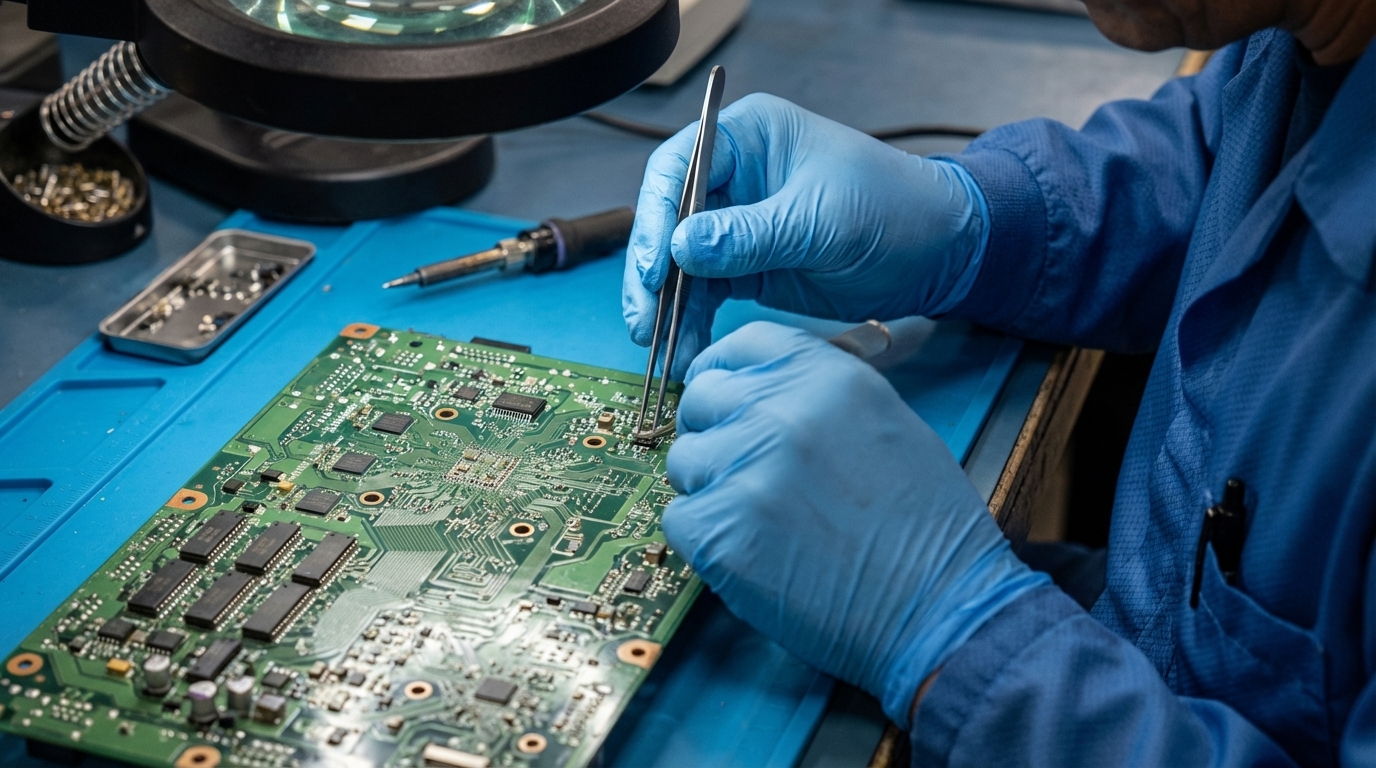
- L1–L4 depot repair: Premier Logitech’s ASC-authorized technicians perform repairs from software reloads through board-level component work, using OEM-authorized parts and tooling for more than 20 brands.
- Data sanitization: All devices undergo NIST-aligned sanitization, using Clear, Purge or Destroy, matched to the device’s data classification and the seller’s compliance requirements. Audit trails include serial number, sanitization method, technician identifier, date and verification outcome.
- Refurbishment and grading: Cosmetic refurbishment follows Back Market’s grading standards. Devices are graded and documented for secondary market redeployment or responsible recycling.
- Redeployment or disposition: Repaired and graded devices return to the seller’s inventory, ship as replacement units or route to asset recovery channels. Real-time tracking provides visibility at each stage.
Premier Logitech’s DFW hub and nearshore Mexico operations provide geographic proximity and labor capacity that absorb volume surges without extending cycle times. The compliance stack that includes TAA, NIST, CMMC, ISO, SOC 2 and TAPA is maintained across all facilities, so government-adjacent sellers avoid segmenting workflows by compliance tier.
Implementation Checklist for Back Market RMA Integration
Transitioning to a specialized depot partner requires alignment across systems, SLA language and seller-performance monitoring. These three categories address the most common integration failure points. Systems integration removes manual data entry that causes delays. SLA language alignment ensures contractual obligations match operational reality. Seller-performance monitoring closes the feedback loop that protects quality scores. The following checklist covers the critical integration steps.
Systems integration:
- Establish bidirectional API connections between the depot’s operational system and the seller’s ITSM platform such as ServiceNow or Jira. Bidirectional API integration eliminates manual copy and paste, prevents data entry errors and enables real-time transmission of ticket data for claims tracking.
- Configure event-driven ticket creation so that when scanned identifiers such as serial number, RMA or airway bill do not match during receiving, the system automatically generates a discrepancy ticket with full context.
- Implement webhook subscriptions for real-time status updates, including received, approved, repaired and returned, so seller-side dashboards reflect depot status without manual polling.
- Use API token authentication for Jira Cloud integrations and validate rate-limit handling before production deployment.
SLA language alignment:
- Map Back Market’s resolution window to the depot partner’s intake-to-disposition SLA, including inbound transit time.
- Define escalation triggers for L3–L4 repairs that may require parts procurement beyond standard stock.
- Align replacement-unit availability commitments with rapid exchange program parameters.
Seller-performance monitoring:
- Configure trailing 30, 60 and 90 day resolution analytics to identify claim-type patterns that predict SLA risk.
- Establish compliance reporting cadence for TAA, NIST and CMMC documentation delivery.
- Review Back Market quality-score data monthly against depot performance metrics to close feedback loops.
Get help scoping an integration plan from Premier Logitech.
Addressing Concerns on Vendor Consolidation, Security and Turnaround
Objection: Consolidating to a single vendor creates concentration risk.
Consolidation to one vendor removes the handoff latency and accountability gaps that appear when repair, fulfillment and recycling sit with multiple providers. Premier Logitech operates as both a single-source lifecycle partner and a modular services provider, so organizations can consolidate progressively rather than through a single transition. The DFW hub and nearshore Mexico operations provide geographic redundancy inside the consolidated model.
A related concern centers on visibility and control.
Objection: Data security during repair is harder to audit with an external partner.
NIST 800-88 requires a compliant audit trail that includes equipment manifests with serial numbers, sanitization method, tool used, date, technician identifier, verification outcome, certificate of data destruction and chain-of-custody records. Premier Logitech’s compliance stack, which includes NIST, CMMC and SOC 2, produces that documentation as a standard output of the depot workflow rather than a post hoc report. Government-adjacent sellers receive the same documentation chain that Department of Defense contractors require for devices that carry controlled unclassified information.
Objection: Turnaround times vary too much for a 5-day SLA commitment.
Turnaround variability in generic 3PL and MSP models stems from subcontracted repair handoffs and parts-sourcing delays. Premier Logitech’s in-house L1–L4 repair capability removes the subcontracted handoff by performing all repair tiers under one roof. OEM-authorized parts access for more than 20 brands removes parts-sourcing delays by maintaining inventory for common repairs. Purpose-built triage routing prevents queue backlogs by directing devices to the correct repair tier at intake and avoiding the requeuing that occurs when a generalist operation misclassifies a device. Regulations such as NIST and GDPR have raised minimum data erasure standards, adding certified multipass wiping and serialized reporting costs to refurbishment processing. Those costs are already embedded in Premier Logitech’s per-unit workflow rather than billed as exceptions.
Conclusion: Selecting a Scalable Back Market Warranty Partner
Enterprise sellers managing Back Market warranty claims in 2026 face rising return volumes, tighter data-security mandates and a 5-day resolution window that leaves no margin for fragmented vendor chains. The four-model framework of in-house, generic 3PL, MSP and specialized depot partner aligns cleanly with volume bands and compliance obligations.
At 200 or more monthly devices, and particularly where TAA, NIST or CMMC requirements apply, a specialized ASC-authorized depot partner consolidates repair, refurbishment, grading and compliance reporting into one accountable relationship. Premier Logitech’s multi-brand ASC authorization, cross-border operations and government-grade compliance stack support that threshold and higher volumes.
Talk to a lifecycle expert at Premier Logitech to map Back Market claim volume to the right operational model and build a transition plan that protects seller quality scores while satisfying compliance requirements.
Frequently Asked Questions
What volume threshold signals that an enterprise Back Market seller needs a specialized depot partner?
The inflection point for needing a specialized depot partner appears as monthly warranty claims increase and serialization requirements, OEM-authorized repair needs and compliance documentation exceed what in-house teams or generic 3PLs can sustain without dedicated tooling and staffing. At higher volumes, the case for a specialized depot partner becomes structural. Queue management, parts inventory and audit-trail generation at that scale require purpose-built operations. Premier Logitech’s depot model is designed to scale for mid-to-high volume programs without degrading SLA performance or compliance posture.
How does Premier Logitech maintain TAA, NIST and CMMC compliance during Back Market device repair?
Premier Logitech’s compliance stack covers TAA, NIST, CMMC, ISO, SOC 2 and TAPA across all operating facilities. For data sanitization, every device processed through the depot receives a sanitization method matched to its data classification, using Clear, Purge or Destroy, with a full audit trail that includes serial number, method applied, technician identifier, date and verification outcome. TAA compliance is maintained through supply-chain origin controls and the substantial transformation standard for repaired components. CMMC-relevant documentation is produced as a standard workflow output rather than a custom reporting engagement, which reduces administrative burden for government-adjacent sellers.
Can Premier Logitech integrate with existing ServiceNow or Jira environments for RMA tracking?
Premier Logitech supports bidirectional API integration between its operational systems and enterprise ITSM platforms including ServiceNow and Jira. The integration pattern uses event-driven ticket creation, which automatically generates a discrepancy record when scanned identifiers do not match during receiving, and webhook-based status updates that push repair-stage changes to the seller’s dashboard in real time. Automated case closure in the seller’s ITSM system triggers when the linked depot ticket resolves and removes manual status reconciliation. Integration scope and authentication patterns are defined during onboarding based on the seller’s existing ITSM configuration.
What happens to Back Market devices that cannot be repaired to resale grade?
Devices that do not meet Back Market’s grading standards after repair move through Premier Logitech’s asset recovery and responsible recycling programs. Parts reclamation and harvesting recover component value from units that are not economically repairable. Devices that contain sensitive data and cannot be sanitized to NIST SP 800-88 Purge standard are processed through certified physical destruction with full chain-of-custody documentation. The goal is to maximize asset recovery value at each disposition tier, including refurbishment, parts harvest and materials recovery, while maintaining compliance documentation throughout.
How does Premier Logitech’s nearshore Mexico operation support Back Market SLA compliance?
Premier Logitech’s Laredo and Nuevo Laredo nearshore operations provide cost-effective labor capacity that scales with volume surges without extending cycle times. Geographic proximity to the DFW hub enables rapid movement of devices between facilities based on repair complexity routing. The nearshore model operates under the same compliance framework as the DFW facilities, including TAA, NIST, CMMC and ISO, so sellers avoid maintaining separate compliance documentation for devices processed at different locations. For enterprise sellers managing seasonal volume spikes or accelerated refresh programs, nearshore capacity provides a buffer that prevents queue backlogs from compressing the 5-day resolution window.
