Last updated: August 9, 2026
Key Takeaways for 2026 PCBA Sourcing
- High-volume PCB assembly in 2026 depends on automation, certified quality systems and full-lifecycle integration, not simple unit pricing.
- US and nearshore production often deliver lower total cost of ownership than offshore sourcing once tariffs, freight and compliance risks are included.
- Medical, defense and government OEMs require partners with IPC Class 3, ITAR, ISO 13485, TAA, NIST, CMMC and SOC 2 certifications to meet regulatory mandates.
- Board-level traceability through MES, serial marking and lot genealogy is mandatory for regulated industries and should be verified during supplier qualification.
- Premier Logitech delivers end-to-end PCBA, box-build and reverse logistics under one compliant program; talk to a lifecycle expert to start an assessment.
8-Step RFQ Checklist for High Volume PCB Assembly
Procurement teams can use this checklist when issuing an RFQ to any US or nearshore PCBA partner.
- Confirm the annual volume tier and whether the partner’s automation level matches that tier’s yield and throughput benchmarks.
- Verify certification coverage, including IPC Class 3, ITAR, ISO 13485, TAA, NIST, CMMC and SOC 2 as applicable to the program.
- Assess board-level traceability depth, including MES integration, serial number marking and lot genealogy capability.
- Evaluate scalability and request evidence of capacity tested at volumes above nominal program demand.
- Confirm box-build and sub-assembly capability within the same partner to remove handoff risk.
- Assess reverse logistics integration, including RMA management, depot repair and asset recovery programs.
- Review total cost of ownership factors such as tariff exposure, freight mode, inventory carrying costs and quality-related costs.
- Validate network coverage across US domestic facilities, nearshore operations and authorized service center authorizations.
Reshoring Drivers and Practical Volume Tiers for 2026
The CHIPS and Science Act appropriates federal funding to rebuild domestic semiconductor manufacturing. Section 48D provides a 35% tax credit for qualified US semiconductor manufacturing equipment placed in service after Dec. 31, 2025, with eligibility ending for property whose construction begins after Dec. 31, 2026.
Tariff rates on Chinese electronics imports in mid-2026 include elevated levels on semiconductors, higher rates on passive and active components and increased rates on rigid and flex PCBs. Federal Reserve and NBER analyses show a high passthrough rate, so US importers absorb nearly all tariff costs. On March 6, 2025, USMCA-compliant goods from Mexico were exempted from new tariffs pursuant to an Executive Order, which restored nearshore viability for manufacturers meeting Tariff Shift or Regional Value Content thresholds.
Senate bill S.4569, the Protecting Circuit Boards and Substrates Act introduced May 19, 2026, would create a 25% tax credit for American-made PCBs. A limited number of US PCB fabricators remain, holding a small share of the global market, which creates capacity constraints for complex defense, aerospace and medical programs.
Volume tier definitions vary by source and program type. Industry sources commonly define high-volume PCB assembly as 1,000 or more units per production run, with higher tiers for mass production.
Certification and Capability Matrix for Regulated Programs
In a survey of PCB designers, a majority identified IPC-6012 Class 3 and UL certifications as the most important standards when selecting a manufacturer. A portion selected ITAR or MIL-PRF-31032 for aerospace and defense, and a smaller share selected ISO 13485:2016 for medical device applications.
| Certification / Standard | Applicable Industry | Premier Logitech Status |
|---|---|---|
| IPC Class 3 (IPC-A-610, IPC-6012) | Medical, defense, aerospace | Assembly executed to IPC standards |
| ITAR | Defense, government | Compliance supported for defense programs |
| ISO 13485 | Medical devices | ISO quality frameworks supported |
| TAA / CAGE Code 4WAJ9 | Federal government | TAA-compliant pre-vetted federal partner |
| NIST / CMMC | Defense, public sector | Certified compliance supported |
| SOC 2 | Enterprise, government | SOC 2 certified |
Talk to a lifecycle expert to confirm which certifications apply to a specific program and how Premier Logitech’s compliance posture maps to those requirements. Once certification requirements are clear, the next evaluation dimension is whether the partner’s automation infrastructure can sustain the required volume at the certified quality level.
Automation and Capacity Benchmarks for High-Volume Runs
High-volume PCB assembly targets a high first-pass yield, strong overall equipment effectiveness and short changeover times. These benchmarks support the RFQ checklist items on volume tier and automation level, since a partner claiming high-volume capability should meet yield and OEE targets for the stated tier.
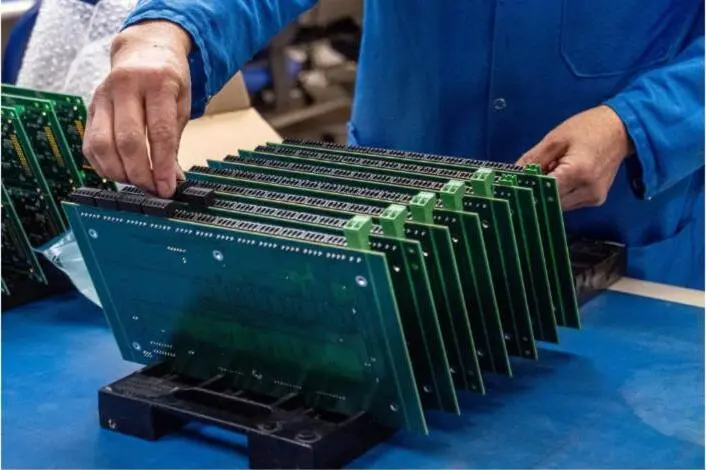
Scalability testing for high-volume suppliers runs above nominal volume, and short lead times for high-volume orders signal robust manufacturing capacity. These results provide concrete evidence for RFQ requests that ask for performance at volumes above expected demand.
Automated optical inspection systems in high-volume lines scan for defects at high rates. Providers scaling toward high-volume runs benefit from 3D SPI with closed-loop feedback, offline feeder preparation, SMED changeover methods and real-time OEE dashboards, which together support consistent output.
Board-level traceability functions as a non-negotiable benchmark at high volumes. Strong traceability systems capture unique board IDs tied to production records, including batch numbers, machine settings, operator data, AOI and ICT test results, material sources, component lot data and shipment history through an MES. Traceability checkpoints should appear at incoming inspection, material kitting, solder paste printing, placement, reflow, AOI, X-ray testing, rework and packing, which aligns with the RFQ checklist focus on traceability depth.
Industries with Strong Fit for High-Volume US PCBA
Defense and aerospace procurement mandates require domestic sourcing and ITAR compliance, which directs spending to US contract manufacturers regardless of unit price. Medical device OEMs are tightening supply-chain security requirements after years of single-source exposure, which increases demand for certified domestic and nearshore partners.

The industries with the strongest fit for high-volume US PCBA in 2026 include the following segments.
- Medical devices: ISO 13485, IPC Class 3 and full traceability function as baseline requirements. Domestic or nearshore production reduces regulatory risk and supports FDA audit readiness.
- Defense and government: ITAR, TAA, CMMC and NIST compliance are mandatory. CAGE Code 4WAJ9 status positions Premier Logitech as a pre-vetted federal partner.
- Automotive and industrial: Automotive PCB production volumes often exceed millions of units annually per model line, which requires facilities equipped for sustained high-scale output while meeting IPC-6012E and IPC-A-600K standards.
- Telecom and enterprise IT: High-volume programs with complex BOMs benefit from nearshore production and integrated lifecycle services that manage returns and warranty cycles.
Total Cost of Ownership Across US, Nearshore and Offshore
TCO in electronics manufacturing equals acquisition costs plus operating costs plus supply chain costs plus quality and warranty costs plus end-of-life costs plus risk-related costs. A supplier offering a lower unit cost may generate higher total costs due to poor quality, long lead times, high defect rates and air freight used to compensate for delays.
China carries higher total landed cost for goods sold into the US market due to tariffs, which shifts the cost advantage toward nearshore and domestic options. For mid-volume programs where tariffs represent the dominant cost factor, nearshoring electronics from China to Mexico frequently delivers the lowest total landed cost among the three geographies. US domestic production narrows that gap for high-reliability programs in defense-adjacent industrial and automotive sectors, because these programs require certifications and IP protection that offset Mexico’s tariff advantage, and domestic production eliminates tariff exposure while providing shorter lead times.
China-sourced electronics supply chains impose a longer replenishment cycle, including ocean transit, customs and safety stock, versus shorter cycles for nearshore or domestic production. Shipping costs from Shanghai to Los Angeles remain higher than 2019 levels. These factors compound across a multi-year program and often reverse the apparent unit-cost advantage of offshore sourcing.
Integrating PCBA, Box-Build and Reverse Logistics
Fragmented suppliers create compliance gaps, traceability breaks and cost overruns that a single integrated partner can remove. Premier Logitech bundles PCBA, box-build and reverse logistics under one program structure without the volume minimums and account-tier constraints associated with mega-EMS providers.
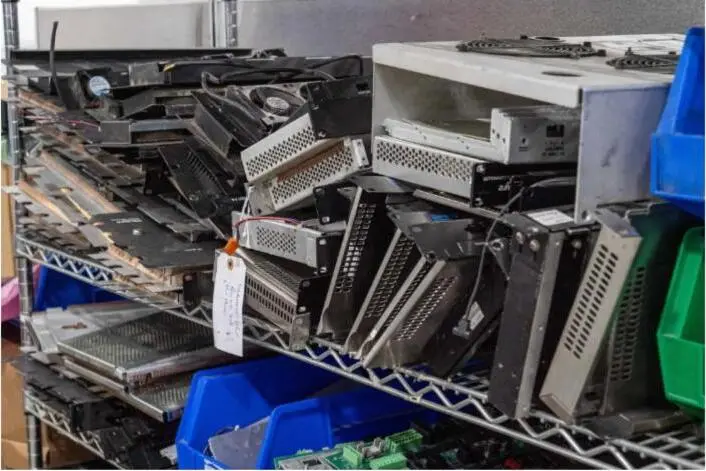
Premier Logitech’s manufacturing capabilities span PCBA, single and double-side SMT, through-hole, flex circuit assembly, sub-assembly, final assembly, burn-in and functional testing and BGA reballing. Box-build and electromechanical assembly connect PCBA output directly to finished-goods fulfillment, which simplifies program management.
Reverse logistics services, including RMA management, depot repair at levels 1 through 4, sorting, grading and secure data destruction, close the lifecycle loop without requiring a separate vendor relationship. With OEM Authorized Service Center authorizations and nearshore operations in Laredo and Nuevo Laredo, Premier Logitech provides USMCA-compliant production capacity that reduces tariff exposure while maintaining the compliance posture required for medical and defense programs.
How Premier Logitech Aligns to a Seven-Point Evaluation Framework
The framework below organizes Premier Logitech’s capabilities across seven dimensions that address the evaluation criteria in the RFQ checklist and certification matrix.
- Service scope: End-to-end lifecycle from sourcing and PCBA through box-build, fulfillment and reverse logistics, available as a full program or modular services.
- Technical capabilities: SMT, through-hole, flex circuit, BGA reballing, burn-in, functional testing and board-level traceability via MES.
- Quality and compliance: Certified across the standards detailed in the matrix above, including IPC-A-610 assembly, ITAR, TAA with CAGE Code 4WAJ9, ISO frameworks, NIST, CMMC, SOC 2 and TAPA.
- Scalability: Kitting capacity at scale, repair capacity at scale and modular engagement models that grow with program demand.
- Visibility: Real-time inventory tracking, lifecycle analytics and TMS integration across the supply chain.
- Network coverage: Three DFW facilities, nearshore Mexico operations, vetted North American LTL carriers and OEM Authorized Service Center authorizations.
- Total cost: Nearshore USMCA-compliant production, vendor consolidation and integrated lifecycle services reduce hidden costs that inflate TCO under fragmented supplier models.
Downloadable RFQ Template and Action Plan
The evaluation framework in this guide, including the certification matrix, volume-tier benchmarks, TCO factors and traceability requirements, gives procurement and supply-chain leaders a structured basis for comparing PCBA partners in 2026. The eight-step RFQ checklist converts that framework into a document ready for supplier distribution.
Three concrete next steps for OEM supply-chain leaders follow a logical sequence.
- Use the certification matrix to audit current supplier coverage against IPC Class 3, ITAR, ISO 13485, TAA, NIST, CMMC and SOC 2 requirements for each active program, which establishes a compliance baseline.
- Run a TCO analysis that includes tariff exposure, freight mode, inventory carrying costs and quality-related costs for any offshore or fragmented supplier relationship, because certification alone does not ensure cost competitiveness.
- Engage Premier Logitech to assess whether a bundled PCBA, box-build and reverse logistics program structure addresses identified gaps while reducing total program cost compared with the current supplier model.
Talk to a lifecycle expert at Premier Logitech to request an RFQ template and begin a program assessment.
Frequently Asked Questions
This section addresses common questions about high-volume PCB assembly services for US electronics OEMs.
What volume thresholds define high-volume PCB assembly for US electronics OEMs?
No single universal threshold applies across all programs. Volume definitions depend on board complexity, automation levels, setup costs, test cycle time and annual demand cadence. Industry benchmarks commonly place high-volume production above 10,000 boards per month for simpler designs, while mass production programs often involve orders exceeding 50,000 units.
For regulated industries such as medical and defense, the more relevant threshold is whether the partner’s automation, traceability and quality systems can sustain target yield rates at the required run rate. Typical expectations exceed 98 percent first-pass yield for these programs.
Which certifications are most critical when selecting a high-volume PCBA partner for medical or defense programs?
For medical device programs, ISO 13485 and IPC Class 3 assembly standards function as baseline requirements, with full board-level traceability expected for FDA audit readiness. For defense and government programs, ITAR compliance, TAA compliance, CMMC and NIST frameworks are mandatory.
SOC 2 certification is increasingly required for programs involving sensitive data or government IT assets. Premier Logitech holds TAA compliance with CAGE Code 4WAJ9, supports ISO quality frameworks, ITAR, NIST, CMMC and SOC 2 and assembles to IPC-A-610 standards.
How does nearshore Mexico production compare to US domestic production for PCBA in 2026?
Nearshore Mexico production and US domestic production both offer advantages over offshore China production in 2026, primarily due to tariff exposure on Chinese imports and extended replenishment cycles. USMCA-compliant Mexico production enters the United States at zero tariff for qualifying goods, and nearshore lead times are shorter than ocean freight from Asia.
US domestic production removes all import risk, supports ITAR and defense-specific sourcing mandates and can qualify for federal incentives such as the Section 48D investment tax credit. For mid-volume programs, nearshore production frequently delivers the lowest total landed cost, while defense-critical or highly regulated programs often require domestic production to remain compliant.
What does full-lifecycle PCBA integration mean, and why does it matter for OEMs?
Full-lifecycle integration means a single partner manages PCBA, box-build, fulfillment and reverse logistics under one program structure. This structure removes compliance gaps, traceability breaks and coordination costs that arise when separate vendors handle each stage.
Integration also simplifies vendor consolidation, reduces the number of compliance audits required and provides a single point of accountability for program performance. Premier Logitech operates as both a full-lifecycle partner and a modular services provider, so OEMs can engage at the program level or select individual services based on current gaps.
What traceability capabilities should OEMs require from a high-volume PCBA partner?
Board-level traceability functions as the standard for regulated industries. A capable partner should provide unique serial number marking on each board and MES integration that links board serial numbers to component lot data, machine settings, operator records, AOI and ICT test results, rework history and shipment records.
Traceability checkpoints should cover incoming inspection, kitting, solder paste printing, placement, reflow, AOI, X-ray, testing, rework and packing. OEMs should confirm that traceability records are searchable by serial number, lot, date range, work order and defect type, and that the trace package sits within the program scope rather than as an add-on service.
