
Last updated: August 28, 2026
Key Takeaways for Tech Warehouse Leaders
- Enterprise warehouse optimization works best as a network-wide operating system, not a set of isolated facility projects.
- Serialized tech hardware requires stricter KPIs, unit-level traceability and compliance integration than standard warehouse metrics cover.
- Algorithmic slotting, predictive control towers and multi-echelon inventory planning compound gains when deployed across the full network.
- Reverse logistics performs best as a primary flow with structured triage, disposition logic and asset recovery KPIs for returned devices.
- Premier Logitech delivers single-source infrastructure and expertise for this network-wide model, helping organizations consolidate vendors and capture hidden value.
Five Core Warehouse KPIs for Serialized Tech Operations
WERC and ASCM frameworks converge on five foundational KPIs for warehouse operations. In serialized tech environments, each metric needs a tighter definition than standard distribution benchmarks.
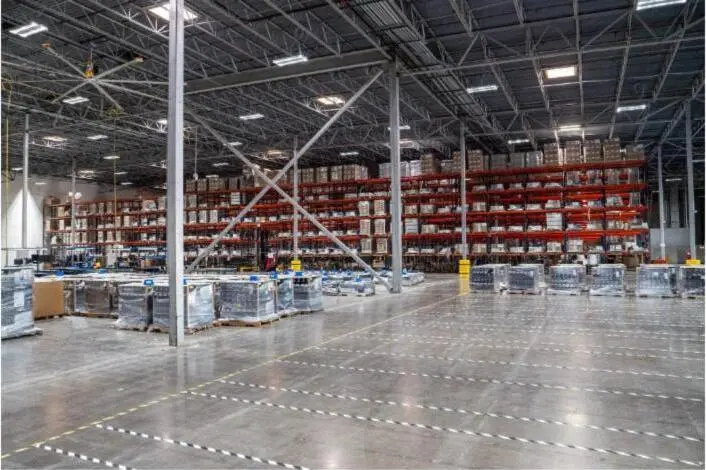
These five KPIs form the foundation because they cover the full warehouse value chain. Inventory accuracy shows what stock exists. Picking accuracy reflects what moves. On-time in-full shows what ships. Cost per order shows what it costs. Cycle count compliance shows how the operation verifies inventory.
Inventory accuracy measures the difference between book and physical counts. Picking accuracy tracks errors against lines picked. On-time in-full compares orders shipped on time and complete against total orders. Cost per order divides total warehouse operating costs by orders fulfilled. Cycle count compliance compares completed counts against planned counts.
These standard definitions work for bulk inventory, but serialized tech hardware requires stricter interpretations. Serialized environments require separate tracking of serial and lot errors from quantity misses. Unit-level traceability raises accuracy thresholds. Serial substitution counts as a miss. Reverse-flow processing costs must be allocated to the order that generated the return. A-items require weekly counts because low compliance correlates to phantom stock.
A practical warehouse KPI dashboard uses three tiers. The executive view presents high-level KPIs. The operational view focuses on process performance. The diagnostic view drills into SKU, location, shift or supplier. This separation matters because diagnostics troubleshoot root causes while KPIs steer strategic decisions. Mixing the two levels overwhelms executives with detail or leaves operators without actionable data.
Ten Network-First Principles of Warehouse Management
Classic warehouse management principles still apply at the facility level. A network-first interpretation connects each principle to multi-facility coordination and reverse flows.
- Network visibility before local optimization. Decisions at one node must account for downstream and upstream impact across all facilities.
- Serialized data as the system of record. Unit-level traceability supports compliance, warranty management and asset recovery.
- Reverse logistics as a primary flow, not an exception. Returns-driven workflows belong in the network design, not bolted on afterward.
- Algorithmic slotting over static assignment. Velocity, affinity and seasonality data should drive location decisions continuously.
- Predictive control towers over reactive dashboards. A supply chain control tower functions as an operating model first and software second.
- Multi-echelon inventory optimization. Safety stock decisions made at one node without modeling the full network create upstream overstocking and downstream stockouts.
- Labor productivity measured at the network level. Network-wide labor visibility reveals the largest improvement opportunities across facilities.
- Compliance embedded in workflow, not audited later. TAA, NIST, CMMC and OEM authorization requirements must be built into receiving, repair and disposition processes.
- Exception-based orchestration. Planners act on flagged deviations while routine decisions execute within defined parameters.
- Continuous improvement through feedback loops. Return patterns, repair trends and disposition outcomes inform upstream forecasting and product design.
Space Optimization Strategies for Serialized Tech Warehouses
High-value serialized tech hardware outgrows static slotting models quickly. Product velocity shifts with launches, warranty cycles and return waves. Algorithmic slotting treats location assignment as a continuous optimization problem instead of a periodic project.
AI-powered dynamic slotting recommends incremental SKU location swaps based on velocity, affinity, seasonality and forecasting data. This model enables a small number of high-impact moves per day during normal operations. It avoids the disruption of full reslots while capturing most efficiency gains.
Digital twin simulation validates slotting changes before any physical inventory moves. This approach removes risk and highlights high-impact moves that deliver most gains with limited relocations.
For serialized hardware specifically, slotting logic must account for compliance, condition and operational constraints that standard velocity-based models ignore.
- Serial number segregation requirements by OEM or warranty program
- Cosmetic grading zones that separate A-grade, B-grade and refurbished units
- Quarantine locations for units pending disposition decisions
- Pick-path ergonomics for heavy or fragile components
These slotting considerations only improve outcomes when the underlying data is trustworthy. Before deploying AI slotting tools, operations must audit WMS data quality because models trained on inaccurate pick history produce worse recommendations than well-maintained heuristic models. Data readiness precedes algorithm deployment.
Operational Techniques for Serialized Inventory Control
Serialized IT hardware introduces traceability requirements that standard warehouse optimization frameworks do not address. Each unit carries a unique identifier such as an IMEI, serial number or asset tag that must remain accurate through receiving, storage, configuration, repair and disposition.
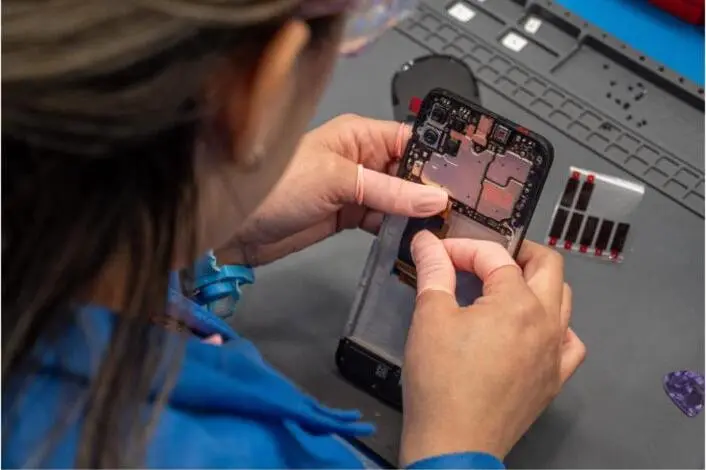
Achieving these stricter accuracy thresholds requires operational disciplines that embed serialization into every warehouse process.
Maintaining unit-level traceability across the full lifecycle requires five operational disciplines that embed serialization into every warehouse process.
- Scan-at-every-touch workflows. Every location move, repair action and disposition event captures the serial number to create a complete chain of custody.
- Lot and serial compliance KPIs. Operations track serial errors separately from quantity errors to isolate traceability failures from basic count inaccuracies.
- Clean item masters. Lot and serial flags, consistent units of measure and ABC classification form the data foundation for trustworthy accuracy, variance and compliance KPIs.
- OEM authorization integration. ASC-authorized repair workflows validate serial numbers against OEM warranty databases before repair actions begin.
- Disposition tracking through end-of-life. Secure data destruction, recycling and remarketing all require documented serial-level disposition for compliance reporting.
Network-Wide Warehouse Optimization for Large Tech Enterprises
Maximum operational impact comes from an end-to-end perspective that improves efficiency across the entire network. Single-site optimization, however well executed, leaves network-level value on the table.
Control-tower architecture provides the infrastructure for network-wide optimization. A mature control tower operates across three decision-making layers.
- Strategic network planning, covering facility roles, inventory positioning and network design
- Tactical carrier and inventory allocation, covering transfer decisions, replenishment and carrier selection
- Real-time operational orchestration, covering exception management, labor reallocation and inbound prioritization
This three-layer architecture enables AI-driven decision-making that separates early adopters from laggards. Early adopters of AI-enabled supply chain management achieve logistics cost reductions, inventory level decreases and service level improvements compared with slower competitors, per McKinsey research.
Multi-echelon inventory optimization addresses a structural problem in multi-facility networks. Safety stock decisions made at individual nodes without modeling the full system create upstream overstocking. Dynamic MEIO reduced total inventory value across a hub-and-spoke network compared with traditional single-echelon approaches, with more than half of inventory reductions occurring at the hub level, according to an MIT capstone study.
The compounding effect of network-wide optimization is significant. Small improvements in warehouse picking efficiency, when scaled across a large network of facilities and pickers, can produce substantial gains in total pick events annually. Network scale amplifies every incremental gain.
Reverse Logistics as a Value-Recovery Engine
Reverse logistics functions as a value-recovery channel, not a cost center. For tech OEMs and enterprises, returned devices carry residual value in refurbishment, component harvesting and secondary market resale. Treating returns as a primary warehouse flow rather than an exception process changes the economics of the entire operation.
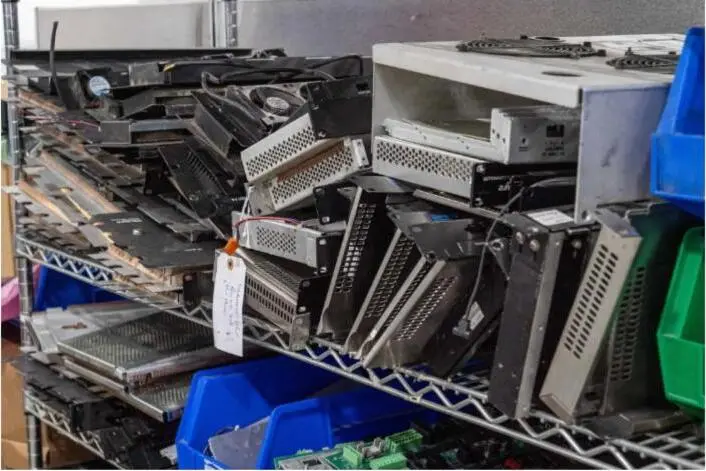
Treating returns as a primary flow rather than an exception process requires four structural changes to standard warehouse operations.
- Returns-driven receiving workflows. RMA intake, triage and grading must be sequenced into inbound dock scheduling alongside forward-flow receipts.
- Disposition decision logic. Each returned unit follows a structured decision path such as repair, refurbish, remarket, harvest or recycle with serial-level documentation at each step.
- Asset recovery as a KPI. Recovery value per returned unit belongs in the warehouse performance dashboard alongside cost per order and OTIF.
- Feedback loops to upstream planning. When reverse logistics data on return patterns, repair trends and disposition outcomes connects to upstream functions, it improves forecasting, reduces excess inventory and strengthens supply continuity.
Secure data destruction forms a nonnegotiable element of this flow for enterprise and government clients. NIST 800-88 Rev. 1 compliant data wipe processes must sit inside the returns workflow, not as a separate downstream step.
Predictive Analytics for Tech Warehouse Operations
AI-powered control towers support exception-based orchestration. The system flags deviations before they become customer-facing disruptions, and planners act on prioritized alerts instead of monitoring static dashboards.
Distribution AI forecasting improves demand planning across complex multi-warehouse networks by modeling demand as a network problem. The model evaluates relationships among nodes, products, channels and constraints instead of treating each warehouse as an isolated unit.
Effective AI forecasting architectures for multi-warehouse tech operations incorporate five categories of input data that model demand as a network problem rather than isolated warehouse forecasts.
- Historical demand, open orders and shipment patterns
- Supplier reliability and lead-time variability
- Warranty return rates and repair cycle times
- Product launch and end-of-life calendars
- External signals including market indicators and channel demand data
Human-in-the-loop workflows are required in AI forecasting deployments so planners can review forecast rationale, apply overrides with reason codes and escalate exceptions involving promotions, strategic accounts or supply disruptions. Automation handles routine decisions. Planners handle judgment calls.
The control tower architecture described earlier enables this exception-based orchestration model, where the system flags deviations before they become customer-facing disruptions.
KPI Hierarchy and Roadmap for Enterprise Warehouse Optimization
A tiered KPI hierarchy prevents local optimization that harms overall network performance. The structure maps metrics to decision levels so each audience acts on the right information.
Executive tier metrics include OTIF, perfect order rate, cost per order, network inventory accuracy and asset recovery value. VP operations and VP supply chain review these monthly.
Operational tier metrics include picking accuracy, dock-to-stock time, labor productivity, cycle count compliance and return turnaround time. Directors of operations and site managers review these weekly.
Diagnostic tier metrics include serial and lot error rate, short-pick rate, exception resolution time, putaway backlog and hold aging. Process leads and shift supervisors review these daily or by shift.
Of all the diagnostic metrics, one stands out as the best predictor of control tower maturity. Exception resolution time, the interval from alert detection to corrective action, is the single most reliable indicator of whether a control tower functions as an orchestration layer rather than a monitoring dashboard.
A 0 to 24 month roadmap structures the journey from fragmented facility metrics to a unified network operating model.
Foundation phase covers months 0 to 6. Focus areas include data readiness and baseline KPI establishment. Key deliverables include clean item masters, serial and lot flags, baseline metrics for all five core KPIs and a WMS data audit.
Integration phase covers months 6 to 12. Focus areas include control tower deployment and reverse logistics workflow integration. Key deliverables include a unified visibility layer, returns-driven receiving workflows, disposition decision logic and an MEIO pilot.
Optimization phase covers months 12 to 18. Focus areas include predictive analytics and algorithmic slotting at scale. Key deliverables include AI forecasting on high-variability SKUs, dynamic slotting deployment and network-level labor productivity tracking.
Orchestration phase covers months 18 to 24. Focus areas include autonomous exception management and continuous improvement loops. Key deliverables include exception-based orchestration, an asset recovery KPI in the executive dashboard and feedback loops to upstream planning.
How Premier Logitech Delivers Network-Wide Optimization
Premier Logitech operates as a single-source lifecycle partner for large tech OEMs, enterprises and government agencies, covering every stage from sourcing and configuration through repair, asset recovery and recycling. This end-to-end scope removes the vendor fragmentation that blocks network-wide visibility and raises total lifecycle cost.
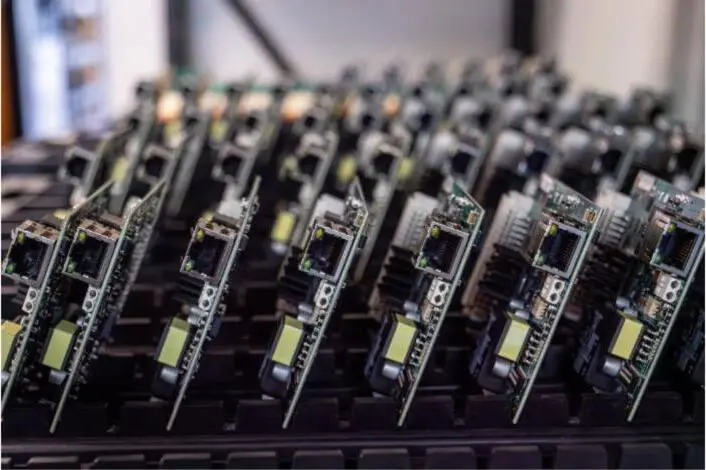
Core capabilities that support network-wide warehouse optimization include the following.
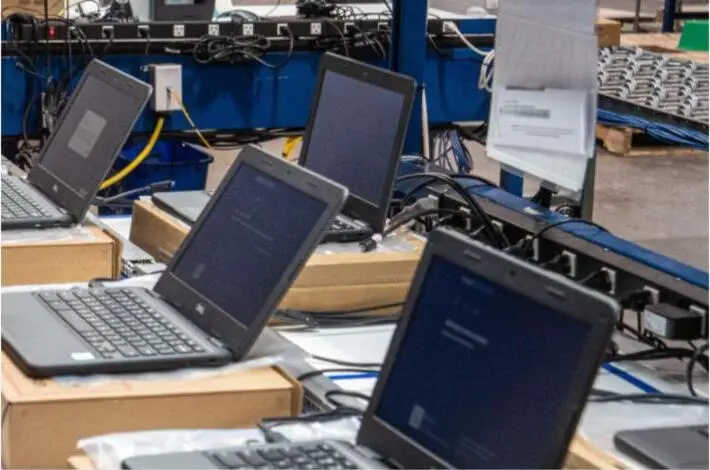
- Serialized inventory management. Asset tagging, device traceability, inventory reporting and lifecycle tracking across 3PL and 4PL warehouse operations in three DFW facilities with nearshore operations in Mexico.
- ASC-authorized repair. Depot repair at Levels 1 through 4 across more than 20 OEM authorized service centers, supporting in-warranty and out-of-warranty claims with full chain-of-custody documentation.
- Reverse logistics at scale. RMA management, triage, sorting, grading, cosmetic refurbishment, rapid exchange and responsible recycling, integrated into forward-flow warehouse operations instead of managed as a separate program.
- Configuration and fulfillment. Imaging, BIOS configuration, SIM and IMEI pairing, kitting and direct-to-consumer or B2B fulfillment with serialization at every step.
- Transportation visibility. TMS-enabled tracking across more than 120 vetted North American LTL carriers, with freight audit and logistics analytics feeding the network control layer.
- Compliance frameworks. TAA, TAPA, ISO, NIST, CMMC and SOC 2 compliance for enterprise and government programs, with CAGE Code 4WAJ9 for federal engagements.
Vendor consolidation follows naturally from this model. Organizations that manage separate providers for repair, fulfillment and recycling carry coordination overhead, data gaps and compliance risk at every handoff. Premier Logitech replaces that fragmented stack with a single accountable partner and a unified data layer.
Talk to a lifecycle expert to assess where vendor fragmentation costs the network the most.
Frequently Asked Questions
What is the difference between facility-level and network-wide warehouse optimization for tech enterprises?
Facility-level optimization improves performance within a single building through better slotting, faster pick paths and tighter labor standards. Network-wide optimization treats all facilities as a single operating system that coordinates inventory positioning, labor allocation and reverse flows across every node. The distinction matters because local gains can shift cost to transportation or inventory carrying elsewhere in the network, leaving total cost unchanged or higher. For large tech enterprises with multiple distribution points, the network model captures compounding efficiency gains that facility-level programs cannot reach.
Why does serialized inventory require a different approach to warehouse KPIs?
Standard warehouse KPIs measure quantity accuracy and throughput. Serialized IT hardware requires unit-level traceability, so every serial number must be tracked through receiving, storage, repair and disposition with a complete chain of custody. This raises the accuracy threshold and introduces additional KPIs such as serial and lot error rate, cycle count compliance by item class and disposition accuracy. OEM warranty programs and compliance frameworks including NIST and CMMC require this level of documentation, making serialized KPIs both a compliance requirement and an operational requirement.
How does integrating reverse logistics into warehouse operations improve asset recovery?
When reverse logistics functions as a primary warehouse flow rather than an exception process, returned devices move through structured triage, grading and disposition workflows with the same speed and visibility as forward-flow inventory. This structure reduces dwell time for returned units, accelerates repair and refurbishment cycles and enables faster redeployment to secondary market channels. Return pattern data also feeds upstream forecasting, which reduces excess inventory and improves supply planning. The result is higher recovery value per returned unit and lower total cost across the lifecycle.
What compliance requirements should a warehouse optimization program address for tech OEMs and government clients?
Tech OEMs and government clients typically require compliance with the Trade Agreements Act for product sourcing, NIST 800-88 Rev. 1 for data destruction, CMMC for cybersecurity practices in defense supply chains, SOC 2 for data handling controls and ISO quality frameworks for operational processes. OEM-specific requirements include ASC authorization for warranty repair and chain-of-custody documentation for serialized units. A warehouse optimization program that embeds these requirements into receiving, repair and disposition workflows reduces audit risk and closes compliance gaps that arise when separate vendors manage these processes.
How long does it take to implement a network-wide control tower for a multi-facility tech warehouse operation?
A phased implementation typically begins with data standardization and baseline KPI establishment in the first several months. The next phase covers control tower integration and reverse logistics workflow alignment. The following phase introduces predictive analytics deployment on high-variability SKUs. The final phase focuses on autonomous exception management with continuous improvement loops. The full journey from fragmented facility metrics to a unified network operating model generally spans 18 to 24 months, depending on the number of facilities, data readiness and the complexity of existing WMS and ERP integrations. Organizations that begin with a data readiness audit and clear KPI ownership at each tier move through the phases faster.
Next Steps to Consolidate Vendors and Capture Network Value
Warehouse optimization for large tech enterprises functions as a network problem, not a building problem. Organizations capturing the most value in 2026 have moved beyond facility-level tactics to treat serialized inventory management, reverse logistics, predictive control towers and compliance as a single integrated operating system.
Premier Logitech provides the end-to-end infrastructure to support this model, including ASC-authorized repair, serialized asset tracking, integrated reverse logistics, TAA and CMMC-compliant handling and TMS-enabled network visibility under one accountable partner relationship.
