Last updated: June 27, 2026
Key Takeaways for Enterprise Returns Programs
- Consumer-grade return portals fall short for enterprise IT and telecom programs that need serialized tracking, OEM-authorized repair and strict compliance.
- Enterprise returns management works best with providers that combine depot repair depth, ITAD services and integration with ERP and asset-management systems.
- Mapping volumes, asset types and disposition paths before vendor selection prevents misalignment and costly program gaps.
- Active certifications and OEM authorizations are nonnegotiable for government and regulated enterprise programs.
- Premier Logitech delivers single-source, OEM-authorized, compliance-ready infrastructure that protects value and reduces risk, so organizations can get started today.
Why Enterprise Returns Outgrow Consumer Platforms
Direct-to-consumer return platforms prioritize speed, customer experience and label generation. They handle high transaction counts but low per-unit complexity. Enterprise IT and telecom programs invert that model. Per-unit complexity is high. Each asset may carry a serial number, warranty status, data classification and disposition path that must be tracked and documented independently.
Consumer platforms typically lack OEM authorizations, so returned devices cannot be repaired under warranty terms. They do not support NIST 800-88 data destruction standards or CMMC requirements. They offer limited integration with enterprise ERP and asset management systems. They are not structured to handle depot repair, cosmetic refurbishment, grading or secondary market remarketing at program scale. For organizations managing thousands of assets per month across multiple device categories, these gaps translate directly into financial and compliance exposure. Addressing them starts with a clear view of what the program must handle.
Step 1: Map Return Volumes, Asset Types and Disposition Paths
Effective provider selection starts with a factual inventory of what is being returned, in what volumes and where those assets need to go. Asset types matter because laptops, mobile devices, networking equipment and peripherals each carry different repair complexity, data risk and recovery value. Disposition paths include repair and redeployment, refurbishment for secondary market sale, parts reclamation, responsible recycling and secure destruction.
Cross-functional stakeholders at this stage include operations, IT asset management, finance and procurement. Finance needs recovery value projections. IT needs data security assurances. Operations needs throughput and turnaround benchmarks. Mapping these inputs before evaluating providers keeps program requirements aligned with vendor capabilities.
Step 2: Define Compliance and Security Obligations
Compliance obligations vary by industry and customer type. Government agencies and their contractors must address TAA sourcing restrictions, NIST data handling standards and CMMC cybersecurity tiers. Enterprises handling sensitive data must address SOC 2 controls. Organizations operating internationally must account for trade compliance and e-waste regulations.
A provider that cannot demonstrate active certifications across required frameworks creates audit risk and potential contract liability. Stakeholders at this stage include legal, compliance and information security teams. The key decision is whether a provider holds the certifications the program requires or whether the organization must cover gaps with additional vendors, which increases cost and complexity.
Step 3: Measure Repair Depth, Refurbishment Quality and Remarketing Strength
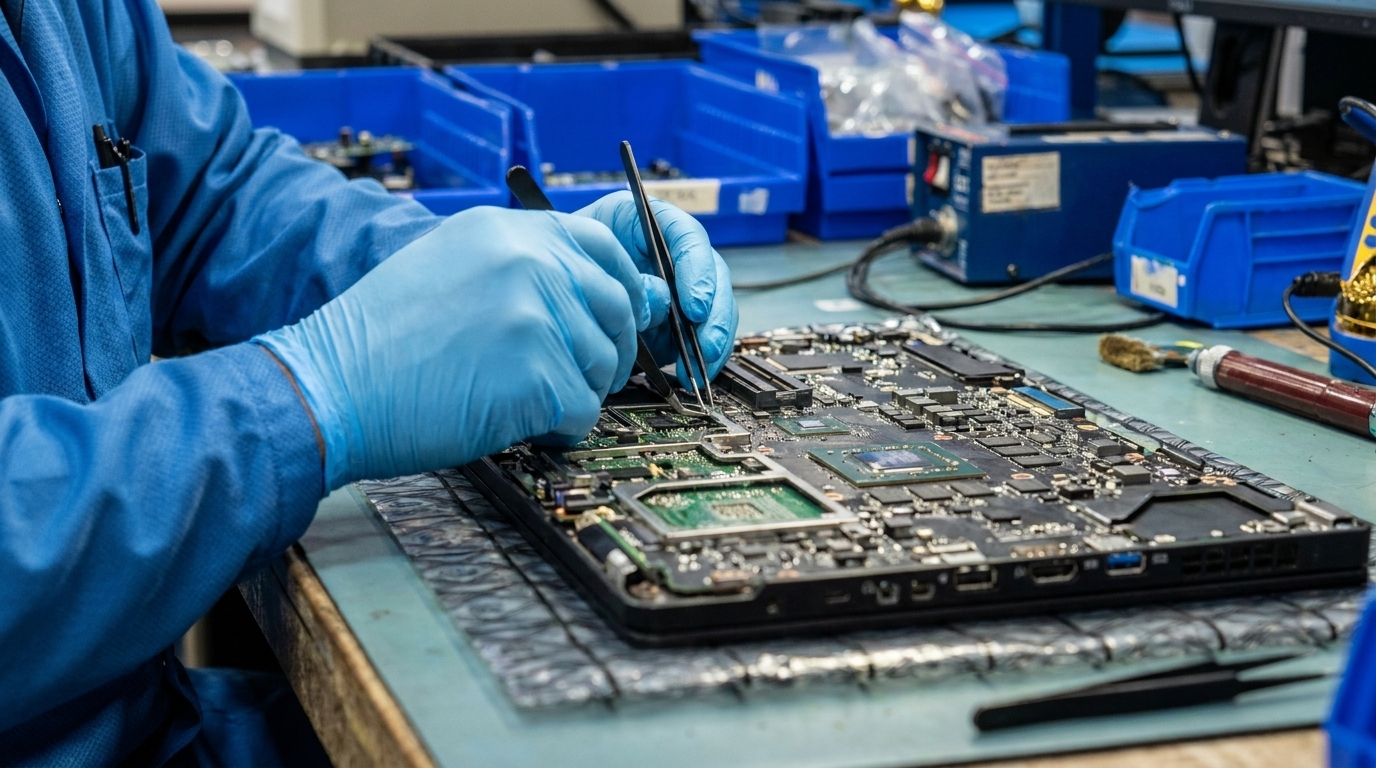
Repair depth determines how much value a provider can recover from returned assets. L1 and L2 repair covers diagnostics, software reloads and component swaps. L3 and L4 repair reaches board-level and subassembly work, which allows more assets to return to working condition instead of being scrapped. A provider limited to L1 and L2 will route repairable assets to disposal or third parties, which reduces recovery value and increases cost.
OEM Authorized Service Center status is a hard requirement for warranty repair. Without that authorization, a provider cannot perform in-warranty repairs under OEM terms, so warranty costs shift back to the program. Refurbishment and grading capabilities determine whether returned units can be sold into secondary markets. Cosmetic refurbishment, functional testing and grading against defined standards make secondary market resale viable. Stakeholders here include product management, finance and channel sales teams that depend on refurbished inventory.
Step 4: Confirm Visibility, Tracking and System Integration
Asset visibility is essential at enterprise scale. Programs managing thousands of units per month need real-time status on every asset from RMA intake through final disposition. That level of control requires a provider with a transportation management system, serialized tracking and reporting infrastructure that integrates with existing ERP and asset management platforms.
Integration depth affects daily operations. A provider that delivers data only through manual reports creates reconciliation work and slows decisions. Stakeholders at this stage include IT, operations and finance teams that rely on asset data for inventory planning, financial reporting and compliance documentation.
Talk to a lifecycle expert about how Premier Logitech tracking and reporting infrastructure supports enterprise visibility requirements.
Step 5: Match Capacity, Scalability and Geographic Coverage
Program volumes change over time. Product launches, end-of-life cycles and contract expansions create volume spikes that a provider must absorb without slowing throughput. Capacity in repair, refurbishment, warehousing and fulfillment should be evaluated against peak volume scenarios, not average monthly figures.
Geographic coverage shapes inbound logistics cost and turnaround time. A provider with facilities near major logistics hubs and access to a broad carrier network reduces transit time and freight cost. Nearshore operations can extend capacity and reduce labor cost for labor-intensive processes such as cosmetic refurbishment and kitting. Stakeholders at this stage include logistics, operations and finance teams that evaluate total program cost.
Step 6: Compare Total Cost of Ownership and Recovery Returns
Total cost of ownership for a returns management program includes more than the per-unit service fee. It includes the cost of assets that are disposed of rather than repaired, the cost of compliance gaps, the cost of fragmented vendor management and the opportunity cost of delayed asset recovery. A provider that charges less per unit but lacks repair depth or required certifications may cost more in aggregate.
Asset recovery returns depend on the provider ability to move refurbished units into secondary markets at defensible prices. That outcome requires grading consistency, channel relationships and refurbishment quality that meets buyer standards. Finance and procurement stakeholders should model recovery scenarios across disposition paths before committing to a provider.
Step 7: Run Operational Due Diligence and Reference Checks
Due diligence at this stage focuses on operations, not only contracts. Request documentation of active certifications, the OEM authorizations discussed earlier and recent compliance audit results. Ask for references from programs with comparable volume, asset types and compliance requirements. Evaluate provider financial stability and operational continuity plans.
Assess the depth of provider OEM relationships. Broad authorizations across multiple brands indicate sustained investment in training, tooling and certification maintenance. A provider with a wide OEM portfolio reduces the need for multiple repair vendors. Stakeholders at this stage include legal, procurement and senior operations leadership.
Red Flags in Enterprise Returns Providers
Several warning signs indicate a provider is not suited for enterprise IT and telecom programs. A provider without OEM authorizations cannot perform in-warranty repairs and will route repairable assets to disposal or unauthorized third parties. A provider without required certifications creates compliance exposure for government and regulated enterprise programs. A provider that cannot demonstrate serialized asset tracking and real-time reporting will create visibility gaps that affect inventory control and financial reporting.
A provider without documented data destruction capabilities and chain-of-custody reporting introduces data security risk. A provider that relies on a single facility or a narrow carrier network cannot absorb volume spikes or geographic distribution requirements. Any provider that cannot supply references from comparable programs should be removed from consideration.
Frequently Asked Questions
What is the difference between a returns management provider and a standard 3PL?
A standard third-party logistics provider manages warehousing, transportation and fulfillment. A returns management provider adds RMA processing, depot repair, data destruction, refurbishment, grading and remarketing. For enterprise IT and telecom programs, repair and compliance capabilities serve as the critical differentiators, not warehousing or freight alone.
When should an organization consolidate to a single returns management provider?
Vendor consolidation becomes a priority when fragmented relationships across repair, fulfillment and recycling vendors create visibility gaps, inconsistent compliance documentation or cost inefficiencies. A single-source provider with end-to-end capabilities reduces coordination overhead, simplifies compliance reporting and creates a single point of accountability for program performance.
What compliance certifications should a returns management provider hold for government programs?
Government programs typically require TAA compliance for sourced products, NIST 800-88 conformance for data destruction, CMMC certification for programs involving controlled unclassified information and SOC 2 attestation for data handling practices. Providers serving federal customers should also hold a CAGE Code, which identifies them as pre-vetted for government contracting.
How does OEM ASC status affect a returns management program?
As noted in Step 3, OEM Authorized Service Center status enables in-warranty repairs under OEM terms instead of routing units to outside parties. It also signals that the provider meets OEM standards for technician training, tooling and quality control, which supports consistent refurbishment quality and stronger secondary market value.
What factors most affect asset recovery value in a returns management program?
Recovery value depends on repair depth, refurbishment quality, grading consistency and the speed at which assets reach secondary market channels. Assets that sit in processing queues lose value as market prices decline. A provider with high-volume repair capacity, cosmetic refurbishment capabilities and established remarketing channels recovers more value per unit than one that routes assets to recycling by default.
Conclusion: Building a Returns Program That Protects Value
Selecting a returns management provider for enterprise IT and telecom assets is a structured decision with measurable consequences for cost, compliance and asset value. The evaluation framework above maps volume and disposition requirements, identifies compliance obligations, assesses repair and remarketing depth, evaluates visibility infrastructure, tests scalability, analyzes total cost and validates provider credentials through due diligence.
Premier Logitech operates as a single-source, OEM-authorized, government-compliant partner for organizations managing complex IT and telecom asset lifecycles. With OEM authorizations across multiple brands, required compliance frameworks and end-to-end capabilities from RMA intake through responsible recycling, Premier Logitech aligns with the requirements this framework identifies.
Talk to a lifecycle expert at Premier Logitech to begin a program assessment.
