Last updated: June 28, 2026
Key Takeaways for OEM-Authorized Depot Repair
- An Authorized Service Center (ASC) is an OEM-certified repair facility that meets strict technical, tooling, staffing and documentation standards before performing warranty or post-warranty repairs.
- ASC status is brand specific, so organizations with multi-brand fleets benefit from partners that hold multiple OEM authorizations to reduce vendor handoffs and maintain warranty validity.
- Depot repair uses a centralized model for high-volume device returns, which supports consistent quality controls, OEM-genuine parts access and integration with broader reverse logistics workflows.
- Repair work is structured across four service levels (L1–L4), ranging from basic diagnostics to advanced PCB-level repair, with Premier Logitech authorized to perform all levels across its DFW and nearshore Mexico facilities.
- Premier Logitech provides multi-brand ASC authorizations, L1–L4 repair capabilities and full compliance certifications—consolidate an OEM repair program with a single ASC partner.
How ASC Status Works in IT and Electronics Service Centers
In the IT and electronics industry, OEMs grant ASC designation to third-party service organizations that meet defined qualification criteria. Those criteria cover technician certification, approved parts sourcing, diagnostic tooling, facility security and quality management processes.
ASC status carries direct warranty implications. When a non-authorized facility repairs a device, the OEM warranty on that unit is often voided. For operations and supply chain leaders managing high-volume return programs, routing devices through unauthorized repair channels creates downstream liability, including rejected warranty claims, parts traceability gaps and potential contractual exposure with OEM partners.
Authorization is brand specific. A facility authorized by one OEM is not automatically authorized by another. Organizations managing multi-brand device fleets must either maintain separate vendor relationships for each brand or consolidate with a partner that holds multiple ASC authorizations. Premier Logitech holds ASC authorization with multiple OEM brands, which reduces the number of handoffs required across a mixed-brand repair program.
ASC status also affects parts access. Authorized centers receive OEM-genuine replacement components, firmware and repair documentation that are not available to the open market. That access directly affects repair quality, device performance after repair and warranty reinstatement eligibility.
Consolidate a multi-brand repair program with a single ASC partner.
Depot Repair Services in OEM-Authorized Environments
ASC authorization applies primarily within depot repair environments, where centralized facilities handle high volumes of warranty and post-warranty work. Depot repair is a centralized repair model in which defective or returned devices are shipped to a fixed facility for diagnosis, repair and return.
Depot repair differs from field service, where a technician travels to the device location. In a depot model, devices move through a defined intake and triage process. Each unit is received, logged, assessed against warranty eligibility, diagnosed, repaired or replaced, tested and returned to the originating party or redirected into a secondary channel.
The centralized structure supports higher repair volumes, consistent quality controls and better parts inventory management than distributed field repair. For OEMs and telecom providers managing warranty return programs, depot repair is the standard operating model.
Depot repair supports RMA management, in-warranty and out-of-warranty claim processing, cosmetic refurbishment, grading and end-of-life disposition within a single operational flow. It also integrates with broader reverse logistics programs, so returns processing, sorting, data destruction, parts reclamation and responsible recycling can occur within the same facility or campus, which reduces transit steps and improves asset traceability.
Depot Repair Service Levels L1–L4
Depot repair work is structured across four service levels, each representing a deeper degree of technical intervention. The appropriate level depends on the failure type, device category and OEM repair authorization scope.
- L1 — Basic diagnostics and software: Functional testing, software reloads, firmware updates, configuration resets and cosmetic inspection. No hardware disassembly is required. L1 work is typically performed by technicians following scripted procedures.
- L2 — Component replacement: Replacement of field-replaceable units such as batteries, screens, keyboards and storage drives. This level requires access to OEM-approved parts and basic disassembly. L2 is the most common level in consumer electronics and mobile device programs.
- L3 — Board-level and subassembly repair: Diagnosis and repair at the subassembly level, including motherboard component replacement, connector repair and module-level swap. This level requires certified technicians, specialized tooling and OEM technical documentation.
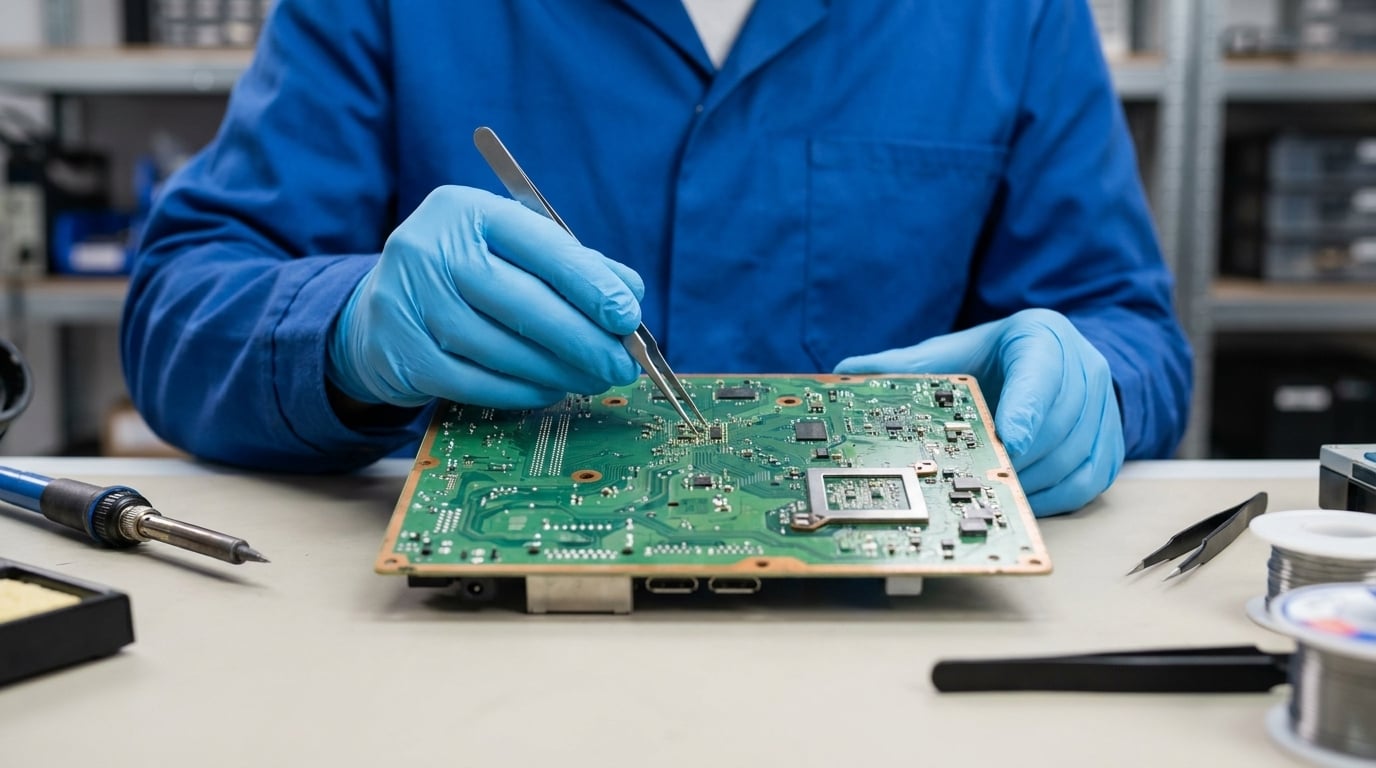
- L4 — Deep component and PCB-level repair: Micro-soldering, BGA reballing, PCBA rework and chip-level diagnostics. L4 repair requires advanced equipment and the highest technician certification tier. Not all ASC partners receive authorization to perform L4 work across all brands.
Premier Logitech performs L1 through L4 depot repair across its DFW facilities and nearshore Mexico operations.
Steps in the ASC Warranty Repair Authorization Process
OEM warranty repair authorization follows a formal credentialing process. Requirements vary by brand, but the general framework remains consistent across the IT and electronics sector.
The authorization process typically involves the following elements.
- Application and business review: The OEM evaluates the repair facility’s operational history, financial standing and existing service capabilities.
- Facility audit: The OEM or its designated auditor inspects the facility for physical security, environmental controls, ESD compliance and parts storage standards.
- Technician certification: Technicians complete OEM-specific training programs and pass certification exams. Certifications are typically renewed on an annual or biennial basis.
- Tooling and parts approval: The facility demonstrates access to OEM-approved diagnostic tools and commits to sourcing replacement parts through authorized channels.
- Documentation and reporting: Authorized centers submit repair data, warranty claim documentation and quality metrics to the OEM on a defined schedule.
Maintaining authorization requires ongoing compliance. OEMs conduct periodic re-audits and can revoke ASC status for documentation failures, parts sourcing violations or quality metric shortfalls. For operations leaders, a depot partner’s authorization history and audit record matter as much as its repair capacity.
Review a program’s authorization requirements with the Premier Logitech team.
Evaluating a Single OEM-Authorized Depot Repair Partner
Selecting an ASC depot repair partner involves more than confirming authorization status. The following engagement process reflects how operations and supply chain leaders can structure the evaluation.
- Map the brand portfolio: List every OEM brand in the return program and confirm which require ASC-authorized repair to maintain warranty validity.
- Verify authorization scope: Confirm that the candidate partner holds active ASC status for each brand and at the repair levels required by the program.
- Assess volume capacity: Match the partner’s weekly repair throughput against peak return volumes in the program. Capacity gaps create backlog and extend device-out-of-service windows.
- Review compliance posture: Confirm that the partner meets the security and regulatory frameworks required by the customer base, particularly for government or enterprise programs.
- Evaluate logistics integration: A partner with in-house transportation management, carrier relationships and nearshore operations can reduce transit steps and improve end-to-end cycle times.
- Define program scope and SLAs: Align on intake procedures, repair routing logic, reporting cadence and escalation paths before program launch.
Premier Logitech operates three DFW facilities and nearshore operations in Laredo and Nuevo Laredo, Mexico, supported by a network of more than 120 LTL carriers in North America. The combination of geographic positioning and multi-brand ASC authorization supports single-vendor consolidation for complex, high-volume programs.
Compliance and Security Standards for U.S. Depot Repair
For enterprise and government programs, compliance is a nonnegotiable selection criterion. The relevant frameworks for U.S.-based depot repair partners include the following.
- TAA (Trade Agreements Act): Required for federal procurement programs. Confirms that products and services originate from designated countries.
- NIST (National Institute of Standards and Technology): Provides the cybersecurity and data-handling framework for organizations that manage federal or sensitive commercial data.
- CMMC (Cybersecurity Maturity Model Certification): Required for defense contractors and their supply chain partners that handle controlled unclassified information.
- SOC 2: An auditing standard covering security, availability and confidentiality controls relevant to service organizations that handle customer data.
- ISO 9001/14001: Quality management and environmental management standards that govern repair process consistency and responsible disposition practices.
Premier Logitech holds TAA compliance, TAPA certification, ISO quality framework alignment, NIST and CMMC compliance and SOC 2 certification. The company also holds CAGE Code 4WAJ9, which designates it as a pre-vetted partner for U.S. federal government programs.
ASC Programs in IT and Electronics Versus Other Industries
The term “ASC” appears across military, automotive and medical device industries, each with distinct regulatory frameworks. Military depot repair operates under Department of Defense maintenance tiers and ITAR controls. Automotive ASC programs are governed by dealer network agreements and OBD diagnostic standards. Medical device repair falls under FDA 21 CFR Part 820 quality system regulations.
IT and electronics depot repair operates under OEM-specific authorization programs, commercial quality standards and data security frameworks. The compliance requirements, parts traceability expectations and technician certification structures are specific to this sector. Guides or vendor claims drawn from military or automotive contexts do not translate directly to IT and electronics program requirements.
Frequently Asked Questions About ASC and Depot Repair
What is the difference between an ASC and an independent repair shop?
An ASC has been formally authorized by the OEM and meets its technical, tooling and documentation standards. An independent repair shop operates without that authorization, which typically means no access to OEM-genuine parts, no warranty reinstatement eligibility and no OEM audit oversight.
Can a single depot partner hold ASC authorization for multiple OEM brands?
A depot repair facility can pursue and maintain ASC authorization with multiple OEMs simultaneously. Each authorization is obtained and maintained independently. Premier Logitech holds active ASC authorization with multiple OEM brands.
What happens to devices that cannot be repaired at the depot?
Devices that are beyond economical repair move to disposition workflows, which may include parts reclamation and harvesting, responsible recycling or secure data destruction and e-waste processing. Premier Logitech manages all disposition stages within its reverse logistics program.
How does depot repair integrate with a broader reverse logistics program?
Depot repair functions as one stage within a reverse logistics flow that also includes RMA intake, triage, sorting, grading, refurbishment, redeployment and end-of-life recycling. A single partner that manages all stages removes inter-vendor handoffs and improves asset traceability across the full return cycle.
What compliance documentation should a depot repair partner provide?
Partners should provide current certificates for applicable frameworks such as TAA, ISO, NIST, CMMC and SOC 2, along with repair reporting, chain-of-custody documentation and data destruction certificates where applicable.
Next Step for ASC-Authorized Depot Repair Programs
Premier Logitech has delivered IT lifecycle and depot repair services since 2007. The company’s multiple OEM ASC authorizations, multi-level repair capabilities, DFW hub, nearshore Mexico operations and verified compliance posture support single-vendor consolidation for OEMs, telecom providers and enterprise programs that manage high-volume device returns.
Get started with a depot repair and reverse logistics program.
