Last updated: July 10, 2026
Key Takeaways for Enterprise Charging Port Repair
- Enterprise charging port repair at scale requires structured depot capabilities, compliance documentation and end-to-end reverse logistics, not fragmented consumer-style fixes.
- Repair-versus-replace decisions should follow the 50% rule and CMARV analysis, which show that charging port repairs on mid-cycle devices deliver strong ROI through asset recovery and reduced replacement spend.
- Outsourcing to an OEM-authorized partner converts fixed costs into variable pricing while supporting warranty compliance, SOC 2, CMMC and other certifications that in-house programs struggle to maintain.
- L1-L4 depot repair, rapid exchange programs and real-time visibility reduce total cost of ownership by cutting vendor handoffs, lost devices and missed remarketing revenue.
- Premier Logitech provides a complete solution for enterprise fleets; talk to a lifecycle expert to scale a depot repair program.
Why Enterprise Charging Port Repair Requires a Different Approach
Consumer walk-in repair shops solve a single-device problem. Enterprise fleets present a different challenge with hundreds or thousands of devices returning through RMA channels at the same time. Each device requires triage, repair authorization, compliance documentation and disposition tracking.
Fragmented vendor networks increase that complexity. When repair, refurbishment, data destruction and remarketing sit with multiple providers, visibility drops. Devices sit in queues. Recovery value erodes. Compliance gaps appear at every handoff.
Charging port failures rank among the most common hardware defects in mobile device fleets. At scale, they drive unnecessary replacement spend, inflate return volumes and reduce secondary market value. A device with a failed charging port that is replaced instead of repaired represents lost asset recovery value. A structured depot repair program captures that value.
The global enterprise IT asset disposition market is valued at US$8.8 billion in 2026 and is projected to reach US$19.1 billion by 2033, growing at a CAGR of 11.7%. That growth reflects how seriously enterprises treat asset recovery and how costly replace-first decisions become at scale.
Repair-Versus-Replace Economics for Fleet Charging Ports
Given the value at stake, the repair-versus-replace decision at enterprise scale requires structured financial analysis, not ad hoc judgment. Two frameworks guide that analysis.
The first is the 50% rule. If a single repair costs more than 50% of the asset replacement value, the financial case for replacement is generally stronger. For charging port repairs on mid-cycle mobile devices, repair cost typically falls well below that threshold. That cost profile makes repair the defensible choice.
The second is CMARV, or Corrective Maintenance to Replacement Asset Value. When annual corrective maintenance cost approaches 40–60% of an asset current replacement value, the economic replacement case is established. World-class CMARV sits below 3% of replacement asset value. A device fleet with CMARV trending upward signals that stronger repair program discipline, not automatic replacement, is the intervention needed.
The asset recovery opportunity mentioned earlier becomes concrete when examining remarketing data. Remarketing and value recovery is the fastest-growing segment in the ITAD market, accounting for nearly 28% of the market by 2025. Devices repaired and returned to secondary market channels generate revenue. Devices scrapped generate disposal costs. The difference between those outcomes, multiplied across a fleet, is material.
Comparing In-House and Outsourced Depot Repair Models
Running depot repair in-house requires fixed investment in technician headcount, facility space, tooling, compliance infrastructure and OEM authorization maintenance. Those costs remain fixed regardless of return volume. Fixed costs create margin pressure during low-volume periods and capacity constraints during peaks.
Outsourcing converts fixed costs into variable, per-unit pricing. A qualified provider can reduce costs compared with a comparable in-house program at the same volume. The operational burden of technician hiring, facility management and compliance oversight shifts to the partner.
Partner qualification becomes the critical variable in that model. An outsourced depot repair provider without OEM authorization cannot perform warranty-compliant repairs. A provider without SOC 2 or CMMC certification cannot handle government or regulated enterprise devices. Selecting an unqualified partner trades one operational risk for another.
SLA alignment carries equal importance because turnaround time directly affects fleet availability. Standard industry turnaround for depot repair ranges from several business days to two weeks depending on repair complexity and program structure. Advance exchange programs exist to compress that window for high-priority fleet devices by shipping replacements before repairs complete. To keep these timelines consistent at scale, any outsourced program should define first-pass yield targets, escalation paths for L3-L4 repairs and reporting cadences before go-live.
OEM Authorization and Compliance for Enterprise Repair Programs
OEM authorization is not a differentiator; it is a prerequisite. Repairs performed outside an authorized service center network void warranties, create liability exposure and may violate carrier or enterprise procurement agreements. For government agencies, unauthorized repair can trigger compliance failures under NIST and CMMC frameworks.
Premier Logitech holds ASC status for more than 20 OEM brands. That authorization covers the repair procedures, parts sourcing and quality standards that OEMs require for warranty-compliant service. Providers without ASC status cannot offer the same compliance assurance, regardless of technical capability.
Enterprise and government programs also require a broader compliance stack that includes TAA, NIST, CMMC and SOC 2. Premier Logitech maintains certifications across these frameworks along with ISO quality standards. The company CAGE Code 4WAJ9 identifies it as a pre-vetted partner for U.S. federal government programs.
Compliance certifications also govern data handling. Devices returned for charging port repair may contain sensitive data. Secure data destruction and sanitization must sit inside the repair workflow, not as a separate downstream step. Data destruction and sanitization accounts for a significant share of the North America ITAD market, driven by data privacy regulations and cybersecurity requirements.
Premier Logitech Service Scope and Technical Scale
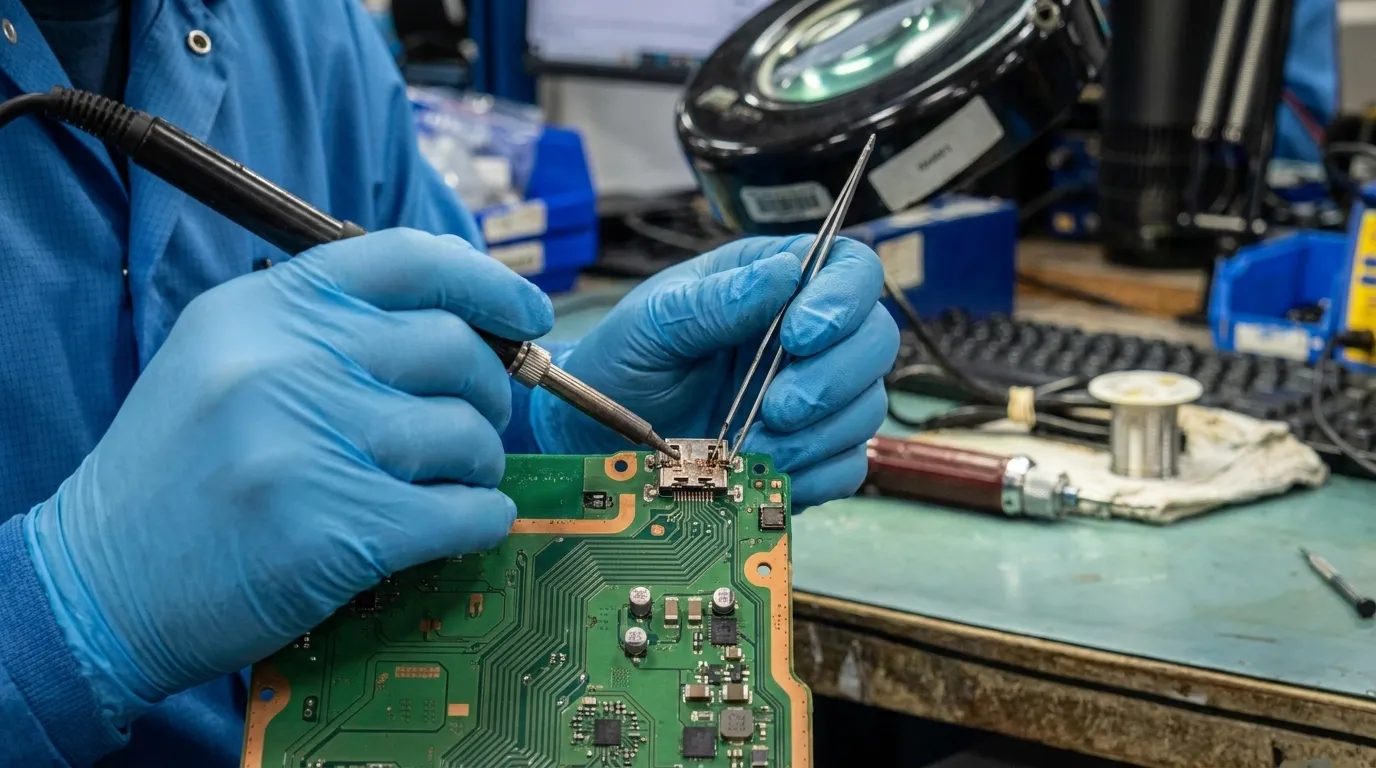
Premier Logitech depot repair capabilities span L1 through L4. The range covers cosmetic triage and software resets at the entry level through component-level board repair and charging port replacement at the advanced level. That range allows a single partner to handle the full spectrum of return conditions without routing devices to secondary vendors.
Repair capacity supports high-volume programs across Premier Logitech DFW facilities and nearshore operations in Laredo and Nuevo Laredo, Mexico. That scale supports OEM warranty programs, carrier return volumes and enterprise fleet refresh cycles without the queue delays that constrain smaller providers.
Rapid exchange programs ship a working unit before the defective unit is returned, which maintains fleet uptime while the repair cycle completes in the background. To support this model, RMA intake, serial verification and routing into refurbishment or recovery workflows must run in parallel. That requirement makes integration with existing RMA systems a core part of program setup, not an afterthought.
Parts reclamation and harvesting extend recovery value further. Components from devices that cannot be economically repaired are harvested for use in other repairs. Harvesting reduces parts procurement costs and supports circular economy commitments.
Visibility, Network Coverage and Total Cost of Ownership
Total cost of ownership for a depot repair program includes more than per-unit repair cost. It also includes inbound and outbound transportation, inventory holding time, data destruction, compliance reporting, remarketing proceeds and the cost of unrepaired devices that become write-offs.
Premier Logitech Transportation Management System provides real-time tracking across the repair lifecycle. Inventory reporting and device traceability give operations teams visibility into where each unit sits, what its repair status is and when it will be available for redeployment or remarketing. That visibility reduces the hidden costs of lost devices, stalled queues and unreconciled RMA credits.
The DFW logistics hub provides proximity to one of the world busiest air cargo networks. Nearshore operations in Mexico enable cost-competitive labor for high-volume, labor-intensive repair workflows without sacrificing compliance or quality standards. That geographic footprint supports both domestic and cross-border program structures.
Vendor consolidation reduces TCO further. Replacing fragmented repair, fulfillment and recycling providers with a single partner removes redundant onboarding costs, contract management overhead and the compliance gaps that appear at vendor handoffs.
Frequently Asked Questions
Charging Port Repair Costs at Enterprise Scale
Enterprise depot repair pricing is structured on a per-unit basis. Pricing varies based on device model, repair level, volume commitments and program structure. Unlike consumer walk-in pricing, enterprise programs incorporate RMA processing, compliance documentation, data handling and reporting into the per-unit cost. The relevant comparison is the total repair program cost against replacement value and secondary market recovery. That calculation favors repair for mid-cycle devices with repairable port failures.
Repair Versus Replacement Decisions for High-Volume Fleets
For most mid-cycle mobile devices with charging port failures, repair is the economically sound choice. The 50% rule, which recommends replacement when repair cost exceeds 50% of replacement value, rarely applies to charging port repairs because they are component-level interventions. The stronger argument for repair comes from asset recovery. A repaired device returned to secondary market channels generates revenue, while a replaced device generates disposal cost. At fleet scale, that difference is significant.
The decision becomes more complex for devices approaching end of economic life or with recurring failure histories. That complexity makes a structured triage process at intake essential.
Compliance Standards for OEM-Authorized Depot Repair
OEM-authorized depot repair programs operate under a layered compliance framework. OEM authorization governs repair procedures, parts sourcing and warranty validity. Data security compliance, including NIST SP 800-88 for media sanitization and SOC 2 for operational controls, governs device handling and data destruction. Government programs add CMMC and TAA requirements. Environmental compliance, including ISO 14001 and responsible recycling standards, governs disposition of non-repairable devices and harvested components. A qualified depot repair partner maintains certifications across all of these layers, not just one or two.
How Rapid Exchange Programs Connect to Existing RMA Workflows
Rapid exchange programs operate within existing RMA workflows rather than replacing them. Integration typically involves API or EDI connections between the enterprise RMA management system and the depot partner inventory and tracking platform. When a device is flagged for exchange, the depot ships a refurbished replacement unit while the defective unit returns through the existing RMA channel. Serial number tracking, condition grading and disposition routing happen at the depot, with reporting fed back into the enterprise system of record. Program setup defines escalation paths, return windows and penalty structures for unreturned units.
Conclusion: Centralizing Enterprise Charging Port Repair with One Authorized Partner
Enterprise charging port repair functions as a supply chain discipline, not a consumer service. The economics favor repair over replacement for mid-cycle devices. The compliance requirements demand OEM authorization and a certified compliance stack. The operational requirements demand scalable depot capacity, real-time visibility and seamless RMA integration.
Premier Logitech delivers these capabilities under one roof with ASC status for more than 20 OEM brands, L1–L4 depot repair, TAA, NIST, CMMC and SOC 2 certifications, rapid exchange programs and end-to-end reverse logistics from intake through remarketing. For OEMs, carriers and enterprise fleet operators managing high return volumes, that combination removes fragmentation, compliance risk and missed recovery value.
Talk to a lifecycle expert and build a depot repair program that scales with enterprise fleets.
