Last updated: July 11, 2026
Key Takeaways for Enterprise IT Repair Depots
- Enterprise IT repair depots consolidate fragmented vendor relationships into a single accountable partner, which reduces downtime and compliance gaps for high-volume corporate fleets.
- Depot operations follow a structured L1–L4 repair process with documented chain-of-custody, quality checkpoints and OEM-authorized service capabilities across laptops, servers, POS systems and peripherals.
- Key benefits include faster turnaround, vendor consolidation, asset recovery through refurbishment, conversion of fixed costs to variable costs and real-time serial-level visibility.
- Compliance frameworks such as TAA, NIST SP 800-88, CMMC, SOC 2, ISO 9001/14001 and PCI DSS support government, healthcare and financial services programs that handle sensitive data.
- Premier Logitech delivers end-to-end lifecycle services with ASC authorization across 20+ OEM brands. Schedule a lifecycle consultation to consolidate an existing depot repair program.
Enterprise IT Repair Depots for Centralized Hardware Service
An enterprise IT repair depot is a centralized facility that receives, diagnoses, repairs and returns corporate hardware at scale. It operates under defined service levels, documented chain-of-custody controls and, in many cases, OEM authorization that permits warranty-compliant repairs.
Depot repair programs typically cover a broad range of device categories, which allows organizations to consolidate repair operations across the entire hardware fleet instead of managing separate vendors for each device type:
- Laptops and Chromebooks
- Servers and data center hardware
- Point-of-sale (POS) systems and payment terminals
- Mobile scanners and handheld devices
- Printers and peripherals
- Networking and communications equipment
Enterprise and government programs require depot partners to operate within recognized compliance frameworks that address sourcing, data security and operational controls. These frameworks appear in more detail in the Compliance and Security Considerations section below.
How the Enterprise Depot Repair Process Operates
A structured depot repair process moves devices through defined stages, each with quality checkpoints and documentation. The standard flow follows this sequence:
- RMA intake. The facility receives the device, logs it and assigns a unique identifier. Chain-of-custody documentation begins at this step.
- Triage and diagnosis. Technicians assess the device and classify the repair level required.
- L1: Basic troubleshooting. Teams perform software resets, OS reimaging, firmware updates and configuration corrections.
- L2: Component replacement. Technicians swap field-replaceable units such as batteries, keyboards, displays and storage drives.
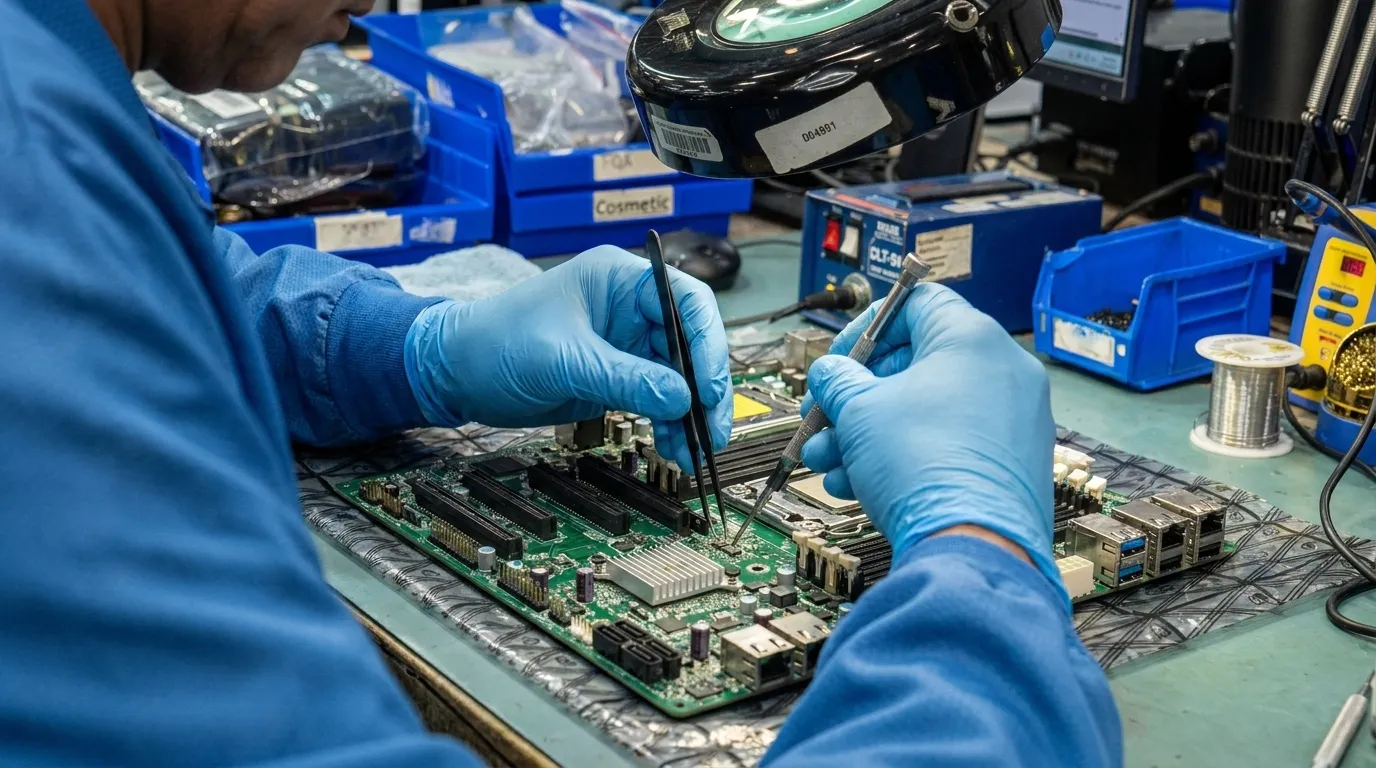
- L3: Board-level repair. Work includes soldering, BGA rework, fine-pitch device replacement and component-level diagnostics.
- L4: Engineering-level repair. Engineers handle reverse engineering, test fixture development, root cause analysis and depot-to-OEM escalation for complex failures.
- Quality assurance and testing. Teams complete functional and cosmetic verification before the device is cleared for return or redeployment.
- Outbound logistics. Staff manage packaging, labeling and return shipment under the program SLA.
Premier Logitech operates this process at scale across three DFW facilities with nearshore operations in Laredo and Nuevo Laredo, Mexico. With that multi-brand authorization and a repair capacity that supports enterprise and government programs, the program serves organizations that cannot absorb volume spikes or extended downtime.
Key Benefits of High-Volume Enterprise IT Repair Solutions
Consolidating depot repair under a single authorized partner produces measurable operational improvements across several dimensions.
Reduced downtime. Organizations consolidating to a dedicated depot partner report hardware downtime reductions compared to fragmented repair models. Manufacturer RMA processes often involve multiweek waits, while a purpose-built depot with stocked FRUs and rapid exchange programs shortens that window.
Vendor consolidation. Managing separate vendors for repair, refurbishment, data destruction and recycling creates coordination overhead and accountability gaps. A single-partner model removes that friction. Premier Logitech replaces multiple vendor relationships with one program that covers intake through end-of-life disposition.
Asset recovery. That end-to-end scope also enables asset recovery. Devices that cannot return to primary service can be graded, refurbished and routed to secondary market channels. Premier Logitech certified refurbishment and grading capabilities support resale programs that recover value from returned inventory instead of writing it off.
Operational efficiency. Outsourced depot repair converts fixed infrastructure costs, such as tooling, bench equipment, parts inventory, facility space and technical workforce, into variable costs that move with actual repair volume. That structure allows operations teams to scale without new capital investment.
Real-time visibility. Premier Logitech provides serial-level tracking, repair history and inventory reporting through a single operational view. Supply chain and logistics leaders gain the visibility needed to manage SLAs, forecast parts demand and report on program performance.
Connect with a lifecycle specialist about consolidating depot repair services under one partner.
Compliance and Security Considerations for Depot Repair Services
Enterprise and government hardware carries data, credentials and configuration information that must be handled under documented controls. Compliance requirements vary by industry and customer type, but several frameworks apply broadly to depot repair operations.
Data destruction. NIST SP 800-88 defines media sanitization standards for federal and enterprise environments. For devices handling sensitive data, physical destruction removes recovery risk entirely. Premier Logitech supports secure data destruction and provides compliance reporting aligned to NIST, CMMC and SOC 2 requirements.
Chain-of-custody documentation. Every device must remain traceable from intake to disposition. Gaps in chain-of-custody create audit exposure and, in government programs, potential contract violations. Premier Logitech asset tagging, serialization and inventory reporting systems maintain that documentation at every stage.
Payment hardware. Depots servicing POS terminals, PIN entry devices or ATM components operate within PCI DSS and PCI PTS requirements, which define security controls for environments that store, process or transmit cardholder data. Service providers handling payment hardware fall under these standards as part of the broader cardholder data environment.
Government and defense programs. Federal contractors and defense supply chain participants require CMMC certification and TAA-compliant sourcing. Premier Logitech holds a CAGE Code (4WAJ9), which confirms pre-vetted status as a U.S. federal government partner. The company compliance posture covers TAA, TAPA, ISO 9001/14001, NIST, CMMC and SOC 2.
Healthcare and financial services. HIPAA requires physical safeguards for systems handling protected health information, and PCI DSS requires physical access restrictions for systems handling cardholder data. Depot partners serving these sectors must demonstrate documented controls, not only certifications.
Checklist for Choosing an Enterprise IT Repair Partner
Selecting a depot repair partner requires evaluation of capabilities across six dimensions. The following checklist supports that assessment.
Service scope.
- Covers L1 through L4 repair levels
- Supports rapid exchange and next-day replacement programs
- Handles end-of-life disposition, including secure data destruction and responsible recycling
Technical capabilities.
- OEM Authorized Service Center (ASC) status for relevant device brands
- Component-level repair including BGA rework and fine-pitch device replacement
- Certified refurbishment and grading for secondary market channels
Compliance posture.
- TAA, NIST, CMMC and SOC 2 documentation available for review
- ISO 9001 and ISO 14001 certifications in place
- PCI DSS controls for payment hardware programs
- CAGE Code or equivalent government pre-vetting
Scalability.
- Demonstrated capacity to absorb volume spikes without extending SLA windows, supported by cross-trained staff and redundant workstations
- Modular engagement model that supports individual services and expansion to full lifecycle coverage as volumes grow
- Nearshore or multisite operations for geographic redundancy, which maintains continuity if a single facility experiences disruption
Visibility and reporting.
- Serial-level tracking from intake to disposition
- Real-time inventory and repair status reporting
- Integration capability with customer ERP or CRM systems
Total value.
- Single-vendor consolidation that replaces multiple repair, fulfillment and recycling providers
- Asset recovery and remarketing programs that offset program costs
- Executive-level engagement and a dedicated point of contact
Premier Logitech meets each criterion on this list. The company ASC-authorized repair network, government-grade compliance posture, high weekly repair capacity and single-partner model support the scale and accountability that enterprise and government programs require. As depot repair evolves alongside device proliferation and sustainability requirements, the ability to manage the full lifecycle, from repair through responsible recycling, becomes a core selection criterion.
Conclusion: Next Steps for Operations and Supply Chain Leaders
The evaluation framework above aligns with the operational risks that fragmented depot repair creates, including compliance exposure, limited visibility, vendor accountability gaps and inability to scale. The first step involves mapping current repair flows, identifying which vendors handle each device type, where chain-of-custody documentation is incomplete and where SLA performance is inconsistent.
The second step involves engaging internal stakeholders, including operations, IT security, procurement and legal, to align on compliance requirements before issuing an RFP. Government and enterprise programs often surface CMMC, TAA or PCI requirements late in the process, which restricts partner options.
Premier Logitech is structured to support that conversation from the start. With end-to-end lifecycle services, the ASC coverage mentioned earlier and a compliance posture that covers federal, enterprise and commercial requirements, the company operates as a single partner across the full device lifecycle.
Schedule a consultation to map current repair flows and identify consolidation opportunities.
Frequently Asked Questions
What is the difference between depot repair and field service repair?
Depot repair involves shipping devices to a centralized facility where technicians perform diagnosis, component-level repair and quality testing before returning the device. Field service repair sends a technician to the device location for on-site work. Depot repair suits high-volume programs where devices can be exchanged or temporarily replaced, because it allows deeper diagnostic work, controlled environments and consistent quality processes. Enterprise programs often combine both models, using rapid exchange to keep users productive while devices move through the depot.
How does an Authorized Service Center differ from a third-party repair provider?
An Authorized Service Center (ASC) has a formal agreement with an OEM that permits warranty-compliant repairs using genuine parts, certified tooling and OEM-approved processes. Third-party repair providers operate without that authorization, which means repairs may void device warranties and may not meet OEM quality standards. For enterprise programs that manage devices under active warranties, ASC status functions as a prerequisite, not a preference. Premier Logitech holds ASC authorization across multiple OEM brands, which covers a broad range of enterprise device categories.
What compliance frameworks apply to enterprise IT repair depots handling government hardware?
Government hardware programs typically require alignment with the Trade Agreements Act for sourcing, NIST SP 800-88 for media sanitization, CMMC for defense supply chain participation and SOC 2 for operational security controls. Facilities handling federal equipment may also need to demonstrate ISO 9001 quality management certification and maintain documented chain-of-custody records for every device. Partners with a CAGE Code have already completed federal pre-vetting, which simplifies onboarding for government contracting vehicles. Premier Logitech holds a CAGE Code and maintains compliance documentation across these frameworks.
How should operations leaders evaluate depot repair capacity for high-volume programs?
Capacity evaluation should extend beyond stated weekly throughput numbers. Operations leaders should assess whether a partner can absorb seasonal or program-driven volume spikes without extending committed turnaround windows, whether the facility has cross-trained staff and redundant workstations and whether nearshore or multisite operations provide geographic flexibility. Modular service models, where a partner can handle repair, refurbishment, data destruction and recycling under one program, reduce coordination overhead and improve accountability when volumes scale.
What happens to devices that cannot be repaired at the depot?
Devices that fail repair triage or are deemed beyond economical repair enter an end-of-life disposition process. Depending on the program, this process can include cosmetic refurbishment and grading for secondary market resale, parts reclamation and harvesting for spare parts inventory, secure data destruction with compliance documentation and responsible recycling through certified e-waste programs. Premier Logitech supports all of these disposition paths, which allows enterprise programs to recover asset value from nonrepairable devices instead of absorbing a full write-off.
