Last updated: July 8, 2026
Key Takeaways for Depot Repair Buyers
- Depot repair services centralize intake, diagnosis, repair, testing and return at one facility. This structure improves quality control, traceability and cost compared with fragmented field repair networks.
- U.S. demand for high-volume depot repair grows as data security rules tighten, sustainability mandates expand and supply chains reshore. Providers now build integrated lifecycle programs that combine repair, refurbishment and remarketing.
- Cost models range from per-unit fees to fully managed programs. Total cost of ownership improves when fixed in-house expenses convert to variable costs and asset recovery offsets repair spend.
- Successful programs require in-house L1–L4 repair capability, OEM ASC authorizations, strong compliance credentials (TAA, NIST, CMMC, SOC 2, ISO) and ERP integration for visibility and chain-of-custody.
- Premier Logitech delivers the scale, certifications and end-to-end capabilities U.S. OEMs, telecoms and government contractors need. Talk to a lifecycle expert to start a program.
Why U.S. Organizations Rely on High Volume Depot Repair
Centralized depot repair supports large fleets of devices across enterprise IT, telecom and government programs. Organizations that manage thousands of assets each week gain stronger visibility, compliance and asset recovery than fragmented multi-vendor repair networks provide.
Three pressures have reshaped the U.S. depot repair market since 2023. Data security expectations now require documented chain-of-custody and certified data destruction at every repair stage. Sustainability mandates push organizations to extend product lifecycles and reduce e-waste instead of defaulting to replacement. Supply chain reshoring increases demand for domestic repair capacity with verifiable compliance credentials.
Leading providers now run integrated lifecycle programs that combine depot repair with refurbishment, grading, parts reclamation and remarketing under one operational roof. Premier Logitech operates this model from DFW-area facilities with nearshore capacity in Laredo and Nuevo Laredo, serving OEMs, telecom providers and government contractors nationwide.
High Volume Depot Repair Services Cost Structure
Pricing for high-volume depot repair typically follows three models: per-unit repair fees, tiered volume contracts or fully managed agreements that bundle intake, repair, refurbishment and reporting.
Total cost of ownership matters more than headline unit price. Outsourcing depot repair converts fixed costs such as technician salaries, facility space, diagnostic tooling, parts inventory and training into variable costs that scale with actual repair volume. This conversion often reduces operational spend compared with maintaining in-house repair capability once all fixed costs are included.
Several factors influence per-unit cost in high-volume programs. Understanding these variables helps buyers model program economics and identify where volume commitments or scope changes can reduce unit costs.
- Repair level required (L1 cosmetic through L4 board-level component repair)
- Device category and parts availability
- No Fault Found (NFF) rate, which affects labor allocation and program design
- Turnaround commitment and expedite requirements
- Compliance documentation and reporting requirements
- Integration complexity with existing ERP or RMA systems
Programs that include asset recovery, refurbishment and remarketing return value from repaired or graded inventory. Buyers should model net recovery against gross repair spend when evaluating total program economics.
Six-Step Depot Repair Process for Traceable Outcomes
A well-structured depot repair workflow follows six sequential steps. Each step generates data that supports traceability records and first-pass yield metrics.
- Intake and RMA registration: Best practice opens an RMA in the ERP system at first customer contact, with portal visibility from the moment a unit is logged. Each device receives a unique identifier upon arrival, enabling real-time tracking throughout the repair lifecycle.
- Triage and routing: Remote triage before physical receipt covers packaging verification, content checks and configuration review. Units then move into repair, refurbishment, parts reclamation or responsible recycling queues.
- Diagnosis: Certified technicians perform visual inspection, functional testing and component-level analysis to identify all failure modes, not only reported symptoms.
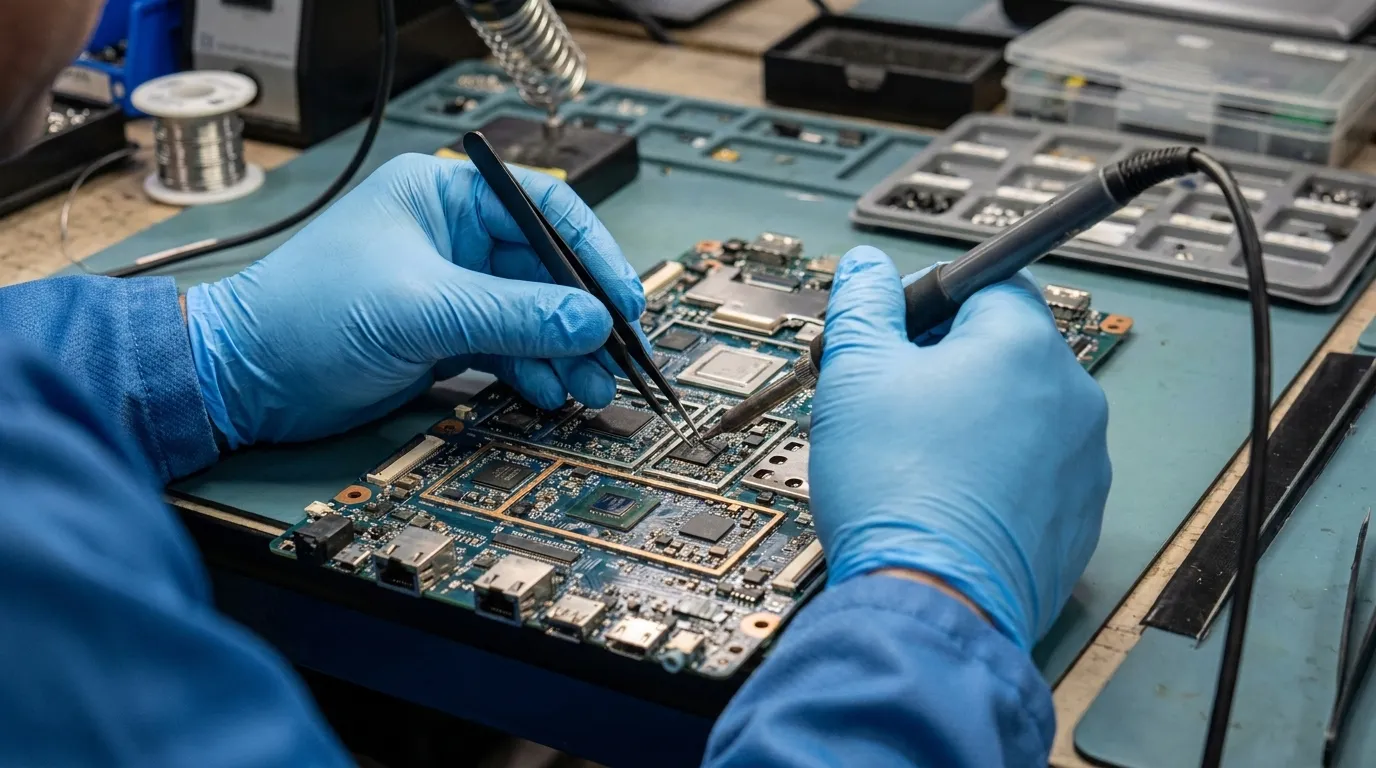
- Repair: Repair scope ranges from L1 cosmetic work to L4 board-level rework including BGA and fine-pitch component replacement, PCB testing and precision soldering. Manufacturer-grade technicians perform component-level diagnosis and repair under ISO 9001 and ISO 14001 processes.
- Quality control and testing: Functional testing includes stress testing and stability verification across all systems, not basic power-on checks. High-volume operations target order accuracy rates of 99.5 percent or higher and inventory accuracy of 98 percent or above.
- Return and reporting: Repaired units ship against committed turnaround windows. Regular reporting on volume, root causes and failure trends via portal or API closes the loop and enables engineering teams to address recurring failures.
Evaluating Service Scope and Technical Capabilities
Operations leaders assessing depot repair partners should review six capability dimensions before selecting a provider.
- Repair level range: Confirm that the provider performs L1 through L4 repairs in-house. Subcontracted board-level work introduces turnaround variability and chain-of-custody gaps.
- OEM authorization status: ASC authorization from relevant OEM brands is a core requirement for warranty-eligible repairs. Premier Logitech holds ASC status for more than 20 OEM brands, which many providers cannot match.
- Parts reclamation and harvesting: A capable partner recovers usable components from beyond-economic-repair units. This practice reduces parts costs and supports sustainability reporting.
- NFF handling: Programs need clear workflows for the large share of returns that test functional. Routing NFF units into refurbishment and grading channels instead of discarding them directly affects asset recovery value.
- System integration: Integrating returns disposition directly into ERP systems removes manual reconciliation and improves inventory accuracy.
- Modular vs. end-to-end engagement: Some programs require full lifecycle management, while others need depot repair as a standalone service. Premier Logitech supports both models, allowing engagement for a single service or a complete program.
Quality, Compliance and Regulatory Assurance
Government contractors and enterprise buyers face strict compliance requirements that quickly remove unqualified providers. Evaluating a depot repair partner’s compliance posture requires reviewing several frameworks.
- TAA (Trade Agreements Act): Required for any repair program that supports federal procurement. Confirms that products and services originate from TAA-compliant countries.
- NIST SP 800-53 and NIST CSF 2.0: NIST SP 800-53 Rev. 5 is a common framework for federal contractors, requiring continuous monitoring and annual Authorization to Operate. NIST CSF 2.0 is a voluntary risk-driven framework built around six functions: Govern, Identify, Protect, Detect, Respond and Recover.
- CMMC (Cybersecurity Maturity Model Certification): Required for defense contractors that handle Controlled Unclassified Information. Depot repair providers that support DoD-program devices must demonstrate CMMC alignment.
- SOC 2 Type II: SOC 2 Type II provides evidence that controls operated effectively over a 6- to 12-month period.
- ISO 9001 and ISO 14001: ISO 9001 governs quality management system consistency across repair operations. ISO 14001 covers environmental management and supports sustainability reporting on material recovery and responsible disposal.
- Secure data destruction: DoD-approved HDD data erasure, certification and destruction services with documented secure handling protocols are required for any program that involves devices storing sensitive data.
Premier Logitech maintains TAA compliance, TAPA, ISO quality frameworks, NIST, CMMC and SOC 2 certifications and holds CAGE Code 4WAJ9 as a pre-vetted federal government partner.
Talk to a lifecycle expert about compliance requirements for a depot repair program.
Scalability, Visibility and Total Program Value
Weekly repair capacity, real-time asset tracking and asset recovery performance determine whether a depot repair partner can sustain program performance at scale.
Capacity must be elastic, not only large. Cross-trained technical staff and elastic capacity absorb volume spikes from product issues or promotional cycles without extending committed turnaround windows. Premier Logitech structures repair operations to handle high weekly volumes across its DFW facilities.
Visibility requires more than a status portal. Logging every product movement with a timestamp, responsible party and condition status creates chain-of-custody traceability for quality disputes. Programs that surface this data via API or portal give operations leaders the inventory accuracy needed to manage exchange pools and secondary market inventory.
Asset recovery value completes the program economics picture. Repaired and graded units that re-enter certified refurbishment channels generate revenue that offsets repair spend. Parts reclamation from beyond-economic-repair units reduces new parts procurement costs. Responsible recycling under ISO 14001 supports sustainability reporting requirements.
Fragmented vendor networks often separate providers for repair, refurbishment, fulfillment and recycling. These networks introduce handoff delays, data gaps and compliance inconsistencies. Consolidating to a single authorized partner reduces those gaps and lowers management overhead.
Implementation Checklist for Depot Repair Programs
The following steps guide selection and onboarding of a high-volume depot repair partner.
- Define repair scope: identify device categories, repair levels required (L1–L4) and estimated weekly volumes including seasonal peaks. This scope definition determines which providers have the technical capacity to support the program.
- Confirm OEM authorization: verify ASC status for every brand in the program scope before shortlisting providers. Without this authorization, warranty-eligible repairs remain out of reach regardless of other strengths.
- Audit compliance credentials: collect current certificates for TAA, ISO 9001 and 14001, NIST, CMMC, SOC 2 and any program-specific requirements. These credentials are mandatory for government and enterprise programs and remove unqualified providers early.
- Assess data security protocols: require documented data destruction procedures and chain-of-custody records for all devices that contain sensitive data. Strong protocols reduce risk during audits and incident reviews.
- Evaluate system integration: confirm that the provider’s portal or API connects to existing ERP and RMA systems without manual reconciliation. Clean integration supports accurate inventory and faster reporting.
- Review reporting cadence: establish KPIs for first-pass yield, NFF rate, turnaround performance and asset recovery value before launch. Clear metrics align expectations and guide continuous improvement.
- Define modular vs. full-program scope: decide whether the engagement covers depot repair only or extends to refurbishment, grading, fulfillment and recycling. Scope clarity prevents gaps in responsibility.
- Align on escalation and account management: confirm executive-level engagement and a single point of contact for program issues. Defined escalation paths keep high-impact incidents under control.
Frequently Asked Questions
What certifications should a high-volume depot repair provider hold?
A provider serving government contractors should hold TAA compliance, ISO 9001 for quality management and ISO 14001 for environmental management, and demonstrate alignment with NIST SP 800-53 and CMMC requirements. Enterprise buyers typically require SOC 2 Type II as evidence that security controls operated effectively over an extended audit period. TAPA certification supports programs with physical security requirements during transport and storage. Premier Logitech maintains these credentials and holds CAGE Code 4WAJ9 as a pre-vetted federal government partner.
How does secure data destruction work in a depot repair program?
Secure data destruction in a depot repair environment begins at intake, where devices containing storage media are flagged and segregated. Certified technicians perform data erasure using DoD-approved methods and generate a destruction certificate for each unit. Chain-of-custody records document every handler and location from receipt through erasure confirmation. For devices that cannot be wiped because of damage, physical destruction with documented verification serves as the standard approach. Premier Logitech provides secure data destruction as part of its depot repair and reverse logistics programs, with compliance reporting available for audits.
What performance metrics should operations leaders track?
Core metrics for program health include first-pass yield rate, No Fault Found rate, turnaround time from receipt to return shipment, inventory accuracy across the repair pool and asset recovery value from refurbished and graded units. Root cause reporting by failure mode also serves as a leading indicator. Programs that surface recurring failure patterns allow engineering teams to address upstream product issues before they generate additional return volume.
What is the difference between L1 and L4 depot repair?
Repair levels describe the depth of technical intervention. L1 covers cosmetic and basic functional work such as screen replacement, battery swap and cleaning. L2 addresses module-level replacement of components like cameras, keyboards or charging ports. L3 involves subassembly replacement and more complex diagnostics. L4 is board-level repair, including component-level rework such as BGA reballing, PCB trace repair and precision soldering. Not all depot repair providers perform L3 and L4 work in-house, and subcontracting those levels introduces turnaround variability and chain-of-custody risk. Premier Logitech performs L1 through L4 repairs across its authorized service center network.
How does ASC authorization affect a depot repair program?
Authorized Service Center status means the provider has been vetted and approved by the OEM to perform warranty-eligible repairs using genuine parts and OEM-specified procedures. Without ASC authorization, repairs on in-warranty devices may void the manufacturer warranty and create liability for the program operator. ASC status also typically grants access to OEM parts supply chains, technical documentation and firmware tools that unauthorized providers cannot access. Premier Logitech holds ASC authorization for more than 20 OEM brands, covering a broad range of IT and consumer electronics categories relevant to enterprise and government programs.
Conclusion: Selecting a Partner That Reduces Risk and Increases Recovery
High-volume depot repair is a compliance-critical and operationally complex function. A strong partner consolidates vendors, delivers traceability at every step, meets applicable regulatory requirements and returns measurable value from repaired and refurbished inventory.
Premier Logitech brings the ASC authorizations and repair capabilities described above, along with a complete compliance credential stack and the operational scale to absorb high weekly volumes from U.S.-based facilities with nearshore support. The company operates as a single-source lifecycle partner or a modular service provider, depending on program requirements.
Talk to a lifecycle expert to build a depot repair program that reduces risk and maximizes recovery.
