Last updated: July 13, 2026
Key Takeaways for Depot Repair Buyers
- IT repair depots provide centralized L1–L4 repair, diagnostics, data sanitization and compliance reporting for enterprises, OEMs and government agencies.
- Fragmented vendor relationships create visibility gaps and compliance risks, while centralized ASC-authorized depots deliver consistent quality and cost efficiency.
- Premier Logitech operates three DFW facilities that process more than 40,000 units weekly, with ASC authorizations for more than 20 OEM brands and certifications including TAA, NIST, CMMC and SOC 2.
- Key buyer considerations include OEM authorizations, compliance frameworks, throughput capacity and integration with existing RMA and ERP systems.
- Organizations seeking a compliant, scalable depot partner can connect with a lifecycle expert at Premier Logitech to scope program requirements.
Market Pressures Driving Centralized Depot Repair
Large enterprises, OEMs and government agencies managing high return volumes face consistent operational pressure. Repair relationships often fragment across multiple vendors, with separate partners for depot repair, logistics and data destruction. This structure creates visibility gaps and compliance exposure at every handoff.
Centralized depot services consolidate expertise, tools and processes to deliver consistent quality and help lower operational costs compared with distributed or in-house models. Distributed IT environments often struggle with redundant processes, weak documentation and inadequate tools that increase security risk.
OEM warranty and ASC requirements introduce additional complexity. Repairs performed outside an authorized service network can void warranties, disqualify devices from refurbishment channels and expose organizations to audit risk. Government clients also manage FISMA, CMMC and TAA mandates that many generic repair providers cannot meet.
Assess operational gaps with a Premier Logitech lifecycle expert and map them to depot capabilities.
How Commercial Depot Repair Evolved
The term “depot repair” originated in military maintenance doctrine and described the highest level of sustainment at centralized facilities. Commercial IT adopted this framework and expanded it over time.
During the past five years, commercial depot operations have grown to include board-level diagnostics, firmware-level repair, certified data sanitization aligned to NIST 800-88, secondary market grading and reverse logistics integration with enterprise ERP and TMS platforms. Depot services now support the full IT hardware lifecycle from deployment through repair, refurbishment and disposal.
The shift toward Device-as-a-Service and subscription-based hardware models increased demand for rapid exchange programs and high-throughput refurbishment. Many organizations that previously managed repairs in-house now consolidate to single-source depot partners that handle volume, compliance and OEM authorization requirements together.
Explore how Premier Logitech’s depot model supports modern lifecycle programs and subscription hardware strategies.
Core Depot Capabilities and L1–L4 Service Levels
IT depot repair follows four service levels, with each level covering a deeper scope of technical work.
- L1 — Field or Basic Repair: Software reloads, OS reimaging, basic hardware swaps and functional testing. Intake teams or end-user support groups typically perform this level before escalation.
- L2 — Depot-Level Component Swap: Replacement of field-replaceable units such as batteries, screens, keyboards and storage drives. This level requires depot tooling and a managed parts inventory.
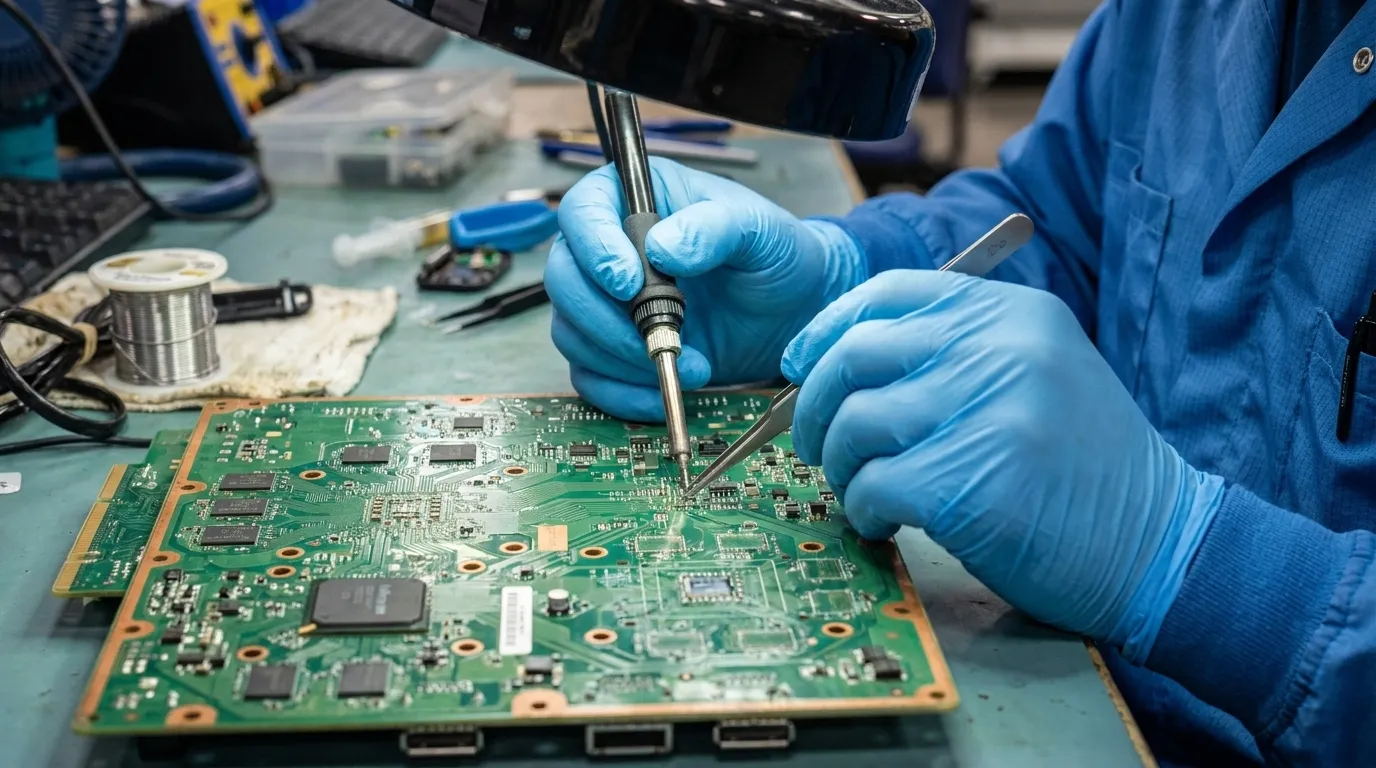
- L3 — Board-Level Diagnostics and Rework: Component-level diagnosis, PCB rework, BGA reballing and advanced soldering. This level depends on specialized equipment and certified technicians.
- L4 — OEM or Engineering-Level Repair: Vendor or partner teams provide depot support for complex hardware, systems and services that internal teams do not handle directly. Typical work includes firmware modification, engineering change orders and root-cause failure analysis.
These four repair levels form the technical foundation of depot operations. A full-capability depot extends beyond repair alone and delivers additional lifecycle services.
- Cosmetic refurbishment and multi-tier grading for secondary market channels
- NIST 800-88-aligned data sanitization with certificate issuance
- Burn-in and functional testing after repair
- Parts reclamation and harvesting from non-repairable units
- RMA management plus in-warranty and out-of-warranty claim processing
Scope the right mix of repair levels with Premier Logitech based on program volume and device mix.
Premier Logitech Operating Model and Service Delivery
Premier Logitech operates three facilities in the Dallas-Fort Worth area, supported by nearshore operations in Laredo and Nuevo Laredo, Mexico. The DFW hub sits near one of the world’s busiest cargo airports, which supports time-sensitive exchange programs and inbound logistics from national return networks.
Premier Logitech holds ASC authorizations for more than 20 OEM brands, which enables warranty-compliant repairs that preserve device eligibility for refurbishment and resale. The repair operation handles high-volume processing across L1–L4 service levels.
Rapid exchange programs allow organizations to ship a defective unit and receive a pre-tested replacement without waiting for the original repair cycle. This model reduces downtime for end users and supports SLA-driven programs in enterprise and government environments.
Premier Logitech functions as both a single-source lifecycle partner and a modular services provider. Clients can engage for end-to-end program management or select individual services, such as depot repair, configuration, fulfillment or transportation, on a standalone basis.
Compliance Standards That Shape Depot Operations
Government and enterprise clients expect depot partners to operate within defined compliance frameworks. The primary standards for IT repair depot operations in the United States include the following.
- TAA (Trade Agreements Act): Requires that products and services procured by the federal government originate from designated countries. Premier Logitech maintains TAA-compliant sourcing and handling workflows.
- NIST SP 800-88: The federal standard for media sanitization, which requires depot operations to follow specific guidelines for clearing, purging and destroying storage media on government devices.
- CMMC (Cybersecurity Maturity Model Certification): Required for defense contractors and their supply chain partners. CMMC sits within a broader ecosystem of cybersecurity frameworks, including FISMA, SOC 2 and NIST CSF 2.0, that emphasize supply chain security through risk assessments of ICT service providers and third-party vendors.
- SOC 2 Type 2: An AICPA auditing standard that verifies vendors manage client data securely through more than 60 compliance requirements and extensive auditing processes.
- ISO 9001/14001: Quality management and environmental management certifications that validate consistent process execution and responsible disposition practices.
- FISMA: Extends federal security requirements to third-party vendors and repair depots that support federal agencies. Covered areas include asset inventory, risk categorization, minimum security controls and continuous IT infrastructure monitoring.
Premier Logitech holds a CAGE Code (4WAJ9), which identifies the company as a pre-vetted, high-security partner for U.S. federal government programs. The company also maintains TAPA certification for high-value cargo security in transit.
Primary Customers and Typical Depot Use Cases
Premier Logitech’s depot repair services support three primary customer segments.
- Large Enterprises: Organizations that manage fleets of laptops, tablets and peripherals across distributed workforces. Common use cases include warranty claim processing, rapid exchange for field devices and end-of-lease refurbishment.
- OEMs and Consumer Electronics Brands: Manufacturers that need ASC-authorized repair to maintain warranty integrity, support secondary market channels and manage return volumes from retail and direct-to-consumer programs.
- Government Agencies: Federal, state and local agencies that require TAA-compliant repair, NIST-aligned data sanitization and CMMC-ready handling for sensitive devices. Premier Logitech’s CAGE Code supports direct engagement with federal procurement programs.
Buyer Roles and Key Decision Drivers
Directors of reverse logistics, operations and supply chain typically lead depot repair vendor evaluations. Their priorities focus on vendor consolidation, operational visibility, compliance assurance and scalable repair capacity.
Organizations evaluating vendors for IT depot repair should assess experience and expertise by reviewing the vendor’s industry track record, specialized technical knowledge and capabilities including equipment and process knowledge. Quality evaluation requires examining certifications, compliance with industry standards and quality assurance processes. These evaluation principles translate into specific decision drivers.
Common decision drivers include the following factors.
- ASC authorization status for relevant OEM brands
- Demonstrated compliance with applicable government frameworks
- Ability to handle volume fluctuations without service degradation
- Integration with existing RMA, ERP and TMS platforms
- Single-vendor consolidation across repair, logistics and disposition
Comparing In-House, Third-Party and ASC-Authorized Depots
Organizations evaluating depot repair options typically consider three models: in-house operations, non-authorized third-party providers and ASC-authorized partners such as Premier Logitech.
In-house depot operations require capital investment in tooling, certified technicians and compliance infrastructure. Captive shared service centers often struggle with volume swings, and the organization carries the full cost of excess capacity during downturns. Establishing a captive GCC operation typically requires 6 to 12 months from initial decision to operational readiness, and larger scales can take up to 18 months.
Non-authorized third-party providers may offer lower unit costs but cannot perform warranty-compliant repairs for OEM programs. Repairs outside the ASC network can void device warranties and disqualify assets from certified refurbishment channels.
Premier Logitech’s broad ASC authorization coverage, combined with its compliance certifications and multi-facility North American footprint, creates a capability profile that generic providers and in-house models match only with significant investment.
Evidence of Scale and Program Readiness
Premier Logitech’s operational scale reflects its position as a high-volume, multi-capability depot partner. The company supports kitting capacity of 500,000 units per month across its DFW facilities.
Compliance certifications, including TAA, TAPA, ISO 9001/14001, NIST, CMMC, SOC 2 and CAGE Code 4WAJ9, are maintained through active third-party audits and government vetting processes. ASC authorizations are granted and renewed by OEM partners based on technician certification, tooling standards and quality metrics.
Premier Logitech has operated since 2007 and maintains long-term relationships across IT OEMs, telecom providers, enterprise IT programs and public-sector organizations.
Practical Steps for Scoping a Depot Program
Organizations that plan a depot repair engagement benefit from defining program requirements before issuing an RFP. Key inputs include the following details.
- Device categories and OEM brands that require repair
- Estimated weekly or monthly return volumes
- Required repair levels from L1 through L4
- Compliance frameworks that apply to the program
- Data sanitization requirements and certification needs
- Integration requirements with existing RMA, ERP or TMS systems
- Disposition requirements such as refurbishment, resale, recycling or destruction
Common mistakes in vendor selection include weak definition of evaluation criteria and vendor choice based only on cost without attention to quality, reliability or strategic fit. To avoid these pitfalls, a structured evaluation process that scores vendors on compliance, ASC status, throughput capacity and integration capability produces more durable program outcomes than cost-only comparisons.
Build a structured depot repair scoping framework with Premier Logitech before launching a formal RFP.
Frequently Asked Questions
What does “depot level repair” mean in commercial IT?
Depot level repair refers to work performed at a centralized facility rather than at the end-user location. In commercial IT, depot repair follows four levels, labeled L1 through L4, that represent progressively deeper technical intervention. L1 covers software reloads and basic swaps. L2 covers field-replaceable unit replacement. L3 covers board-level diagnostics and component rework. L4 covers OEM-level engineering repair, firmware modification and root-cause analysis. A full-capability depot manages all four levels under one roof.
What is an Authorized Service Center and why does it matter?
An Authorized Service Center is a repair facility that an OEM certifies to perform warranty-compliant repairs on its products. ASC status requires technician certification, approved tooling and adherence to OEM quality standards. Repairs performed outside an ASC network can void device warranties and disqualify assets from certified refurbishment or resale channels. For OEM programs and enterprise warranty management, ASC authorization functions as a baseline requirement rather than a differentiator.
What compliance certifications support government depot programs?
Government-facing depot repair programs typically require TAA compliance for product sourcing and handling, NIST SP 800-88 alignment for data sanitization, CMMC certification for defense-related programs and FISMA-compatible security controls for federal agency work. SOC 2 Type 2 and ISO 9001 certifications provide additional validation of data security and quality management practices. A CAGE Code identifies the depot as a pre-vetted federal contractor. Organizations should verify that a depot partner holds active certifications, not just claimed alignment, before awarding a government program.
How does a rapid exchange program differ from standard depot repair?
In a standard depot repair model, a defective device ships to the depot, receives repair and then returns to the end user. The end user remains without the device for the full repair cycle. A rapid exchange program maintains a pool of pre-tested replacement units. When a defective device arrives, a replacement ships immediately, which removes the wait associated with the repair cycle. The defective unit then moves through repair and returns to the exchange pool. Rapid exchange programs are common in enterprise field device programs and government deployments where device downtime has direct operational impact.
What should organizations prioritize when evaluating a depot repair partner?
Key evaluation criteria include ASC authorization for relevant OEM brands, demonstrated compliance with applicable government and industry frameworks, throughput capacity that matches program volume requirements, integration capability with existing RMA and ERP systems and a clear disposition path for non-repairable assets. Organizations also benefit from assessing whether the depot can serve as a single-source partner across repair, logistics, refurbishment and recycling or whether additional vendors will be required to complete the lifecycle. Vendor consolidation reduces handoff risk and simplifies compliance reporting.
Conclusion: Building a Resilient Depot Repair Program
Fragmented depot repair relationships, non-authorized providers and outdated compliance postures create measurable risk for enterprises, OEMs and government agencies that manage high-volume device programs. A single-source, ASC-authorized depot partner with verified compliance certifications and demonstrated throughput capacity addresses these risks at scale.
Premier Logitech delivers L1–L4 depot repair, rapid exchange, certified data sanitization, cosmetic refurbishment and end-to-end lifecycle integration from its North American facilities. With ASC authorizations for more than 20 OEM brands and active certifications across TAA, NIST, CMMC, SOC 2 and ISO frameworks, Premier Logitech serves as a compliant, scalable partner for programs that cannot accept gaps in repair quality or regulatory coverage.
Discuss depot repair program requirements with Premier Logitech and align capabilities with long-term lifecycle goals.
