Key Takeaways
-
High return volumes and fragmented vendor relationships compress margins for IT, telecom and consumer electronics OEMs. Structured reverse logistics recovers asset value and reduces risk.
-
The five R’s returns, repair, refurbish, remarket and recycle form a connected framework. Each stage acts as a decision point where value is either recovered or lost.
-
Compliance requirements in 2026 span warranty authorization, data security NIST, CMMC, SOC 2, government procurement TAA and environmental regulations. Certified partners help reduce liability and brand risk.
-
Consolidating vendors into a single authorized partner with L1–L4 depot repair and real-time visibility tools removes handoff delays, improves recovery rates and delivers unified reporting.
-
Premier Logitech delivers end-to-end reverse logistics solutions tailored for OEMs. Request a reverse logistics assessment to evaluate consolidation opportunities and design a scalable program.
Reverse Logistics for OEMs in Electronics and Telecom
Reverse logistics for OEMs is a structured process that moves products back through the supply chain after sale. Units flow from end users or channel partners to repair, refurbishment, remarketing or responsible disposal. For IT, telecom and consumer electronics manufacturers this includes warranty returns, trade-ins, end-of-life collections and defective unit recalls.
Each of the five R’s represents a decision point where value is either recovered or lost. A single authorized partner with L1 to L4 depot repair capabilities and ASC status across multiple OEM brands can manage all five stages without unvetted handoffs. That structure protects brand integrity and recovery margins.
Premier Logitech has delivered lifecycle and reverse logistics services since 2007 across IT, telecom, consumer electronics, wearables and smart appliances. DFW-based facilities and nearshore Mexico operations support high-volume programs at scale.
Connect with Premier Logitech to design a reverse logistics program aligned with OEM requirements.
How the 5 R’s Work in OEM Reverse Logistics
Returns The intake stage covers RMA management, receiving, sorting and initial triage. For electronics OEMs speed and accuracy at this stage shape downstream recovery rates because every unit must move to repair, refurbish, remarket or recycle based on condition and value potential. A strong reverse logistics provider offers structured receiving, configurable inspection rules and clear disposition logic so units reach the correct path without delay.
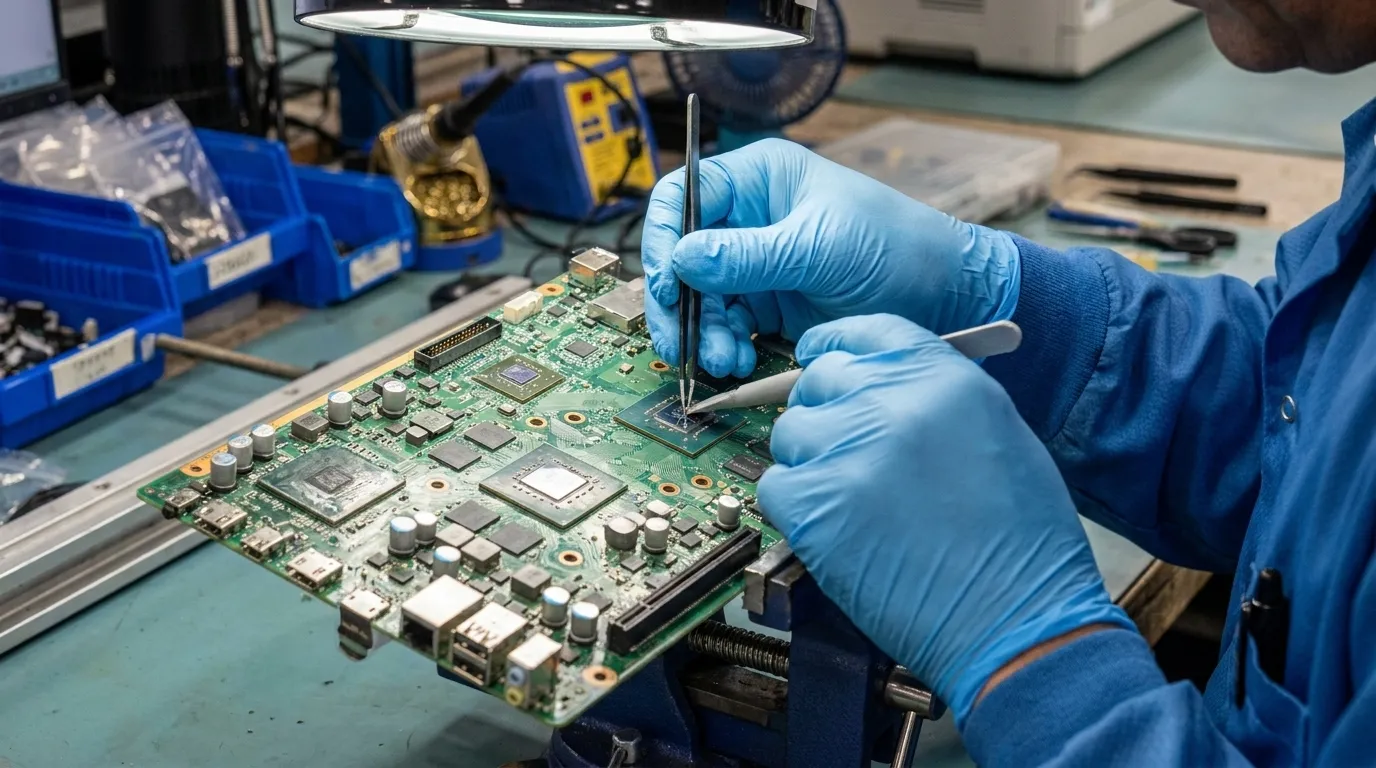
Repair Units flagged as repairable during intake move to depot repair. Work spans L1 cosmetic and basic functional checks through L4 board-level and component repair. The depth of repair capability matters less than authorization status because OEM warranty terms often restrict repair to ASC-certified providers.
Unauthorized repair voids warranty coverage and creates liability for the OEM. Premier Logitech holds ASC authorization for multiple brands, so L1 to L4 repair preserves warranty coverage and meets OEM specifications for in-warranty and out-of-warranty units.
Refurbish Refurbishment restores returned units to a sellable condition through cleaning, cosmetic repair, functional testing and grading. The remanufacturing segment held a 28% share of the global reverse logistics market in 2025, reflecting growing OEM investment in certified refurbishment as a revenue recovery channel. Refurbishment decisions depend on accurate intake grading and clear criteria for resale versus recycling.
Remarket Graded and refurbished units reenter secondary market channels, including B2B, B2C and direct-to-consumer fulfillment. Accurate grading and certified data destruction support secondary market credibility and pricing. Premier Logitech provides certified refurbishment and grading for secondary resale along with rapid exchange and next-day replacement programs that keep end customers satisfied.
Recycle Units that cannot be repaired or remarketed move to responsible disposal. Warehouses handling returns must manage universal waste streams such as batteries, lamps and certain electronics under EPA rules that mandate labeling, training and proper disposal. Premier Logitech e-waste reduction programs and responsible recycling services support circular-economy objectives and environmental compliance requirements.
Improving Reverse Logistics for Electronics Manufacturers
Reverse logistics performance often stalls when high return volumes outpace processing infrastructure. Fragmented vendor relationships add handoff delays, data gaps and inconsistent quality outcomes. These issues reduce recovery value and increase warranty cost.
High defect volumes are driving electronics and consumer goods OEMs to implement root-cause analysis and supplier feedback loops to reduce return rates. Managing that volume requires a partner with proven capacity and electronics focus, not a general 3PL that treats electronics as one category among many.
Improving reverse logistics often delivers the fastest ROI for companies building circular programs. Strong returns processing supports broader initiatives such as redistribution and recycling. Consolidating vendors into a single partner removes redundant coordination, lowers error rates and provides unified reporting across the full returns flow.
Premier Logitech nearshore Mexico operations in Laredo and Nuevo Laredo provide a cost-competitive processing option for high-volume programs and complement DFW facilities. Managing high-volume flows across multiple locations requires unified visibility into each unit status and location.
The integration of AI, IoT and blockchain technologies in reverse logistics improves tracking and monitoring of returned goods, reduces errors and improves resource utilization. Premier Logitech Transportation Management System and real-time lifecycle analytics deliver this visibility across DFW and nearshore facilities, which fragmented multi-vendor programs cannot match.
Compliance Requirements for OEM Reverse Logistics in 2026
Compliance in OEM reverse logistics spans warranty and ASC authorization, data security, government procurement and environmental regulation. Improvements in infrastructure and vendor consolidation must align with these requirements to protect revenue and brand equity.
Warranty and ASC compliance OEM warranty terms require repairs through authorized service centers. Work performed by non-ASC providers exposes OEMs to warranty voidance and brand risk. Premier Logitech ASC authorizations across multiple brands help repairs meet OEM specifications and preserve warranty coverage.
Data security Returned IT assets often contain sensitive data. NIST 800-88 guidelines govern media sanitization for federal and enterprise programs. CMMC applies to defense-adjacent supply chains. SOC 2 certification demonstrates operational controls over data handling. Premier Logitech holds certifications across NIST, CMMC and SOC 2, supporting secure data destruction and compliance reporting for government and enterprise clients.
Government procurement The Trade Agreements Act governs product sourcing for U.S. federal contracts. Premier Logitech TAA compliance and CAGE Code 4WAJ9 designation position the company as a pre-vetted partner for public-sector reverse logistics programs.
Environmental regulation PHMSA defines reverse logistics under 49 CFR 171.8 for ground transport with specific rules governing hazmat returns, including lithium batteries, which are not eligible for the reverse logistics exception due to their unique hazards.
Damaged or leaking returned products can become hazardous waste under EPA regulations in 40 CFR Parts 260 through 273, requiring waste identification, container labeling and licensed hazardous waste transporters. Premier Logitech ISO 9001 and ISO 14001 frameworks support environmental compliance across its facilities.
Looking ahead electronics companies shipping non-compliant batteries face border rejections and fines of up to 4% of EU revenue under ESPR mandates after July 2026. That shift creates material risk for OEMs with international distribution and heightens the value of compliant partners.
Choosing a Reverse Logistics Partner for OEM Programs
Partner selection should evaluate six dimensions: service scope, repair depth, compliance posture, scalability, visibility tools and vendor consolidation capability. Strong performance across these areas supports durable programs.
Service scope The partner should cover the full five R’s without subcontracting critical steps to unvetted providers. Reverse logistics spans inspection, refurbishment, resale preparation, recycling, disposal, vendor returns, warranty flows and liquidation. Only some providers deliver true end-to-end lifecycle management.
Repair depth L1–L4 depot repair capability, combined with ASC authorization for the OEM brands, is a core requirement for warranty-compliant programs. Limited repair depth forces premature replacement and lowers recovery value.
Compliance posture Programs should verify certifications across data security NIST, CMMC, SOC 2, environmental ISO 14001, EPA hazmat handling and procurement TAA frameworks before engagement. Strong compliance reduces audit exposure and contract risk.
Scalability OEMs must weigh higher upfront investment in technology, infrastructure and training against longer-term savings from reduced raw-material procurement and improved asset utilization. This cost-benefit tension makes scalability critical. Programs benefit from starting with focused scopes and expanding as ROI becomes clear. A partner with modular service options supports that approach and reduces upfront commitment while preserving room to grow.
Visibility tools Real-time tracking, lifecycle analytics and ERP integration now serve as baseline requirements. Data and visibility gaps represent a primary risk in circular logistics implementations. Integrated digital platforms reduce that risk and support continuous improvement.
2026 trends to factor in AI-driven disposition routing, ESG reporting requirements and circular-economy mandates are reshaping partner expectations. Analytics and dynamic valuation tools tied to product usage data can improve remanufacturing yields and residual value for OEMs managing asset recovery. Partners that invest in these tools help OEMs stay ahead of regulatory and market shifts.
Implementation Roadmap for OEM Reverse Logistics
Step one is mapping current reverse logistics flows. This work identifies every touchpoint from return initiation through final disposition, including all current vendors, handoffs and data gaps. The map reveals where handoffs occur and where visibility breaks down.
Step two is gap analysis. Teams measure current performance against benchmarks for return processing time, warranty cost and asset recovery rate. They then identify where fragmentation, compliance exposure or capacity constraints limit outcomes. The gaps identified in step two determine which flows to prioritize in step three.
Step three is partner engagement. A qualified single-source partner joins the assessment process early and reviews mapped flows and performance gaps. Premier Logitech conducts tailored program assessments that highlight consolidation opportunities, compliance gaps and recovery improvement potential before any commitment. These findings shape the phased rollout plan.
Step four is phased implementation. Programs start with the highest-volume or highest-risk return flows, then expand scope as processes stabilize and performance data accumulates. Each phase uses results from the previous phase to refine procedures and investment decisions.
Fragmented reverse logistics programs reduce recovered value, weaken compliance standing and slow operations. A consolidated authorized partner with strong certifications, repair depth and scalable capacity addresses these issues in a single integrated program.
Frequently Asked Questions
What is the difference between a general 3PL and an authorized reverse logistics partner for OEMs?
A general 3PL handles transportation, warehousing and basic returns processing. An authorized reverse logistics partner adds OEM-specific capabilities such as ASC authorization for in-warranty repairs, L1 to L4 depot repair depth, certified data destruction and compliance frameworks such as NIST, CMMC and SOC 2.
For OEMs with warranty obligations and data security requirements this distinction is material. Unauthorized repair voids warranty coverage and non-certified data handling creates liability. Premier Logitech holds ASC authorization for multiple brands and operates under the compliance frameworks described above, which general 3PLs typically do not offer.
How does vendor consolidation improve OEM reverse logistics performance?
Fragmented vendor relationships create handoff delays, inconsistent quality outcomes and data gaps between systems. When repair, refurbishment, recycling and fulfillment sit with separate providers, no single party has visibility into the full returns flow or accountability for end-to-end performance.
Consolidating into a single-source partner removes redundant coordination, unifies reporting and creates one point of accountability. Premier Logitech replaces fragmented repair, fulfillment and recycling vendors with one integrated program that covers the lifecycle from RMA intake through secondary market remarketing or responsible disposal.
What compliance certifications should an OEM require from a reverse logistics partner in 2026?
The minimum compliance posture for a reverse logistics partner serving IT, telecom or consumer electronics OEMs in 2026 includes NIST 800-88 for media sanitization, SOC 2 for operational data security controls, ISO 14001 for environmental management and TAA compliance for government-adjacent programs.
Programs touching defense supply chains should also require CMMC certification. Environmental compliance covering EPA hazardous waste rules under 40 CFR Parts 260 to 273 and PHMSA hazmat transport requirements under 49 CFR is essential for programs handling lithium batteries or other regulated materials. Premier Logitech meets these requirements.
What is L1 to L4 depot repair and why does it matter for OEM reverse logistics?
Depot repair levels define the depth of technical intervention a service center can perform. L1 covers basic diagnostics, cosmetic inspection and simple replacements. L2 includes module-level repair and component swaps. L3 involves board-level repair and advanced diagnostics. L4 covers component-level repair, BGA reballing and deep circuit work.
OEMs with complex product lines such as smartphones, laptops, networking equipment and wearables benefit from partners capable of L3 and L4 work to maximize repair yield and avoid unnecessary unit write-offs. Partners limited to L1 to L2 push more units to replacement or recycling, which reduces recovery value. Premier Logitech supports L1 to L4 repair across its depot operations.
How do nearshore operations in Mexico benefit OEM reverse logistics programs?
Nearshore operations in Mexico, particularly in border regions such as Laredo and Nuevo Laredo, provide a cost-competitive labor environment close to U.S. distribution infrastructure. For high-volume returns programs nearshore processing can reduce per-unit handling costs compared with fully domestic operations while maintaining short transit times to U.S. fulfillment centers.
Premier Logitech Laredo and Nuevo Laredo operations complement DFW facilities and give OEM clients flexible capacity options for programs that require cost efficiency at scale without sacrificing turnaround performance or compliance standards.
