Key Takeaways for Configuration Buyers
- Technology configuration services cover device imaging, BIOS setup, software installation, asset tagging, kitting and direct-to-user fulfillment before assets reach end users.
- Market pressures such as hybrid work, device proliferation, vendor fragmentation and strict compliance mandates drive enterprises and government agencies to outsource configuration and lifecycle management.
- Core capabilities include integrated imaging, kitting, fulfillment, API connections to ITSM platforms and quality controls that maintain accuracy at high volumes.
- Buyers should evaluate partners on security certifications (TAA, NIST, CMMC, SOC 2), geographic reach, systems integration and lifecycle scope including returns and repair.
- Premier Logitech offers certified, end-to-end technology configuration and lifecycle services; talk to a lifecycle expert to get started.
Market Pressures Increasing Demand for Configuration Services
Enterprise IT environments have grown more complex as hybrid work, BYOD adoption and device proliferation expand the number of endpoints organizations must manage. This complexity drives organizations to outsource; the global managed services market continues to grow, fueled in part by demand for outsourced IT infrastructure, mobility and security services.
Endpoint complexity compounds the problem. Many organizations allow employee-owned phones and tablets on corporate networks, which multiplies OS permutations and unmanaged data paths. These conditions require configuration controls at scale. Large enterprises account for a significant share of managed services spending because multi-site operations and regulatory requirements strain internal teams.
Fragmented vendor relationships amplify these pressures. When imaging, kitting, fulfillment and returns sit with separate providers, visibility gaps emerge and deployment timelines extend. Compliance documentation also becomes inconsistent. IT talent shortages compound the challenge. Shortages in cloud automation, cybersecurity and device lifecycle management lead enterprises to outsource to providers that deliver specialized skills and scalable resources.
Beyond operational capacity constraints, regulatory pressure adds another layer of complexity. Defense contractors, federal agencies and regulated enterprises face mandatory compliance with frameworks including CMMC, NIST SP 800-171 and TAA. These requirements cannot be met through ad hoc vendor arrangements. They demand a partner with documented controls, certified facilities and auditable processes across every lifecycle stage.
Core Capabilities Required in Configuration Programs
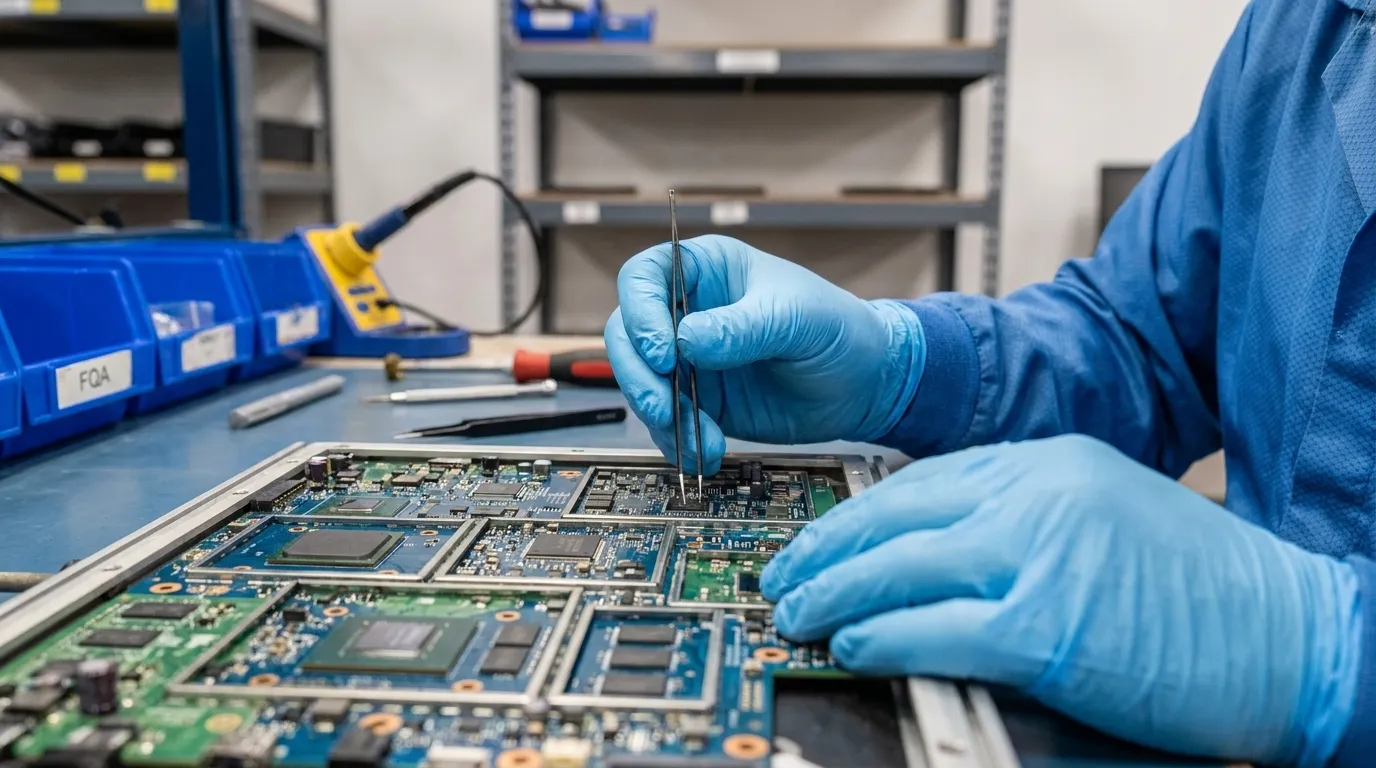
Technology configuration and kitting programs rely on several integrated capabilities that work together. Device imaging and BIOS configuration establish the software baseline for each asset class. Software installation and updates then layer in applications, security policies and MDM enrollment profiles. Asset tagging and serialization create traceability records that feed inventory systems and support compliance audits throughout the asset life.
Kitting assembles devices, peripherals, cables, documentation and packaging into deployment-ready units. By consolidating multiple items into single packages, kitting can reduce order processing time compared to traditional multi-item picking, which delivers meaningful efficiency at enterprise deployment volumes. Once kits are assembled, fulfillment operations route them through direct-to-user, B2B or channel distribution paths.
Integrated lifecycle management requires more than physical throughput. API integrations with ITSM platforms such as ServiceNow synchronize logistics data so hardware requests, inventory movements, device configuration and deployment are tracked within a single interface. This approach reduces manual data entry errors and improves audit readiness. Quality controls such as scan verification, weight checks and photo documentation maintain accuracy across high-volume programs.
Premier Logitech combines these elements into a single operating environment. Configuration and fulfillment capabilities include SIM and IMEI pairing, connected configuration, modern cloud-based provisioning, new hire kit assembly, order processing and channel distribution. Kitting capacity supports significant monthly volumes, and repair capacity handles high weekly throughput across L1-L4 depot repair. These services operate within a logistics network of 120+ vetted LTL carriers across North America and function as a coordinated system rather than isolated tasks.
Who Buys Configuration Services and How They Use Them
Operations, supply chain and lifecycle leaders at large enterprises, OEMs and government agencies drive most configuration decisions. Common titles include VP of Global Operations, VP of Supply Chain, Director of Operations, Director of Logistics, Director of Reverse Logistics and Director of Product Lifecycle. These leaders face shared pressures around deployment scale, compliance obligations, vendor fragmentation and return volume.
Several industries show the strongest demand. IT and telecom, consumer electronics, public sector and defense, healthcare and education all depend on consistent device readiness. Each sector carries distinct compliance and operational requirements. Defense contractors must meet CMMC and DFARS obligations. Healthcare organizations face HIPAA requirements for encryption and audit logging on every device accessing electronic health records. Federal civilian agencies require TAA-compliant sourcing and NIST-aligned security controls.
Use cases span the entire asset journey. A large enterprise deploying thousands of laptops to a distributed workforce needs imaging, kitting and direct-to-user fulfillment with MDM enrollment built into each device. A telecom OEM managing high return volumes needs RMA intake, triage, depot repair and refurbishment with grading for secondary market channels. A defense agency refreshing field devices needs TAA-compliant sourcing, CMMC-aligned configuration and secure data destruction at end of life. Premier Logitech supports all three scenarios through a single program structure.
Decision Criteria and Compliance Requirements for Partners
Buyers evaluating technology configuration services focus first on security and compliance. NIST SP 800-171 defines requirements for protecting Controlled Unclassified Information in nonfederal systems and is the key publication for federal contractors and subcontractors handling CUI. CMMC requires defense contractors and subcontractors handling Federal Contract Information or CUI to demonstrate cybersecurity maturity at one of several levels.
SOC 2 is an AICPA audit standard for service organizations covering Trust Services Criteria including security, availability, processing integrity, confidentiality and privacy. TAA compliance governs the country of origin for products procured under U.S. government contracts. Partners without these certifications cannot serve regulated buyers regardless of operational capability.
Beyond certifications, buyers assess geographic reach and facility footprint, systems integration capability, turnaround expectations and cost structure. A partner operating a single facility introduces geographic risk for national programs. A partner without API integrations to ITSM or ERP systems creates manual reconciliation work. A partner without authorized service center status cannot perform warranty repairs under OEM terms.
Premier Logitech holds TAA, NIST, CMMC, SOC 2, ISO 9001/14001 and TAPA certifications. Its CAGE Code 4WAJ9 identifies it as a pre-vetted federal partner. Its DFW hub and nearshore operations in Laredo and Nuevo Laredo provide geographic flexibility and proximity to major cargo infrastructure while supporting cost-competitive assembly programs. Its 20+ OEM authorized service center relationships cover warranty repair obligations that general 3PLs cannot fulfill.
Configuration Operating Models and Competitive Options
Organizations managing technology configuration typically choose among four operating models: in-house management, traditional third-party logistics providers, specialized repair or configuration firms and integrated lifecycle partners.
In-house management offers direct control but requires capital investment in facilities, equipment, staffing and compliance infrastructure. As device volumes and regulatory complexity grow, internal teams face capacity constraints and compliance gaps that remain difficult to close without dedicated resources.
Traditional 3PLs such as Ingram Micro handle warehousing and distribution at scale but typically lack OEM authorizations, compliance certifications and depot repair capabilities required for broad lifecycle programs. Specialized repair firms such as CDTI, Encompass or Flex may offer deep technical capability in a narrow service area but require separate vendor relationships for configuration, fulfillment and returns.
Integrated lifecycle partners consolidate these functions under a single program structure. Organizations are prioritizing unified platforms that offer enterprise-grade visibility, device management and analytics across distributed deployments, which supports outsourcing of configuration and lifecycle support to a single provider.
Premier Logitech operates as an integrated lifecycle partner and uses the OEM authorizations described earlier as a structural advantage. Its DFW logistics hub and nearshore operations support cost-competitive assembly and configuration programs while maintaining access to major transportation corridors. Clients can engage the full program or select individual services on a modular basis.
Practical Checklist for Evaluating Configuration Partners
Before selecting a technology configuration partner, operations and supply chain leaders can review several practical factors.
Volume and device mix: Configuration programs vary in complexity based on the number of SKUs, OS versions, software loads and peripheral combinations. Partners must demonstrate capacity and flexibility across mixed device estates.
Compliance requirements: Identify which frameworks apply, such as TAA, NIST, CMMC, SOC 2 or HIPAA, and confirm the partner holds current certifications with auditable documentation.
Integration complexity: Determine whether the partner can connect to existing ITSM, ERP or inventory systems via API to eliminate manual reconciliation and maintain real-time asset visibility.
Turnaround expectations: Align program timelines with the partner’s facility capacity, staffing model and logistics network. Programs with urgent deployment windows require partners with demonstrated throughput and carrier relationships.
Lifecycle coverage: Evaluate whether the partner can support returns, refurbishment, warranty repair and end-of-life recovery in addition to configuration and fulfillment. Single-vendor consolidation reduces handoff risk and simplifies compliance reporting.
Internal resourcing: Assess whether internal teams have the bandwidth to manage a multi-vendor model or whether a single-source partner better fits the organization’s operational capacity.
Frequently Asked Questions
What lifecycle stages does Premier Logitech support?
Premier Logitech supports every stage of the technology asset lifecycle. Services span sourcing and procurement, contract manufacturing, configuration and kitting, fulfillment and distribution, transportation, reverse logistics, depot repair and end-of-life recovery including secure data destruction and responsible recycling. Clients can engage the full program or select individual services on a modular basis depending on operational needs.
Which compliance frameworks does Premier Logitech support for government and regulated enterprise programs?
Premier Logitech maintains the government and enterprise certifications outlined in the decision criteria section, including TAA, CMMC, NIST and SOC 2. These certifications cover sourcing, configuration, repair, data destruction and asset disposition, which provides a consistent compliance posture across the asset lifecycle.
How does Premier Logitech integrate with existing enterprise IT and supply chain systems?
Premier Logitech supports integration with ITSM, ERP and inventory management platforms to synchronize asset data across procurement, deployment, returns and disposition. Real-time tracking and lifecycle analytics provide operational visibility without requiring clients to build separate reporting infrastructure. Integration scope and depth are defined during the onboarding and program design phase.
What reverse logistics and repair capabilities does Premier Logitech offer?
Premier Logitech provides RMA intake, triage, depot repair at L1 through L4, cosmetic refurbishment, sorting and grading, warranty claim support, rapid exchange and redeployment. The company holds authorized service center status for more than 20 OEM brands, which enables warranty-compliant repair that general logistics providers cannot perform. End-of-life services include secure data destruction, parts reclamation and responsible recycling with compliance reporting.
Can Premier Logitech support both large enterprise and government agency programs?
Premier Logitech serves large enterprises, OEMs, telecom providers and government agencies at the federal, state and local levels. Its certifications, CAGE code and facility infrastructure align with the security, compliance and scale requirements of both sectors. Programs can be structured as end-to-end lifecycle engagements or as targeted service modules depending on existing vendor relationships and operational priorities.
Choosing a Configuration Partner for Long-Term Lifecycle Value
Fragmented vendor relationships create operational risk, compliance gaps and lost asset value across every stage of the technology lifecycle. Integrated technology configuration services, delivered by a single partner with certified facilities and OEM authorizations, reduce that complexity while meeting the security and compliance requirements of enterprise and government programs.
Premier Logitech has delivered end-to-end lifecycle services since 2007. Its DFW operations, nearshore capacity, OEM authorized service center relationships and government-grade certifications position it as a single-source partner for organizations ready to consolidate vendors and gain stronger lifecycle visibility.
