Key Takeaways for Next-Day Hardware Replacement
- Enterprise hardware failures create rapid productivity loss and SLA penalties when standard RMA processes cannot deliver next-business-day resolution.
- A structured six-step framework with scoping, SLA definition, inventory segmentation, rapid exchange repair, compliance controls and ITAD recovery supports consistent next-day replacement.
- Forward-stocked inventory, authorized service centers and coordinated logistics support aggressive SLAs while controlling inventory and transportation costs.
- Data-security compliance (TAA, NIST, CMMC) and chain-of-custody documentation work best when embedded from day one to reduce audit exposure.
- Premier Logitech provides a single-partner model with ASC-authorized repair, government-grade compliance and end-to-end lifecycle services for next-day replacement programs; connect with a lifecycle expert to scope a program.
Why Standard RMA Processes Fall Short of Next Business Day Replacement
A return merchandise authorization (RMA) is the formal process that returns a defective asset to a depot for evaluation and repair or replacement. Standard RMA workflows prioritize cost efficiency over speed. Devices ship to a central depot, wait in queue, move through triage, then ship back. The round-trip cycle often spans multiple business days.
A service level agreement (SLA) defines performance commitments between a service provider and a customer, including response time, resolution time and escalation paths. Hardware SLAs for tier-1 production assets such as storage arrays and network switches commonly require 4-hour parts replacement as a minimum standard, while next business day (NBD) replacement often applies to non-critical components. When SLA language remains vague, support commitments often default to remote phone assistance rather than an on-site field engineer visit, which directly affects resolution time.
Depot repair refers to centralized repair operations at a fixed facility. Forward logistics moves replacement units toward the end user, and reverse logistics moves failed units back through the supply chain. When these flows lack coordination, inventory buffers deplete, SLAs slip and asset recovery value erodes.
These limitations show that next-day replacement requires a different operational model. A coordinated framework must connect requirements, SLAs, inventory, repair, compliance and recovery into one system. The following six steps build that system in sequence so each layer supports the next.
Step 1: Scope Program Requirements and Stakeholder Roles
Program scoping starts with a clear inventory of covered assets, failure modes that trigger replacement and required resolution times. Inputs include asset criticality tiers, geographic deployment footprint, annual failure rate estimates and existing SLA commitments to end customers.
A RACI matrix assigns accountability across the program by linking each decision to a single owner. Operations owns SLA performance because that team controls dispatch and resolution workflows. Supply chain owns inventory positioning and replenishment, which determines whether Operations can meet those SLAs. IT or engineering owns repair authorization and quality standards to keep replacements aligned with technical requirements. Finance owns cost-per-exchange targets to balance speed with budget. Legal or compliance owns data security and regulatory requirements, which shape how assets move through every stage.
The core design trade-off balances speed, cost and control. Faster resolution requires forward-stocked inventory closer to end users, which raises carrying costs. Tighter control over repair quality may require ASC-authorized technicians, which narrows the repair network. Scoping turns these trade-offs into explicit decisions before launch so the program operates on clear rules.
Step 2: Define SLAs and Turnaround Metrics
NBD replacement commits to delivering a functional replacement unit by the close of the next business day after a failure event. A 4-hour replacement target requires regional stocking locations and pre-positioned field inventory. The right target depends on asset criticality and the cost of downtime for each asset class.
The 4-hour target mentioned earlier translates operationally to mean time to repair (MTTR). Enterprise hardware SLAs typically target MTTR below 4 hours for critical infrastructure and below 8 hours for non-critical assets. MTTR measures elapsed time from failure detection to restored operational capacity and serves as the primary performance metric at the asset level.
SLA definitions also distinguish between on-site resolution and remote resolution. A replacement unit shipped overnight meets an NBD delivery commitment but fails an NBD resolution commitment if the end user cannot self-install. Programs serving non-technical end users require field dispatch or white-glove delivery as part of the SLA design. These commitments then shape how inventory must be positioned and how logistics must operate in the next step.
Step 3: Segment Inventory and Establish Forward Logistics Strategy
Not all assets require the same stocking strategy. A segmentation framework groups assets by failure frequency, replacement cost and criticality. High-criticality, high-frequency assets justify forward-stocked buffer inventory at regional depots or third-party logistics nodes. Low-criticality, low-frequency assets can ship from a central warehouse on an NBD basis.
Buffer stock levels depend on historical failure rates, replenishment lead times and acceptable stockout risk. An OEM that manages a nationwide fleet of field devices may position buffer inventory at multiple regional nodes to support same-day dispatch across time zones.
Forward logistics strategy defines how replacement units move from stock to end user. Options include carrier-based NBD shipping, courier dispatch from a regional depot or field technician delivery. Each option carries distinct cost and speed profiles that must align with the SLA commitments defined in Step 2 and the asset tiers defined in Step 1.
Step 4: Execute Depot and Field Repair with Rapid Exchange
Rapid exchange programs operate on a swap model. A functional replacement unit ships to the end user while the failed unit returns to the depot for evaluation and repair. This approach separates resolution time from repair time and supports NBD replacement without waiting for repair on the failed unit.
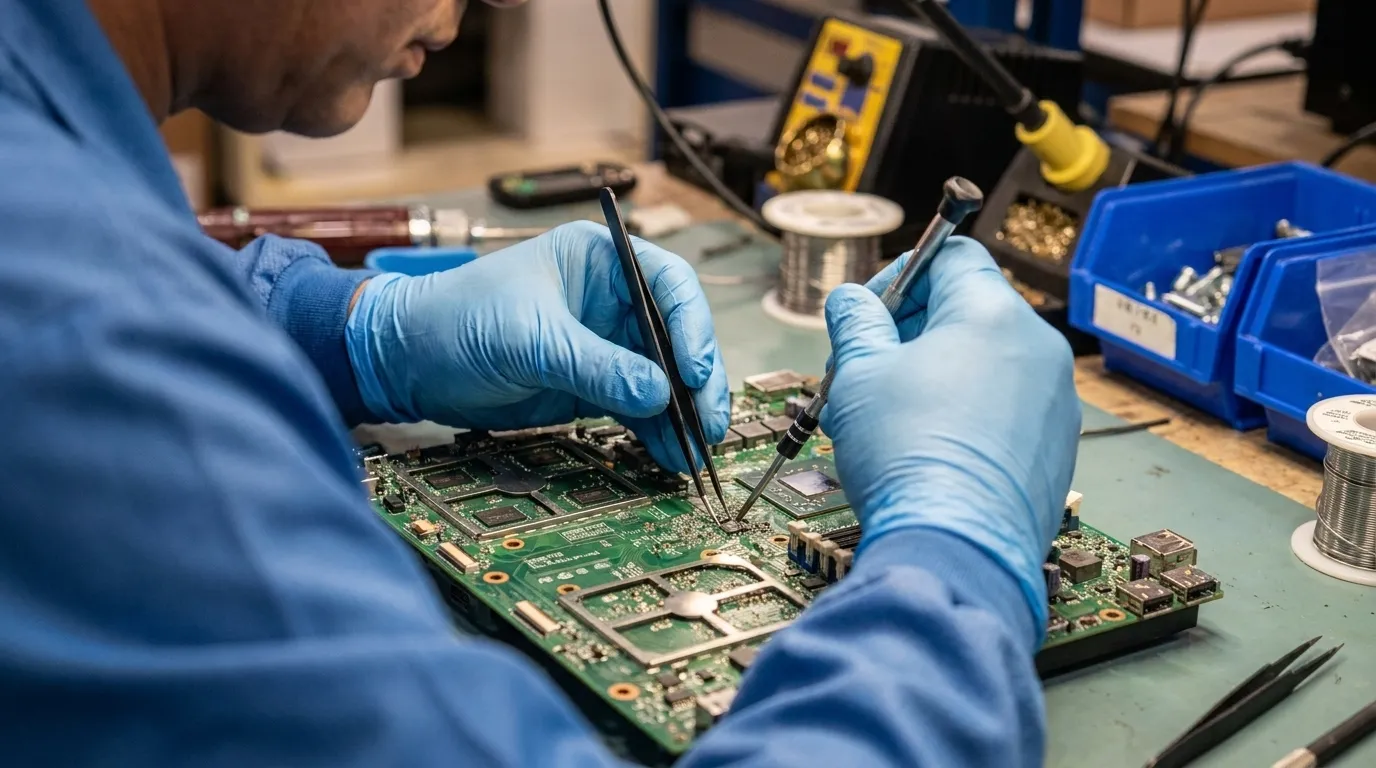
Depot repair falls into complexity tiers. L1 covers basic diagnostics and software resets. L2 covers component replacement such as batteries, screens and keyboards. L3 covers board-level repair and advanced diagnostics. L4 covers full system rebuilds and engineering-level failure analysis. A program that handles only L1 and L2 in-house needs an authorized partner for L3 and L4 work.
ASC (Authorized Service Center) status from an OEM grants a repair facility authorization to perform warranty repairs, use genuine parts and access OEM repair documentation. Programs that include in-warranty assets require ASC-authorized repair to preserve warranty coverage and meet OEM compliance requirements. Premier Logitech holds ASC authorization for more than 20 OEM brands, which supports warranty-compliant repair across a broad asset portfolio.
Step 5: Apply Data-Security and Compliance Controls
Every replacement event creates a chain-of-custody requirement. The failed unit that leaves the end user’s possession must be tracked, secured and processed under applicable data security standards. Gaps in chain-of-custody documentation create compliance exposure, especially for government and regulated-industry customers.
Relevant compliance frameworks for U.S. enterprise programs include the Trade Agreements Act (TAA) for procurement compliance, NIST SP 800-88 for media sanitization and CMMC (Cybersecurity Maturity Model Certification) for defense-related programs. Each framework sets requirements for data destruction, asset tracking and documentation retention.
Secure data wipe must occur before a returned device moves to repair, remarketing or recycling. Wipe processes require documentation with serialized records tied to each asset. Audit documentation, including wipe certificates, chain-of-custody logs and disposition records, supports internal reviews and external audits.
IT asset disposition is becoming a governance-linked service, with enterprises requiring secure data erasure, resale value recovery and verified recycling records in a single service model. Programs that integrate these controls from the start expand the pool of eligible disposition partners and reduce audit risk.
Step 6: Close the Loop with ITAD and Asset Recovery
The final step converts failed and end-of-life assets into recovered value. IT asset disposition (ITAD) covers grading, data destruction, remarketing and responsible recycling. Remarketing and value recovery lead ITAD service segments as enterprises connect resale and component recovery with replacement logistics.
Grading assigns a condition classification to each returned asset, which sets its disposition path. Options include refurbishment and resale, component harvesting or certified recycling. A structured grading process increases the share of assets that qualify for secondary market resale and improves net cost per exchange.
Large enterprises hold a significant share of the ITAD market because frequent hardware refreshes and strict governance drive consistent volume. Environmental compliance, including e-waste regulations and recycling documentation, fits best when built directly into the disposition workflow.
Common Challenges and Proven Mitigation Tactics
Inaccurate asset data represents the most common program failure point. When the asset register does not match deployed inventory, buffer stock calculations miss the mark and SLA commitments rest on weak assumptions. A reconciliation step at program launch that validates asset records against physical inventory corrects this risk.
Missed SLAs often trace to logistics failures rather than repair failures. A replacement unit that ships on time but misses delivery because of carrier exceptions, incorrect address data or end-user unavailability still counts as an SLA miss. Exception-handling workflows and real-time shipment visibility help teams detect and resolve these events before the SLA window closes.
Non-compliant disposition occurs when returned assets bypass the documented chain-of-custody process, often during high-volume periods when manual shortcuts appear. Automated intake scanning and serialized tracking at every handoff point reduce this risk while keeping labor stable.
Key Performance Indicators and Tracking Methods
Turnaround time measures elapsed time from failure event to restored operational capacity at the end-user level. This metric serves as the primary SLA indicator and should be tracked by asset class, not only as a program average.
First-pass yield measures the percentage of returned units that pass quality inspection and return to serviceable inventory without additional repair. A low first-pass yield signals a quality issue in the repair process or a grading issue at intake.
Asset recovery value measures revenue from remarketed units and components as a percentage of original asset cost. This metric directly offsets program operating costs and should appear alongside cost-per-exchange figures.
Compliance findings track the number of chain-of-custody gaps, failed wipe certifications or audit exceptions per period. A target of zero findings fits government and regulated-industry programs.
Advanced Considerations for Automation, Routing and Scale
The global IT asset disposition market continues to grow and reflects the scale of hardware refresh activity that next-day replacement programs must handle. Programs designed only for current volume eventually face capacity constraints as fleets expand.
Dynamic routing uses real-time inventory and carrier data to select the best fulfillment node for each replacement event. This approach balances speed, cost and stock availability. Transportation management systems (TMS) with lifecycle analytics support this routing logic at scale.
Automation in returns intake, including barcode scanning, automated triage routing and system-generated wipe certificates, reduces manual handling errors and accelerates throughput. Programs that scale to high weekly repair volumes rely on these capabilities to maintain SLA performance without matching headcount growth.
Frequently Asked Questions
How quickly can a next day replacement program be launched
Launch timelines depend on program complexity, asset fleet size, geographic coverage and the state of existing asset data. A focused program that covers a single asset class in a defined region can move from scoping to operations faster than a multi-asset, nationwide program. Critical path items include inventory positioning, SLA documentation, chain-of-custody process design and system integration with the client asset management platform. A partner that already operates a depot network and holds OEM authorizations compresses the launch timeline compared with building infrastructure from scratch.
What drives the cost of a next day replacement program
Primary cost drivers include inventory carrying costs for forward-stocked buffer units, transportation costs for NBD delivery, repair labor by complexity tier and compliance overhead for data security and documentation. Asset recovery revenue from remarketing offsets a portion of these costs. Programs that integrate ITAD into the replacement workflow recover more value per unit and reduce net cost per exchange. SLA tier also shapes cost, since 4-hour replacement programs carry higher logistics costs than NBD programs because they require more distributed inventory positioning.
Which compliance frameworks apply to enterprise next-day replacement programs
Applicable frameworks depend on industry and customer base. TAA compliance applies to programs that serve U.S. federal government customers and requires that products originate from designated countries. NIST SP 800-88 governs media sanitization and applies to any program that handles devices storing sensitive data. CMMC applies to programs that support defense contractors and sets tiered cybersecurity requirements on asset handling. ISO 9001 and ISO 14001 govern quality management and environmental management and support programs with sustainability reporting requirements. SOC 2 applies when the program involves handling customer data or operating systems that process that data.
When should a program design be revisited
Program design should be reviewed when asset fleet composition changes materially, when SLA miss rates trend upward over consecutive reporting periods, when new compliance requirements appear or when the program expands to new geographies. Annual reviews provide a baseline practice. Programs that experience rapid volume growth or enter regulated markets benefit from more frequent reviews. Changes in OEM repair authorization requirements, such as new ASC certification standards, also trigger a design review to confirm that the repair network remains compliant.
Conclusion: Building a Cohesive Next Day Replacement Program
A next day replacement program functions as an integrated operational system, not a single service. It depends on scoped requirements, defined SLAs, segmented inventory, authorized repair capacity, compliant data security controls and integrated asset recovery, all coordinated across one lifecycle.
Premier Logitech delivers these capabilities through a single-partner model. With multi-OEM ASC authorization, government-grade compliance across TAA, NIST, CMMC and SOC 2, and end-to-end lifecycle services from forward logistics through ITAD, Premier Logitech supports enterprise and OEM programs at scale with consistent compliance.
