Key Takeaways for Returns Leaders
- Refurbishment kitting services combine depot repair, testing, cosmetic grading, data destruction and compliant packaging in one certified workflow that turns returns into revenue-ready kits.
- Integrated services remove compliance risk, bottlenecks and lost value that appear when separate vendors handle repair, grading and fulfillment.
- Core steps include structured intake and testing, multi-level depot repair, standardized grading with ADISA-certified data sanitization and TAA-compliant kitting and packaging.
- Premier Logitech supports government and enterprise programs with ASC authorization, NIST-aligned data destruction, CMMC, SOC 2 and ISO certifications across DFW and nearshore facilities.
- Consolidating the returns workflow with a single certified partner like Premier Logitech accelerates cycle time, reduces coordination costs and increases asset recovery value.
Step 1: Intake Inspection and Functional Testing
Every unit in a refurbishment kitting program starts with structured intake and inspection. Incoming devices are scanned, photographed and assigned verified digital records that establish chain of custody for all later steps.
AI-driven optical receiving platforms capture part numbers and condition images at intake, creating traceable records that guide repair, grading and kitting decisions. Functional testing follows and covers stress tests, compatibility checks and performance verification. These tests establish a baseline condition grade before any repair work begins.
Accurate intake data protects downstream asset recovery value. Units misclassified at intake either enter the wrong repair tier or are written off early, which reduces recoverable margin.
Step 2: Repair and Refurbishment Across Four Levels
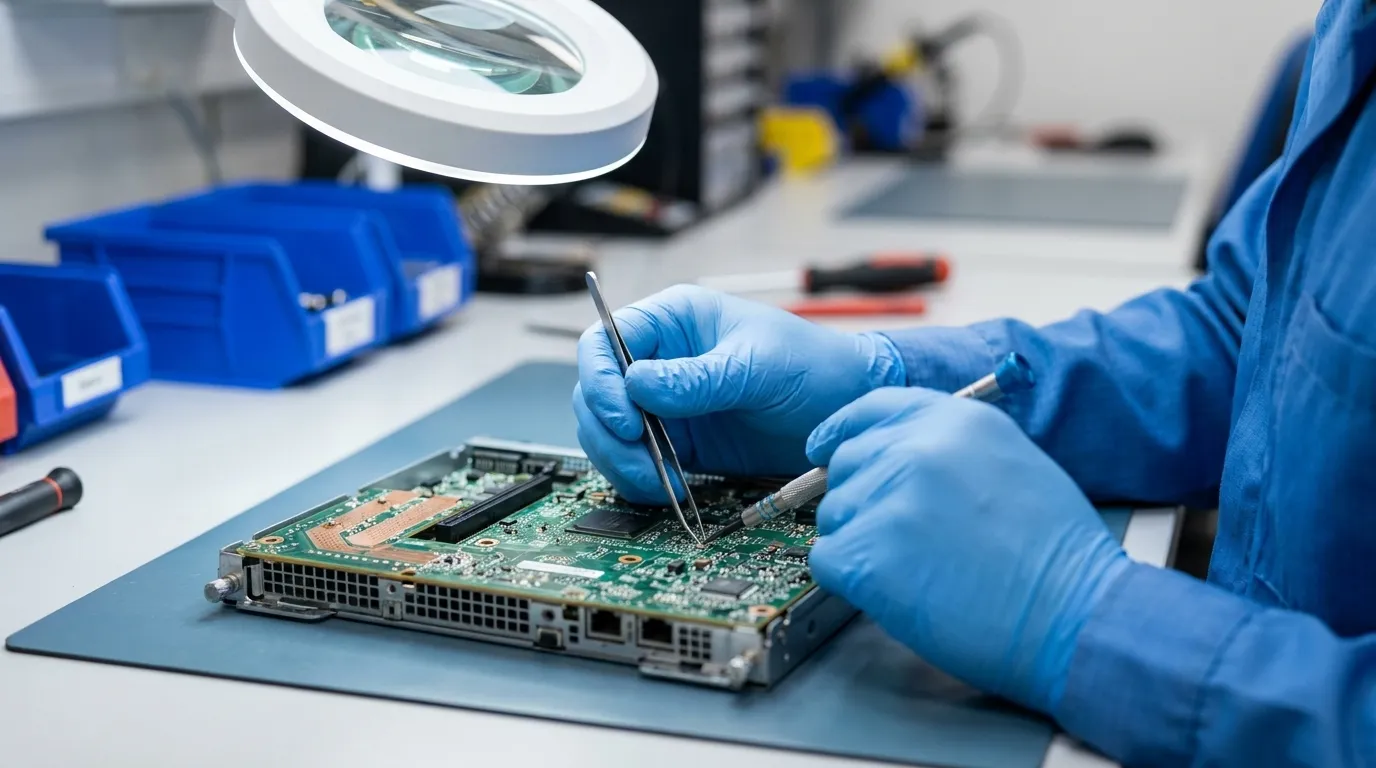
Repair scope follows the condition grade assigned at intake. That grade maps to one of four depot repair levels, from basic diagnostics and software reloads at Level 1 to board-level and component-level repair at Level 4. Premier Logitech performs all four levels across its DFW facilities as an authorized service center for multiple OEM brands, so units move through any required repair tier without leaving the network.
ASC authorization shapes what work a provider can perform. OEM warranty programs and government procurement rules often restrict repair to authorized partners. A provider without ASC status for the relevant OEM brand cannot legally perform warranty repairs, which limits the pool of units that qualify for certified resale or redeployment.
Cosmetic refurbishment runs in parallel with functional repair. AI-powered cosmetic grading systems replace manual inspection with high-speed image recognition that evaluates thousands of SKUs. These systems remove subjectivity from grading and produce consistent, defensible condition classifications that secondary market buyers and enterprise procurement teams require.
Step 3: Grading Standards and Secure Data Sanitization
Grading assigns each unit a standardized condition tier, typically A, B, C or scrap, based on functional test results and cosmetic evaluation. The grade then sets the resale channel, pricing tier and packaging specification for that unit.
Data sanitization runs alongside grading and applies to every device that stored user or organizational data. ADISA-certified HDD and SSD testing and data erasure with full digital audit trails ensure that no residual data advances to kitting or resale. Chain-of-custody enforcement, including physical isolation by data sensitivity and cross-system verification with hard stops, prevents any asset from moving forward without complete documentation.
For government contractors and enterprise clients, this audit trail functions as the compliance record. It shows that data destruction met the required standard before the device left the secure environment.
Step 4: Compliant Kitting, Packaging and TAA Support
Kitting assembles repaired, graded and data-sanitized devices and components into ready-to-deploy sets based on a defined bill of materials. Each kit follows a specific configuration that covers device, accessories, documentation and packaging matched to the downstream channel, such as secondary market resale, enterprise redeployment, government fulfillment or OEM warranty replacement.
Packaging compliance operates as a separate requirement from functional compliance. TAA-compliant packaging, labeling and country-of-origin documentation are required for federal procurement. Premier Logitech nearshore operations in Laredo and Nuevo Laredo meet these requirements while delivering cost-competitive kitting at scale, combining TAA-designated country sourcing with proximity to U.S. distribution networks. Monthly kitting capacity reaches high volumes across the Premier Logitech network.
Talk to a lifecycle expert about building a kitting program scaled to specific return volumes and compliance requirements.
Electronics and Telecom Programs That Benefit Most
Telecom carriers that process handset returns at scale manage high unit volumes, tight warranty windows and secondary market channels that demand consistent grading. Integrated refurbishment kitting services move returned devices from intake through certified resale without multiple vendor handoffs.
Consumer electronics OEMs that manage seasonal return surges gain similar value from consolidation. A single partner that handles repair, grading, data wipe and kitting compresses cycle time and reduces the coordination overhead that fragmented vendor relationships create.
Asset recovery programs that integrate refurbishment with kitting recover more value per unit than programs that treat repair and fulfillment as separate workstreams. The sustainability impact is significant as well. A refurbished smartphone reduces greenhouse gas impact by roughly 77% to 91% compared with manufacturing a new device.
Compliance Frameworks for Government and Enterprise
Government and regulated enterprise programs impose compliance requirements that generic 3PL kitting providers often do not support. The relevant frameworks include:
- TAA (Trade Agreements Act): Requires that products sold to the federal government are manufactured or substantially transformed in TAA-designated countries. Kitting operations must document country of origin for every component in the kit.
- NIST SP 800-88: Establishes guidelines for media sanitization. Data destruction procedures must align with NIST standards and produce auditable records.
- CMMC (Cybersecurity Maturity Model Certification): Defense contractors that handle controlled unclassified information must demonstrate cybersecurity practices that extend to asset handling and data destruction in reverse logistics workflows.
- SOC 2: Requires documented controls over security, availability and confidentiality. This standard applies to enterprise clients whose IT assets contain sensitive organizational data.
- ISO 9001 / ISO 14001: Quality management and environmental management standards that govern process consistency and responsible disposal practices.
Premier Logitech holds certifications across TAA, TAPA, ISO, NIST, CMMC and SOC 2 frameworks and carries CAGE Code 4WAJ9 as a pre-vetted federal government partner. Reliable refurbished IT suppliers must demonstrate compliance and data security procedures, because secure data erasure from used equipment is essential for data-privacy regulations.
Cost and ROI for Integrated Refurbishment Kitting
The ROI case for integrated refurbishment kitting services rests on four drivers: recovered asset value, reduced vendor coordination costs, faster cycle time and compliance risk avoidance.
Fragmented workflows that use separate vendors for repair, grading, data destruction and kitting introduce handoff delays, duplicate handling costs and gaps in chain-of-custody documentation. These gaps create potential compliance events and erode asset value across the pool. Enterprises can reduce IT hardware costs by purchasing certified refurbished equipment rather than new, which creates a direct incentive to maximize the number of units that reach certified resale condition.
Single-vendor consolidation removes the coordination layer. One partner manages intake through fulfillment, one audit trail covers the full workflow and one contract governs the program. That structure reduces administrative overhead and accelerates the return-to-revenue cycle.
Refurbishment Kitting Provider Selection Checklist
Operations and supply chain leaders can use the following criteria when evaluating refurbishment kitting providers:
- ASC authorization status for the relevant OEM brands in the program
- Repair capability that spans L1 through L4 depot repair
- NIST-aligned and ADISA-certified data destruction with full audit trails
- AI-assisted or standardized cosmetic grading with documented condition criteria
- TAA-compliant kitting and packaging operations
- CMMC, SOC 2 and ISO certifications relevant to the client industry
- Monthly kitting and repair capacity that absorbs peak return volumes
- Chain-of-custody documentation from intake through final kit shipment
- Nearshore or domestic operations that support TAA compliance and competitive cycle times
- Single point of contact for program management across all service lines
Definition: What Is a Kitting Service?
A kitting service assembles individual components, devices or accessories into a preconfigured set, or kit, ready for shipment or deployment. In IT and electronics logistics, kitting combines hardware, software media, cables, documentation and packaging into a single unit that ships as one SKU. Refurbishment kitting extends this model by using repaired and graded devices rather than new inventory, which adds repair, data sanitization and compliance documentation to the assembly workflow.
Role Focus: What a Kitting Specialist Manages
A kitting specialist manages the assembly of multicomponent kits according to a defined bill of materials. In a refurbishment context, the role extends to coordination with repair technicians, graders and data destruction teams so that only units with the required condition grade and compliance status enter the kitting line.
Kitting specialists also manage packaging specifications, labeling requirements and serialization to support downstream channel requirements, including secondary market resale, enterprise redeployment and government fulfillment.
Conclusion and Next Steps
Refurbishment kitting services form the operational bridge between raw returns and revenue-ready inventory. The four-step workflow of inspection and testing, repair and refurbishment, grading and data sanitization and compliant kitting and packaging converts high-volume returns into certified, sellable kits while maintaining the documentation that government and enterprise programs require.
Premier Logitech delivers this workflow as a single-vendor program, combining ASC-authorized repair, NIST-aligned data destruction, standardized grading and TAA-compliant kitting across three DFW facilities and nearshore Mexico operations. This structure removes the fragmentation described earlier while maintaining full audit trails across all service lines.
Talk to a lifecycle expert to assess how Premier Logitech refurbishment kitting services can convert a returns program into a structured asset recovery operation.
Frequently Asked Questions
What is the difference between standard 3PL kitting and refurbishment kitting services?
Standard 3PL kitting assembles new or pre-staged inventory into configured sets for outbound fulfillment. Refurbishment kitting services start earlier in the asset lifecycle and process returned or end-of-use devices through depot repair, functional testing, cosmetic grading and secure data destruction before any kitting work begins. The output is a certified, compliant kit built from refurbished inventory rather than new stock, which supports warranty returns, trade-in programs and government surplus programs that require chain-of-custody documentation and compliance certification at every step.
How does Premier Logitech handle data destruction within a refurbishment kitting program?
Premier Logitech performs secure data destruction aligned with NIST SP 800-88 guidelines as an integrated step before grading. The audit trail captures method, date, technician and device serial number, which provides the compliance record that enterprise and government clients require for data-privacy obligations.
What compliance certifications should a refurbishment kitting provider hold for government contractor programs?
Government contractor programs typically require a provider to demonstrate TAA-compliant sourcing and packaging, NIST-aligned data destruction procedures, CMMC certification relevant to the contractor level, SOC 2 controls for data security and confidentiality and ISO 9001 quality management certification. Providers that work with defense or federal civilian agencies should also carry a CAGE Code, which identifies them as a pre-vetted federal government partner. Premier Logitech holds certifications across these frameworks and operates under CAGE Code 4WAJ9.
Can refurbishment kitting services scale to handle seasonal return surges or high-volume OEM programs?
Scalability depends on facility footprint, repair capacity and kitting infrastructure. Premier Logitech operates across three DFW facilities with nearshore operations in Laredo and Nuevo Laredo, which supports high kitting capacity and substantial weekly repair volumes. Programs can run as end-to-end lifecycle management or as modular services, so clients can engage specific capabilities such as depot repair, grading or kitting without a full program overhaul. This flexibility supports steady-state return volumes and peak surge scenarios.
What role does OEM authorization play in refurbishment kitting for warranty returns?
OEM authorization defines which providers can legally perform warranty repairs on a brand portfolio. Unauthorized repair voids warranty coverage and disqualifies units from certified resale channels that require OEM-backed condition certification. Telecom carriers, consumer electronics OEMs and enterprise IT programs that manage warranty return pools rely on ASC-authorized providers to maximize the number of units that reach certified resale or redeployment status. Premier Logitech holds ASC authorization for more than 20 OEM brands, which covers a broad range of IT and electronics product categories.
