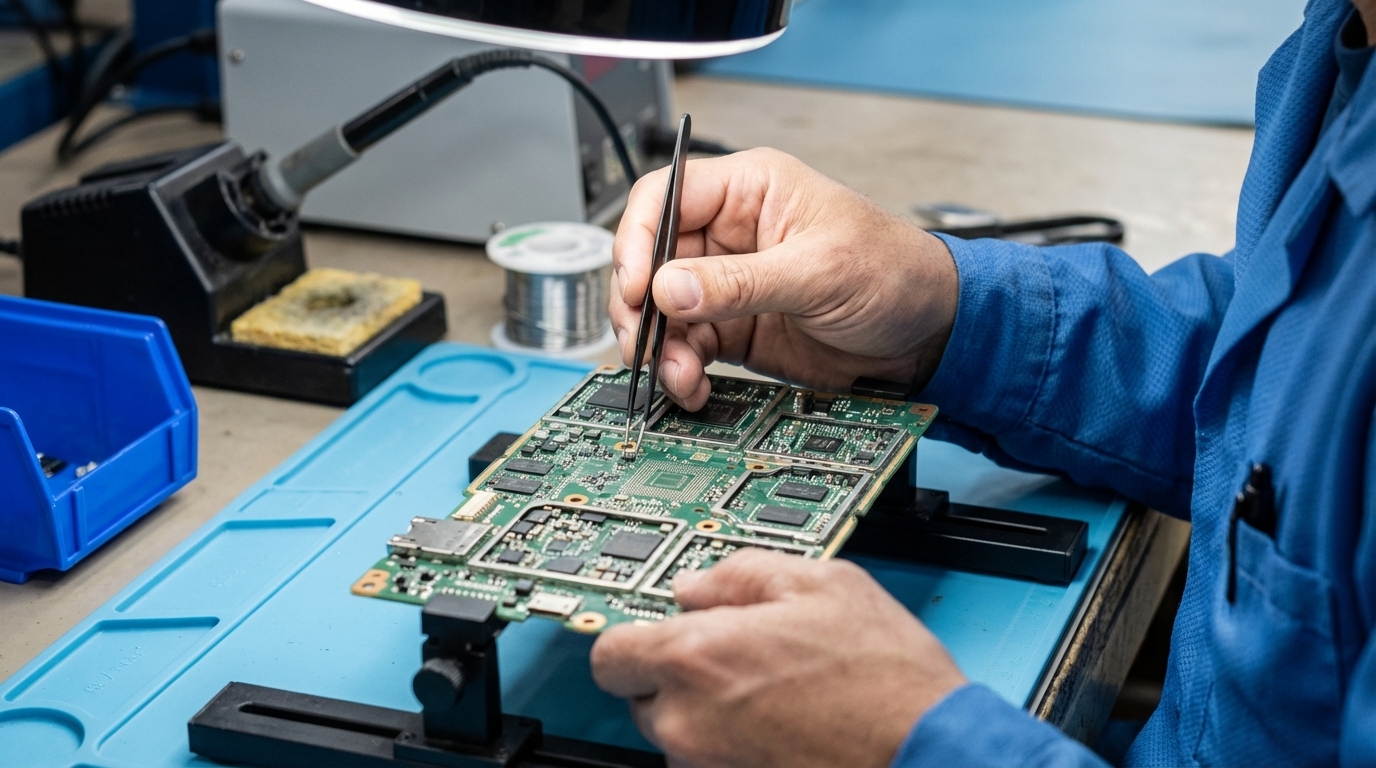
Last updated: August 7, 2026
Key Takeaways for First-Time Hardware OEMs
-
Contract manufacturing lets OEMs outsource production while retaining full IP ownership, brand control and customer relationships.
-
Preparing a complete pre-quote package with design files, BOM, volumes, compliance requirements and packaging specs reduces delays and improves pricing accuracy.
-
Clear distinctions between OEM, EMS and ODM models help companies select the right manufacturing partner and avoid misaligned expectations.
-
Structured NPI phases (EVT, DVT, PVT) and a suitable sourcing model (turnkey, consigned or hybrid) reduce common first-time OEM mistakes.
-
Selecting a partner with integrated lifecycle services from PCBA and box build through depot repair and asset recovery eliminates vendor fragmentation and reduces total program cost.
OEM, EMS and ODM Roles in Hardware Manufacturing
Three distinct models govern how hardware products move from concept to market. Clear definitions prevent misaligned expectations with manufacturing partners.
An OEM owns the design, IP, brand and customer relationship and outsources production to a contract manufacturer or EMS provider. Apple designing the iPhone and contracting Foxconn to build it illustrates this model.
An EMS provider manufactures products to the OEM’s design and specification, with the OEM retaining full IP ownership. EMS scope can extend beyond assembly to include design support, supply chain management, testing and full-scale production. The global EMS industry continues to expand.
An ODM designs and manufactures a product, then sells it to companies that rebrand or lightly customize it. The ODM retains ownership of the core design and IP. Quanta designing laptops sold under HP, Dell and Lenovo brands shows this model in practice.
For first-time U.S. hardware OEMs with original designs, the EMS or contract manufacturing model is the standard path. The OEM supplies complete design files, and the CM or EMS partner executes production.
Information Needed Before Requesting a Manufacturing Quote
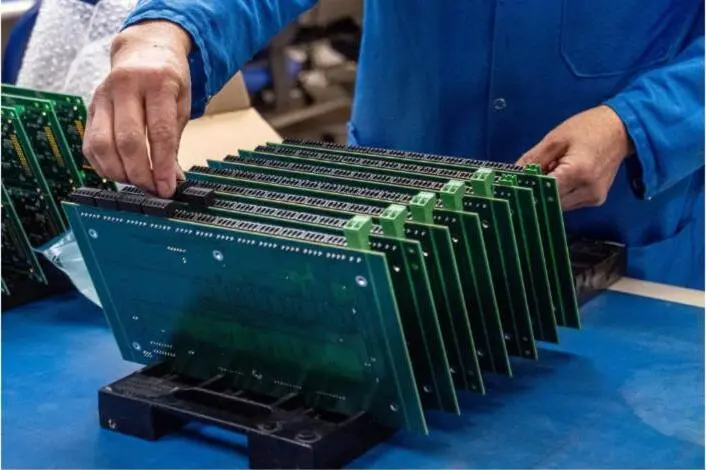
Once the appropriate manufacturing model is selected, the next step is preparing documentation for the RFQ process. A complete pre-quote package reduces back-and-forth, produces accurate pricing and signals to a CM that the program is ready to move. A buyer’s guide recommends treating CM selection as a strategic partnership rather than a simple price comparison, which means arriving prepared.
The seven items below form the minimum viable package for an electronics RFQ. Together they describe what will be built, how it will be tested and the commercial expectations.
-
Design files: Gerber, ODB++ or IPC-2581 files representing the release-ready PCB design.
-
Bill of materials: Full manufacturer part numbers, quantities per assembly and an approved vendor list with lifecycle status.
-
Pick-and-place data: Centroid file mapping component reference designators to board coordinates.
-
Assembly drawings: Mechanical and assembly drawings showing orientation, special instructions and connector locations.
-
Test specifications: ICT, functional test or burn-in requirements with clear pass and fail criteria.
-
Volume and delivery requirements: Initial order quantity, annual forecast and target delivery schedule.
-
Compliance and regulatory requirements: FCC, UL, TAA, CMMC, ITAR, RoHS or other applicable frameworks.
A strong AVL classifies components by country of origin, tariff exposure, lifecycle status and alternate source availability. Section 301 tariffs on China-origin electronics inputs remain in place, which makes domestic U.S. partners more cost-competitive for IP-sensitive programs once tariff exposure and policy volatility are considered.
Production-Ready File Package for Contract Manufacturers
The RFQ package establishes scope and commercial terms. A production-ready submission adds technical depth that supports DFM review and smooth manufacturing execution.
Beyond the seven-item RFQ package described above, a complete file set for a production-ready program includes these additional elements.
-
PCB specification: Material, finish, impedance, stackup and IPC class requirements.
-
Schematic: Circuit-level documentation that supports DFM review and troubleshooting.
-
Firmware files: Hex or binary files with programming instructions and version control notes.
-
Mechanical files: STEP or IGES files for enclosure, connector and thermal interface verification.
Fine-pitch BGA, 01005 and press-fit parts require tighter process control and should be flagged explicitly in the assembly drawing. A useful DFM review identifies specific problems rather than simply stating that a design is manufacturable.
EVT, DVT and PVT Phases for Hardware Products
New Product Introduction in hardware manufacturing is a structured process that takes a design from a working prototype to stable, repeatable mass production. It follows three build phases, each with a defined purpose, typical quantity range and exit criteria.
Engineering Validation Test (EVT) proves that the electronics perform every core function on boards assembled with production-representative processes. EVT typically builds a modest number of units and exits when all functions work, major design risks are retired and the schematic is frozen for DVT. Typical EVT timelines run several weeks including iteration via design changes and re-prototyping.
Design Validation Test (DVT) proves the complete product, including electronics, enclosure and firmware, meets its full specification across environmental, reliability and regulatory requirements. DVT typically builds a moderate number of units and exits when the product meets full spec, certification samples are submitted and the BOM and mechanicals are frozen. DVT timelines typically run several weeks because environmental testing and certification sample preparation often gate the schedule. FCC and other certification testing should be built into the DVT stage using near-production units from the intended production factory, because testing too late can force PCB redesigns that restart tooling.
Production Validation Test (PVT) proves the factory can manufacture the product at target yield, rate and cost using final tooling, fixtures and test coverage. PVT typically builds a larger number of units and exits when target yield is hit at line rate, test coverage and work instructions are locked and unit cost is confirmed. PVT requires a minimum of several weeks.
Common phase-transition risks include skipping DVT and jumping to a large build, which can multiply failures such as EMC issues or enclosure warping across thousands of units and BOM churn during PVT that invalidates validation data.
Turnkey, Consigned and Hybrid Manufacturing Models
The sourcing model chosen for a program affects cost structure, timeline, supply chain control and risk allocation. Three models are in common use.
Turnkey means the CM sources all components and manages the full supply chain. Turnkey reduces administrative overhead and coordination friction by providing single-point accountability for procurement, kitting and assembly. Turnkey is recommended for startups, lean teams, speed-critical launches and projects with complex multi-line BOMs. The tradeoff is reduced direct control over individual component sourcing decisions.
Consigned means the OEM supplies all components and the CM provides only labor, equipment and process expertise. Consigned assembly delivers cost savings for companies that already hold discounted or existing component inventory and is required for defense and aerospace projects under DFARS 252.246-7008 to maintain traceability when using customer-furnished components from approved sources. The risk is that a single missing or incorrect-revision part can halt production. Hidden logistics, kitting, coordination and supply chain management overhead costs can erase apparent savings.
Hybrid lets the OEM consign specialized or long-lead components while the CM sources common passives and standard ICs. Hybrid models balance control with volume pricing and reduced coordination burden and serve as the default model for many mid-sized businesses.
The four primary decision factors are internal procurement bandwidth, component sensitivity or qualification requirements, timeline pressure and production maturity stage.
How to Choose a Contract Manufacturing Partner
Partner selection for a first-time OEM involves evaluating location, experience, volume fit and certification depth. A buyer’s guide recommends evaluating contract manufacturers across seven criteria: scope and capability fit, certification depth, quality metrics, automation maturity, supply chain resilience, NPI process rigor and pilot structure.
Key selection criteria work together to define long-term fit and risk.
-
Location and logistics: Domestic U.S. partners reduce tariff exposure, IP risk and communication friction. Nearshore operations in Mexico offer labor cost advantages with shorter transit times than Asia.
-
Capability breadth: Confirm capabilities in SMT and through-hole assembly, DFM and DFA review, functional test development and box build under one roof to avoid quality risks from multiple handoffs.
-
Certifications: For government or defense-adjacent programs, TAA compliance, CMMC, NIST and ISO certifications are nonnegotiable. Quality standards for electronics CMs include ISO 9001, IPC-A-610, J-STD-001 and RoHS/REACH compliance depending on the product and market.
-
Quality metrics: Request hard quality data including first-pass yield by product type, defect rate in DPMO, on-time delivery percentage, rework rate and CAPA closure time.
-
Lifecycle integration: A partner that handles repair, returns and asset recovery reduces handoffs and simplifies program management.
Premier Logitech operates three DFW facilities with nearshore operations in Laredo and Nuevo Laredo, Mexico. The company holds TAA, ISO, NIST, CMMC and SOC 2 certifications, carries a CAGE Code for federal programs and operates as an authorized service center for more than 20 OEM brands. Services span PCBA, box build, configuration, fulfillment, depot repair and full lifecycle management from a single partner.
Key Questions for Evaluating a CM
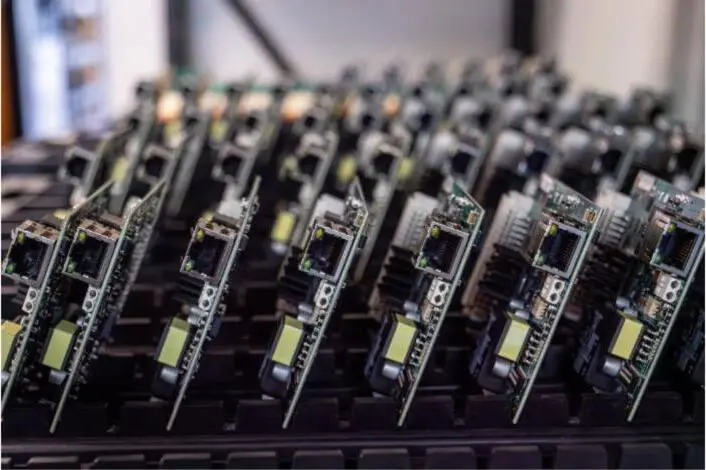
Targeted questions reveal compliance gaps, IP risks and supply chain vulnerabilities before a contract is signed.
-
What certifications does the facility hold, and can the scope documents be reviewed rather than just the logos.
-
How is intellectual property protected under the NDA and master supply agreement, and who owns customer-paid tooling and fixtures.
-
Is the facility TAA compliant, and can it support CMMC or NIST requirements for government-adjacent programs.
-
How are counterfeit components prevented, and does the CM source from authorized distributors such as Digi-Key, Mouser, Arrow or Avnet.
-
What is the process for DFARS 252.246-7008 traceability if the program involves U.S. government supply chains.
-
Does the CM offer ASC-authorized repair for post-production warranty and depot services, or will a separate vendor be required.
-
What visibility tools are available for inventory tracking, lifecycle analytics and real-time program status.
-
Can the partner scale from prototype quantities through volume production and into reverse logistics without a vendor change.
Premier Logitech’s ASC-authorized repair network, government-grade compliance stack and single-source lifecycle model address each of these questions directly. The company’s CAGE Code 4WAJ9 identifies it as a pre-vetted partner for U.S. federal programs.
Common Contract Manufacturing Mistakes for First-Time OEMs
First-time OEMs encounter a recurring set of avoidable problems when engaging contract manufacturers. Awareness of these patterns reduces program risk.
-
Submitting incomplete design files: Missing pick-and-place data, an incomplete BOM or absent test specs forces the CM to pause and request information, which delays pricing and production start.
-
Skipping DVT: As noted in the NPI phase discussion, bypassing design validation testing pushes undetected failures into volume production.
-
Choosing consigned assembly without full cost analysis: Hidden logistics, kitting, coordination and supply chain management overhead costs can erase apparent savings.
-
Delaying compliance planning: Electronic products sold in the United States that emit radio frequency energy must address FCC equipment authorization requirements. Other frameworks such as UL or NRTL, CPSC or TSCA may apply depending on the specific product. Discovering gaps at PVT forces costly redesigns.
-
Fragmenting vendors across repair, fulfillment and recycling: Multiple handoffs create visibility gaps, compliance inconsistencies and higher total program cost.
-
Selecting a CM without ASC authorization: OEM warranty requirements often restrict repair to authorized service centers. A CM without ASC status forces a separate repair vendor relationship after production.
-
Underestimating NRE costs: Total NRE for a straightforward Bluetooth consumer electronics device can be substantial before the first production unit ships.
Premier Logitech’s integrated model, which spans contract manufacturing, configuration, fulfillment, depot repair and reverse logistics, addresses the fragmentation and compliance gaps that generate most of these mistakes.
Conclusion and Next Steps for OEM Programs
Successful contract manufacturing outsourcing depends on preparation across design files, build phases, sourcing models and compliance requirements. First-time OEMs that arrive with complete documentation, understand EVT, DVT and PVT sequencing, select the right manufacturing model and choose a compliant U.S. partner avoid the most costly first-timer mistakes.
Premier Logitech’s integrated model, described in the partner selection and lifecycle sections above, aligns with the preparation, compliance and post-production needs outlined in this guide.
Frequently Asked Questions
What is the difference between a contract manufacturer and an EMS provider
A contract manufacturer builds products strictly to a client’s complete design specifications. An EMS provider offers a broader scope that can include design support, supply chain management, PCB assembly, testing and full-scale production, while the OEM retains full IP ownership. In practice, many EMS providers function as contract manufacturers for OEM programs. The key distinction is scope, because EMS providers typically offer more integrated services beyond assembly alone.
Do first-time OEMs need to complete all three NPI phases, EVT, DVT and PVT, before mass production
Skipping any phase carries significant risk. EVT confirms that core electronics function correctly. DVT validates the complete product against its full specification, including regulatory and environmental requirements, and serves as the correct stage for FCC and other certification testing. PVT confirms that the factory can produce the product at target yield and cost using final tooling. Skipping DVT in particular can result in failures that multiply across large production runs and require costly rework or redesign. Each phase has defined exit criteria that should be met before advancing.
What compliance certifications should a U.S. OEM require from a contract manufacturing partner
The required certifications depend on the end market. For commercial electronics, ISO 9001, IPC-A-610, J-STD-001 and RoHS or REACH compliance form a standard baseline. For government or defense-adjacent programs, TAA compliance, CMMC, NIST alignment and SOC 2 are necessary. Programs involving U.S. federal procurement benefit from a partner with a CAGE Code, which identifies the facility as a pre-vetted government supplier. For medical-adjacent electronics, ISO 13485 is required. OEMs should request actual scope documents rather than relying on certification logos to confirm that covered processes match the program’s needs.
When does it make sense to choose a turnkey manufacturing model over a consigned model
Turnkey fits early-stage programs, lean internal teams, complex multi-line BOMs and speed-critical launches. It provides single-point accountability for procurement, kitting and assembly and reduces coordination overhead. Consigned assembly fits situations where the OEM already holds qualified component inventory, where proprietary or regulated parts must be sourced directly or where defense program traceability requirements under DFARS 252.246-7008 mandate customer-furnished components. A hybrid model, where the OEM consigns specialized parts while the CM sources standard components, offers a practical middle path for many mid-stage programs.
Why does post-production lifecycle management matter when selecting a contract manufacturing partner
Most first-time OEMs focus on reaching production and underestimate the operational complexity of what follows, including warranty repair, returns processing, refurbishment, asset recovery and end-of-life recycling. Engaging a separate vendor for each of these functions creates fragmented visibility, compliance inconsistencies and higher total program cost. A partner with ASC-authorized repair capabilities, depot repair infrastructure and reverse logistics services removes those handoffs. It also ensures that warranty repair meets OEM authorization requirements, which many standard contract manufacturers cannot satisfy without ASC status.
