Last updated: August 6, 2026
Key Takeaways for PCB Contract Manufacturing Decisions
- Selecting a PCB contract manufacturing partner requires clear evaluation of volume fit, certifications, sourcing model, and lifecycle coverage to prevent re-qualification and compliance risk.
- Defense, medical and industrial OEMs prioritize TAA compliance, CMMC, ITAR, IPC-A-610 Class 3 and ISO 13485 when screening manufacturers.
- Turnkey assembly reduces coordination work and supply chain exposure, while mixed sourcing models often fit mid-volume regulated programs.
- Domestic and nearshore manufacturing options cut tariff exposure, shorten transit timelines and support ITAR compliance for US electronics OEMs in 2026.
- Premier Logitech consolidates PCBA, box-build and reverse-logistics services under one TAA-compliant roof explore consolidated lifecycle services.
Match Production Volume to Partner Capabilities
Production volume and product mix determine the minimum capabilities a PCB partner must demonstrate before vendor qualification. Three buyer archetypes cover most PCB contract manufacturing engagements and each aligns with a different partner profile.
- Prototype and low-mix OEMs need flexibility, fast iteration, DFM feedback and low minimum-order quantities. These requirements are met when the partner engages before Gerber files are finalized, provides early DFM input that prevents costly rework and supports engineering changes without production penalties that slow iteration.
- Mid-volume regulated OEMs need a partner that runs the same quality system across NPI and steady-state production, maintains IPC-certified staff and holds the compliance credentials required for regulated programs.
- High-volume enterprise OEMs need process stability, statistical process control, locked BOMs and capacity planning that scales with demand forecasts.
Switching PCB contract manufacturing partners mid-lifecycle creates re-qualification costs, new test fixture validation, operator retraining and yield loss during ramp. These costs arise because institutional product knowledge rarely transfers cleanly between vendors. A scalable partner runs consistent quality systems from prototype through volume production so programs can grow without disruptive transitions.
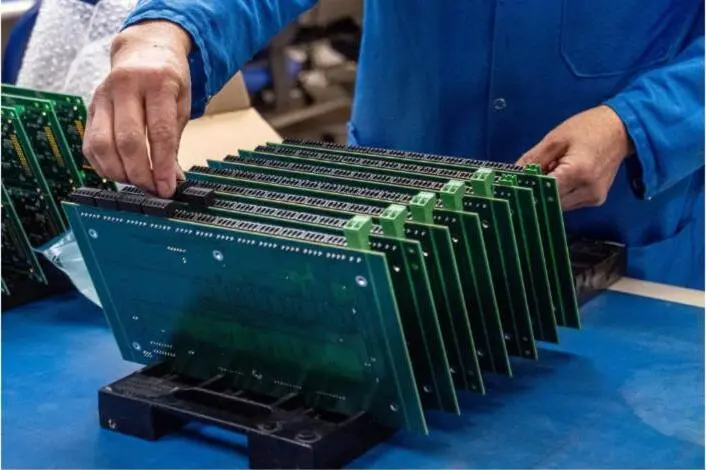
Premier Logitech supports mid-volume regulated OEMs with PCBA capabilities spanning SMT, through-hole, flex circuit assembly, BGA reballing, sub-assembly and full box-build and electromechanical assembly. A single program framework covers these services and removes handoffs between vendors.
Discuss your volume roadmap with a program specialist.
Certifications That Matter Most for Defense and Medical OEMs
Certification depth separates compliant partners from marketing claims and protects regulated programs from audit findings. For regulated programs the following credentials are non-negotiable and should appear in any serious vendor shortlist.
- TAA compliance supports federal procurement and government-adjacent supply chains. Premier Logitech holds TAA certification and CAGE Code 4WAJ9, which establishes pre-vetted status for US federal programs.
- CMMC 2.0 Level 2 requires implementation of all 110 controls from NIST SP 800-171 Rev. 3 with third-party assessment every three years.
- ITAR applies to manufacturers working with defense articles or technical data and requires that data storage, access and transmission occur only on US-person-controlled infrastructure.
- IPC-A-610 Class 3 and J-STD-001 support defense, aerospace and implantable medical device programs that require the most stringent solder fillet minimums, surface conditions and documentation requirements. ISO 9001 alone does not confirm IPC workmanship compliance.
- ISO 13485 requires medical OEMs to demonstrate supplier control under Clause 7.4 and component-level traceability under Clause 7.5.9.
- ISO 9001/14001, NIST, SOC 2 provide broader quality, environmental and data-handling frameworks. Premier Logitech maintains these alongside TAA and CMMC compliance to support commercial and government program requirements.
When auditing a potential partner start by requesting quality manuals that explicitly reference IPC-A-610 and J-STD-001 by revision. Generic mentions suggest the standards have not been built into documented procedures. Next request structured First Article Inspection reports to confirm that the documented procedures are executed on real production builds. Finally confirm that IPC-certified staff hold current credentials so qualified personnel apply those procedures on the line.
Turnkey Versus Consignment Trade-Offs in PCB Sourcing
Once certification credentials are verified the next decision point is sourcing strategy. Turnkey PCB assembly centralizes sourcing, kitting, assembly, testing and box-build into one workflow under a single provider, while consigned models require the OEM to source and ship all components, leaving procurement, authenticity verification and multi-vendor coordination with the OEM.
The core trade-off centers on control versus efficiency. Turnkey transfers supply chain risk and coordination work to the provider and simplifies accountability when issues arise. Consigned assembly preserves direct OEM control over sourcing decisions and can generate savings for OEMs with established distributor pricing and stable high-volume BOMs.
A full turnkey partner manages component sourcing, traceability and obsolescence response across the product lifecycle. Board-only providers leave these responsibilities with the OEM, which increases internal workload and complicates root-cause analysis during failures.
A mixed model often fits mid-volume regulated programs. In this structure high-risk or allocated components remain buyer-controlled while standard passives are sourced by the assembler. Premier Logitech supports turnkey, consigned and mixed models through integrated PCBA, box-build, electromechanical assembly and an authorized service-center network, which reduces coordination burden regardless of the sourcing approach.
US Facilities and Nearshore Options for Regulated Programs
The US share of global PCB production has declined sharply while China has increased its share of world supply, which creates a concentrated dependency for US OEMs. New legislation is moving toward requiring that defense electronics be sourced from the US and the Protecting Circuit Boards and Substrates Act introduced in May 2026 offers a 25 percent tax credit for companies purchasing American-made circuit boards.
Section 301 tariffs of 25 percent on China-origin electronics inputs remain active in 2026, which raises the effective cost of offshore manufacturing. Beyond cost, domestic and nearshore manufacturing eliminates offshore transit delays and compresses total turnaround time for prototypes, design revisions and production support.
Premier Logitech operates three DFW facilities with nearshore operations in Laredo and Nuevo Laredo, Mexico. This hub provides real-time engineering support, same-time-zone communication for rapid ECO resolution and cost-effective capacity for programs that benefit from nearshore labor rates without sacrificing compliance or visibility.
Explore domestic and nearshore capacity for your program.
Red Flags When Vetting PCB Manufacturing Vendors
Vendor selection mistakes in regulated electronics programs are expensive to unwind, so early warning signs matter. The following red flags often indicate systemic capability gaps rather than isolated issues.
- No IPC-certified staff on record indicates that a partner claiming Class 3 capability cannot substantiate the claim with documented, current IPC certifications.
- Generic quality manual references show up when quality manuals mention IPC-A-610 and J-STD-001 only generically instead of by specific revision.
- No authorized repair credentials means a partner without OEM Authorized Service Center status cannot perform warranty-valid repairs, which creates downstream liability for OEMs with field-return programs.
- Counterfeit component risk increases when manufacturers source outside authorized channels. US-based manufacturers reduce this risk by sourcing from authorized distributors and maintaining lot-level traceability, supported by an approved vendor list and documented incoming inspection procedures.
- Fragmented lifecycle coverage occurs when a partner handles PCBA but not box-build, repair or returns, which forces OEMs to manage multiple vendor relationships and raises coordination and compliance risk.
- Engagement only after Gerber receipt signals a production-execution shop rather than a development partner that provides early DFM and DFA input.
Premier Logitech holds ASC status with more than 20 OEM brands, which provides authorized repair credentials that few competitors match. Single-vendor consolidation across PCBA, box-build, configuration, fulfillment and reverse logistics removes fragmentation that drives compliance risk and operational inefficiency.
How to Request Quotes That Reveal the Right Partner
Quote requests can reveal more about a partner than the pricing itself when structured around capability checks. The following questions help qualify vendors before any program commitment.
- At what stage do engineers get involved, before Gerbers or after
- Which IPC certifications does staff hold and when were they last renewed
- What is the First Article Inspection process and can a sample FAI report be provided
- How are EOL and NRND component alerts managed and what response process applies
- What TAA, CMMC, ITAR and ISO certifications are current and can documentation be shared
- Does the partner hold OEM ASC status and for which brands
- How are field returns, depot repair and reverse logistics handled, in-house or subcontracted
- What does the prototype-to-production handoff process include and what documentation is required
A partner that answers these questions with documented evidence rather than marketing language operates a mature quality system. Premier Logitech delivers end-to-end lifecycle services, an ASC network and a compliance framework designed to address every question on this list with verifiable credentials.
Request a program assessment and vendor qualification review.
Frequently Asked Questions
Premier Logitech addresses common questions about PCB contract manufacturing for defense, medical and industrial OEMs.
What certifications should a PCB contract manufacturer hold for defense and medical OEM programs
Defense programs require the TAA, ITAR, CMMC and IPC-A-610 Class 3 credentials outlined earlier. Medical programs require ISO 13485 with scope covering electronic assembly plus the same IPC workmanship standards. Both program types benefit from ISO 9001, NIST alignment and SOC 2 for data handling. Premier Logitech holds the TAA, CMMC and ISO certifications detailed earlier, alongside CAGE Code 4WAJ9 for federal program eligibility.
What is the difference between turnkey and consigned PCB assembly and which model fits regulated OEMs
Turnkey assembly means the contract manufacturer handles component sourcing, PCB fabrication, assembly, testing and often box-build under one workflow. Consigned assembly means the OEM supplies all components and the manufacturer provides assembly services only. For regulated OEMs with complex BOMs, limited internal sourcing resources or lifecycle management needs, turnkey reduces coordination work and consolidates compliance accountability. Consigned models fit situations where the OEM has established distributor pricing and stable high-volume BOMs. A mixed model, where critical components remain buyer-controlled, often suits mid-volume regulated programs.
Why does domestic or nearshore PCB manufacturing matter for US OEMs in 2026
Domestic and nearshore manufacturing eliminates the offshore transit delays and tariff exposure discussed earlier while supporting ITAR compliance by keeping design data and production within US-person-controlled environments. Premier Logitech’s DFW facilities and Laredo and Nuevo Laredo nearshore operations provide domestic compliance coverage with cost-effective capacity options.
How does single-vendor consolidation reduce risk for electronics OEMs
Fragmented vendor relationships across PCBA, box-build, configuration, fulfillment and reverse logistics create multiple points of compliance exposure, communication gaps and accountability gaps when quality issues arise. A single partner that covers the full lifecycle, from sourcing and manufacturing through repair, returns and recycling, reduces coordination overhead, improves traceability and simplifies audit trails for regulated programs. Premier Logitech consolidates these services under one TAA-compliant roof, including ASC-authorized depot repair for more than 20 OEM brands.
What should an OEM include in a prototype-to-production handoff package for a PCB contract manufacturer
A complete handoff package includes the current BOM with manufacturer part numbers and approved alternates, Gerber or ODB++ files, pick-and-place data, assembly drawings, PCB and firmware revision history and target quantities with annual forecast. It also includes turnkey or consigned material preference, test expectations such as AOI, X-ray, ICT or functional test requirements, firmware files and serialization rules, labeling and packaging requirements and acceptance criteria referenced to the applicable IPC class. Providing this package upfront reduces ECO cycles, prevents production delays and gives the contract manufacturer the information needed for a clean NPI process.
