Last updated: August 11, 2026
Key Takeaways
- High-volume PCB fabrication at 100,000 or more boards per year depends on five criteria: capacity, ITAR and defense certifications, HDI and rigid-flex capability, total cost of ownership, and integration with PCBA and lifecycle services.
- Leading U.S. fabricators such as TTM Technologies, Sanmina, Summit Interconnect, AdvancedPCB and Sierra Circuits serve distinct high-reliability segments with documented certifications and production capabilities.
- ITAR registration and defense certifications such as AS9100D and IPC-6012 Class 3 are non-negotiable for government and aerospace programs, and verification must extend to active production lines.
- Domestic sourcing reduces compliance risk and exposure to supply-chain disruption compared with offshore options, even when unit pricing appears lower, because of tariff, logistics and inventory impacts.
- Premier Logitech consolidates PCBA, depot repair and lifecycle services onto any qualified domestic fabricator under a single compliance framework, and maps program requirements to that model.
High-Volume U.S. PCB Fabricators by Capability Segment
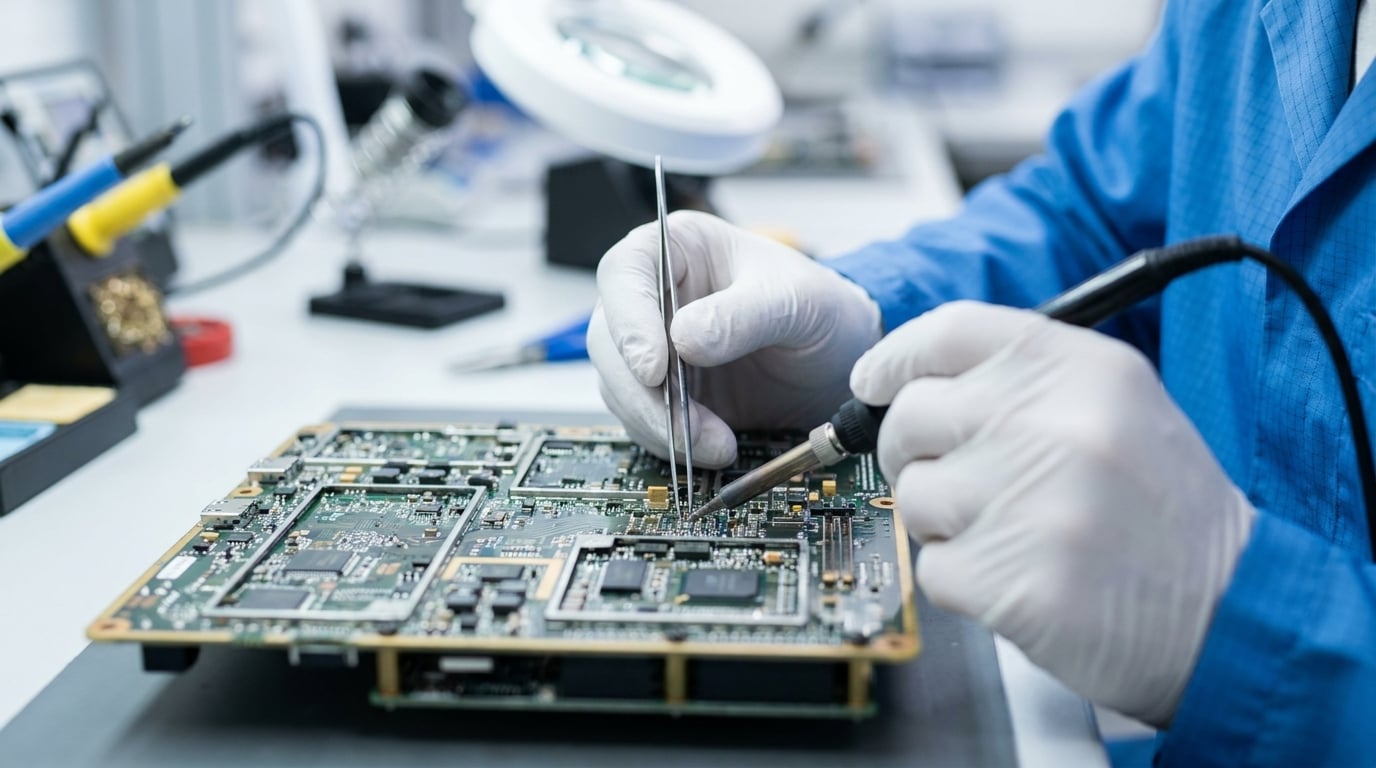
TTM Technologies is the largest company in the U.S. bare printed circuit board manufacturing industry by overall scale and revenue. The company serves aerospace, defense and commercial markets and recently opened an ultra-HDI PCB manufacturing facility in Syracuse, New York, backed by a significant capital investment that includes federal Department of Defense funding. This investment positions TTM for programs that require domestic ultra-HDI capability at scale.
Sanmina Corporation focuses on complex and mission-critical PCBA for aerospace, defense and communications. The company’s recent defense electronics contracts demonstrate active engagement with government programs and reinforce its standing as a high-reliability volume partner for government and enterprise customers.
Summit Interconnect focuses on high-reliability work and serves defense and aerospace customers that require advanced multilayer and rigid-flex builds. The company operates multiple U.S. facilities and maintains certifications aligned with military and aerospace qualification standards.
AdvancedPCB offers HDI capabilities including buried vias, microvias and sequential lamination for high-density routing. The company targets aerospace and defense applications that require IPC-6012 Class 3, AS9100 certification and ITAR compliance, and it supports production from prototype through volume.
Sierra Circuits operates a PCB manufacturing and assembly facility in Silicon Valley and holds AS9100D, ISO 9001:2015, ISO 13485:2016 and ITAR registration. Sierra serves aerospace, medical and industrial customers that require mil-spec and Class 3 capabilities.
Each fabricator addresses a distinct segment of the high-volume market. Buyers running programs at 100,000 or more boards per year should evaluate which fabricator’s certifications, technology stack and facility scale align with specific program requirements before issuing an RFQ.
Map program compliance and capacity requirements to the right fabricator.
ITAR and Defense Certifications for High-Volume PCB Programs
ITAR compliance is a basic requirement for PCB projects involving U.S. defense, military or controlled technology. ITAR registration governs who can access design data, handle boards and participate in the supply chain for these programs.
The non-negotiable compliance requirements mentioned earlier extend beyond ITAR registration to include AS9100D quality management certification, MIL-PRF-31032 qualification and IPC-6012 Class 3 acceptability standards. Aerospace PCB manufacturers adhering to IPC Class 3 and AS9100D standards ensure reliable performance in demanding environments where field failure is not an acceptable outcome.
New U.S. ultra-HDI PCB facilities require contamination-control infrastructure, process knowledge, qualification protocols that meet MIL-STD, AS9100 and IPC standards, and ongoing monitoring systems to achieve reliable high-volume production. Certification alone does not confirm production readiness, so buyers must confirm that active production lines, not just the quality manual, meet the applicable standards for the program.
IPC told the U.S. government in 2025 that IC substrate and PCB manufacturing are among the most vulnerable segments and that the United States lacks meaningful capability or capacity in several advanced electronics areas. This gap increases the importance of early supplier qualification and compliance verification for programs that cannot tolerate supply disruption.
Cost Comparison for U.S. vs Offshore High-Volume PCB Production
Surface-level unit pricing comparisons between domestic and offshore fabrication rarely capture the full cost picture. Offshore manufacturers can offer lower per-unit pricing for high-volume PCB production, but lead time, inventory carrying costs, communication overhead and logistics can offset part of that advantage in total cost of ownership.
Tariff exposure adds another layer of cost and risk. U.S. Customs and Border Protection applies Section 301 tariffs to PCBAs based on the weighted value of components rather than finished-assembly classification. Consigned assembly offshore can also trigger additional import tariff rounds on U.S.-origin components before the finished PCBA faces further U.S. duties.
Raw material costs are rising across the board regardless of geography. Simultaneous price increases across copper foil, copper-clad laminate, glass fiber cloth, gold and tungsten carbide have driven raw materials to a significant portion of bare-board cost on advanced multilayer PCBs. Because these increases affect offshore and domestic fabricators alike, the raw-material cost gap that once favored offshore production has narrowed.
The U.S. Bureau of Labor Statistics Producer Price Index for Bare Printed Circuit Board Manufacturing stood at 156.994 in June 2026, quantifying the sustained upward trend mentioned above that buyers should factor into multi-year program cost models.
For programs that require ITAR compliance, domestic sourcing eliminates the compliance risk of routing controlled technical data through offshore supply chains. That risk reduction has measurable value that does not appear in a per-unit quote comparison. Operational visibility, shorter replenishment cycles and reduced exposure to international logistics disruption further support domestic or nearshore production for high-volume programs with tight delivery requirements.
Consolidating PCBA and Lifecycle Services Around Fabrication
Selection of a qualified U.S. fabricator solves only one part of the program. Managing the downstream flow across separate vendors for assembly, testing, depot repair, returns and end-of-life disposition creates compliance gaps and supply-chain visibility issues that erode the value of a strong fabrication partner.
The consolidation model described earlier extends across authorized PCBA, depot repair and reverse logistics services, functioning as the single-vendor layer that removes fragmentation from high-volume programs. Services include PCBA across single and double-sided SMT and through-hole configurations, flex circuit assembly, sub-assembly and final assembly, burn-in and functional testing and BGA reballing.
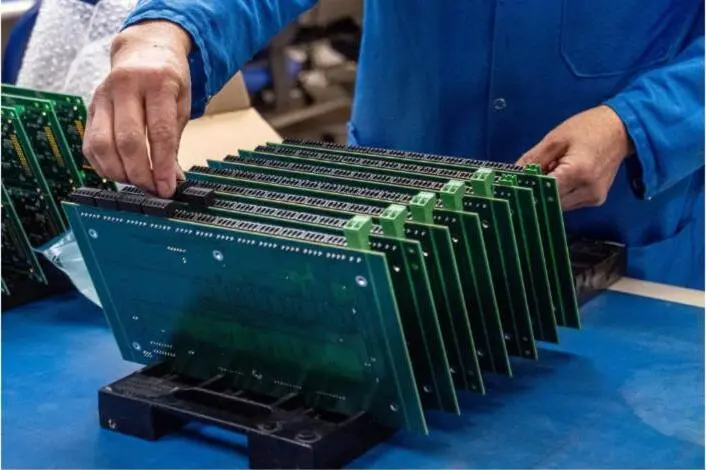
On the lifecycle side, Premier Logitech provides depot repair at Levels 1 through 4, rapid exchange programs, RMA management, asset recovery, secure data destruction and responsible recycling. The company holds TAA, TAPA, ISO, NIST, CMMC and SOC II compliance frameworks, supporting government and enterprise programs that require documented chain-of-custody and regulatory assurance.
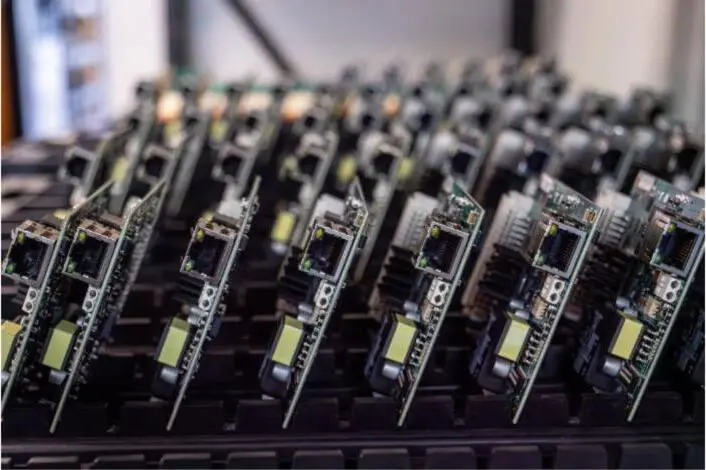
Premier Logitech operates three DFW facilities with nearshore operations in Laredo and Nuevo Laredo, Mexico, which provides cost-effective capacity for programs that benefit from nearshore flexibility without sacrificing compliance oversight. Repair capacity exceeds 40,000 units per week and kitting capacity reaches 500,000 units per month, so the operational scale supports high-volume programs without requiring buyers to manage multiple vendor relationships.

Consolidate fabrication, assembly and lifecycle services under one partner.
RFQ Checklist for High-Volume PCB Programs
The five evaluation criteria translate into specific questions that buyers should ask any fabricator or lifecycle partner before issuing an RFQ for a 100,000-plus board program.
- Annual board capacity: What is the fabricator’s demonstrated annual output for programs at or above the required volume, and what is current utilization across relevant production lines?
- ITAR and defense certifications: Is the fabricator actively registered under ITAR, and does it hold AS9100D, MIL-PRF-31032 or IPC-6012 Class 3 qualification on the specific lines that will build the program?
- HDI and rigid-flex capability: Can the fabricator demonstrate production yields on the specific layer count, via structure and line and space requirements of the design, not just capability on paper?
- Total cost of ownership: Has the fabricator provided a landed-cost model that accounts for tariff exposure, material cost trends, inventory carrying costs and logistics risk rather than unit price alone?
- Integration path to PCBA and lifecycle services: Does the fabricator have an established integration path to authorized assembly, depot repair and reverse logistics, or will the buyer manage those relationships separately?
Frequently Asked Questions
What volume threshold defines high-volume PCB fabrication?
High-volume PCB fabrication generally refers to programs that produce 100,000 or more boards per year. At that scale, per-unit costs decline as tooling and NRE spread across larger runs. Yield management, process control and supply-chain continuity become more critical. Fabricators that serve high-volume programs typically operate dedicated production lines with statistical process control and inline inspection systems.
Why does ITAR registration matter for PCB fabrication beyond defense programs?
ITAR registration governs access to controlled technical data, not just the physical boards. Any program that involves U.S. defense, military or dual-use technology requires that every party handling design files, Gerber data or finished boards be ITAR-registered. Buyers that route controlled data through nonregistered fabricators or assembly partners expose programs to export control violations regardless of where the boards are physically built.
How does Premier Logitech integrate with an existing fabricator relationship?
Premier Logitech operates as a downstream partner that layers PCBA, depot repair and lifecycle services onto boards sourced from any qualified fabricator. Buyers retain existing fabricator relationships and engage Premier Logitech for assembly, testing, repair, returns management and end-of-life services. This model removes the need to replace a qualified fabricator while consolidating the downstream supply chain into a single accountable partner.
What compliance frameworks does Premier Logitech support for government programs?
Premier Logitech holds TAA, TAPA, ISO, NIST, CMMC and SOC II compliance frameworks and operates under CAGE Code 4WAJ9 as a pre-vetted partner for U.S. federal government programs. The company provides secure handling, documented chain-of-custody and compliance reporting aligned with government and enterprise requirements across lifecycle and reverse logistics services.
What are the main risks of managing PCB fabrication, assembly and lifecycle services across separate vendors?
Fragmented vendor relationships create compliance gaps when different parties handle controlled technical data under inconsistent security protocols. Fragmentation also reduces supply-chain visibility, slows turnaround on repair and exchange programs and increases the administrative burden of managing multiple contracts, audits and escalation paths. Single-vendor consolidation addresses these risks by establishing one accountable partner across fabrication integration, assembly, depot repair and lifecycle services.
Conclusion: Building Scalable, Compliant Domestic PCB Programs
High-volume U.S. PCB fabrication succeeds when buyers evaluate annual board capacity, ITAR and defense certifications, HDI and rigid-flex capability, total cost of ownership and the integration path to downstream services before selecting a fabricator. TTM Technologies, Sanmina, Summit Interconnect, AdvancedPCB and Sierra Circuits each address distinct segments of this market with documented capabilities and certifications.
Fabricator selection represents the first decision in a high-volume program. Managing the full lifecycle from bare board through assembly, repair and end-of-life requires a partner that can consolidate those services without introducing compliance risk or visibility gaps. Premier Logitech provides that consolidation by layering authorized PCBA, depot repair and reverse logistics onto any qualified domestic fabricator under a single compliance framework.
Build a compliant, consolidated program around high-volume requirements.
