Last updated: July 2, 2026
Key Takeaways
- Enterprise IT repair depots support high-volume, compliance-driven RMA, warranty and asset recovery programs that consumer repair options cannot handle at scale.
- 2026 market pressures, including device proliferation, data privacy mandates, sustainability goals and supply chain consolidation, are pushing organizations toward single-source authorized depot partners.
- A seven-dimension evaluation framework covering OEM authorization, compliance, throughput, data security, visibility, reverse logistics integration and sustainability supports objective comparison of depot providers.
- Specialized lifecycle partners with multi-OEM authorization, L1-L4 repair depth and integrated compliance outperform 3PLs, OEM networks and ITAD firms for complex enterprise and government programs.
- Premier Logitech delivers the full scope of authorized depot repair and reverse logistics services; map an existing program against this evaluation framework with a lifecycle expert.
Enterprise IT Repair Depots in the Asset Lifecycle
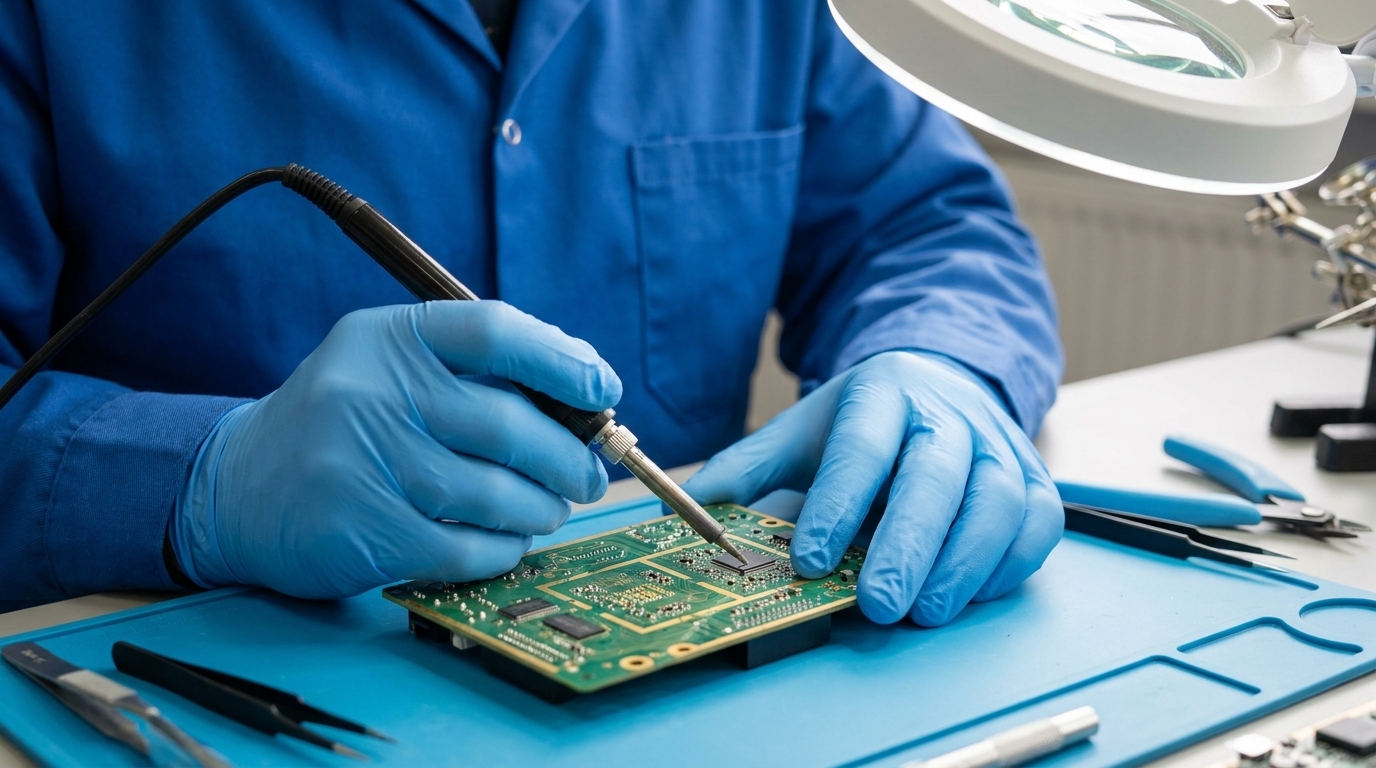
An IT repair depot is a centralized facility that receives, triages, repairs, refurbishes and returns technology assets at scale. In an enterprise lifecycle context, a depot manages inbound RMA flows, warranty adjudication, cosmetic refurbishment, secure data destruction and outbound redeployment or remarketing. Repair depth is classified by level: L1 covers diagnostics and software, L2 covers component swap, L3 covers board-level repair and L4 covers full rebuild or parts harvesting. An authorized service center, or ASC, holds OEM-granted credentials to perform warranty repairs and use genuine parts, which protects device warranties and supports OEM program requirements.
2026 Market Pressures Driving Depot Selection
Understanding what a depot does establishes the foundation for evaluating which capabilities matter most in 2026. Several converging pressures now shape how enterprises and OEMs select depot partners. Device proliferation driven by hybrid work, IoT expansion and government modernization programs has increased return volumes beyond what regional or consumer-focused shops can absorb. Data privacy mandates at the federal and state level require documented chain of custody and certified data destruction, not just a factory reset. Sustainability goals and extended producer responsibility frameworks push organizations to maximize refurbishment rates and minimize e-waste. Supply chain consolidation initiatives are driving organizations toward single-source depot partners instead of fragmented multi-vendor networks.
Seven Dimensions to Evaluate IT Repair Depots
The following seven dimensions provide a practical framework for assessing whether a depot partner can address these pressures while meeting enterprise compliance, scale and visibility requirements.
1. OEM Authorization and Repair Depth. Confirm ASC status for every brand in the device portfolio. Unauthorized repairs can void warranties and create liability. Assess whether the depot covers L1 through L4 repair or only surface-level work.
2. Compliance and Certifications. Government and regulated-industry programs require specific frameworks. Confirm that the depot holds the compliance certifications the program requires, with federal contracts typically mandating TAA, NIST, CMMC, SOC 2 and ISO frameworks detailed in the FAQ section below. A depot without appropriate credentials cannot support federal contracts or handle controlled unclassified information.
3. Throughput and Scalability. Assess weekly repair capacity, surge handling and geographic footprint. A depot that performs well at low volumes can still create bottlenecks during product refresh cycles or large-scale recalls.
4. Data Security and Chain of Custody. Require documented intake, serialized tracking and certified data destruction at every stage. Secure data wipe or physical destruction must remain auditable and reportable.
5. Visibility and Reporting. Real-time inventory tracking, lifecycle analytics and program-level dashboards reduce operational blind spots that drive escalations. Evaluate whether the depot integrates with existing ERP or ITSM platforms.
6. Reverse Logistics Integration. A depot that also manages inbound transportation, RMA processing, sorting, grading and outbound fulfillment closes handoff gaps. Fragmented handoffs between carriers, depots and fulfillment centers are a primary source of cycle-time loss and inventory discrepancies.
7. Sustainability and Asset Recovery. Evaluate refurbishment yield rates, secondary market remarketing capabilities, parts reclamation programs and responsible recycling certifications. A depot that recovers value from returned assets offsets program costs and supports ESG reporting.
Map a current depot program against this seven-dimension framework with a lifecycle specialist.
U.S. Depot Provider Types and Premier Logitech’s Role
The U.S. depot repair market includes four broad provider categories. Large 3PLs offer broad logistics networks but often lack deep repair specialization or direct OEM authorization for every brand. OEM-direct service networks provide brand-specific expertise but typically do not support multi-brand programs or integrated reverse logistics. Independent IT asset disposition firms focus on end-of-life processing and data destruction but often lack L3 and L4 repair capability or rapid exchange programs. Specialized lifecycle partners authorized across multiple OEM brands and operating integrated repair, refurbishment and logistics functions address the full program scope under one contract.
Premier Logitech operates as a specialized lifecycle partner and holds the ASC credentials described earlier across multiple OEM brands. The organization provides L1 through L4 repair capability, integrated reverse logistics and compliance credentials spanning TAA, NIST, CMMC, SOC 2 and ISO 9001/14001. Premier Logitech holds CAGE Code 4WAJ9, which identifies it as a pre-vetted partner for U.S. federal government programs. Operations run from multiple facilities that support both domestic and cross-border program requirements.
Explore single-source consolidation options for depot and reverse logistics programs.
Strategic Trade-Offs in Depot Program Design
In-house depot operations provide direct control over processes and data but require capital investment in facilities, tooling, OEM training and certification maintenance. For most enterprises, sustaining ASC credentials across a multi-brand device portfolio is not operationally practical. Outsourcing to an authorized depot transfers that burden while providing access to established OEM relationships, certified technicians and scalable infrastructure.
Multi-vendor depot networks distribute risk across providers but introduce coordination overhead, inconsistent reporting formats, fragmented data security accountability and higher total management cost. Single-source consolidation reduces vendor management complexity, standardizes compliance documentation and creates a unified data layer for lifecycle analytics. That consolidation also increases dependency on one partner’s performance, which makes the evaluation framework above critical before committing to a single-source model.
Best Practices for High-Volume Depot Program Onboarding
Define scope before contracting by documenting device categories, expected volumes, repair depth requirements, data security standards and reporting cadences in the RFP. Specific scope language reduces ambiguity at the contract stage, which prevents disputes during operations over what the program actually covers.
Establish intake and triage protocols jointly with the depot partner. When both parties co-develop RMA intake procedures, condition grading criteria and disposition decision trees, they create shared definitions that eliminate interpretation gaps that cause misclassification. That alignment prevents devices from being routed to unnecessary repairs or prematurely sent to recycling.
Require serialized traceability from receipt to disposition. Every device should carry a unique identifier that links intake condition, repair actions, technician records, data destruction certificates and final disposition. This complete chain of custody forms the foundation of compliance reporting.
Set program-level KPIs that measure the outcomes the seven-dimension framework is designed to support, including first-pass yield, cycle time by repair level, refurbishment rate and asset recovery value. These metrics drive improvement when reviewed regularly, so monthly or quarterly business reviews with the depot partner are necessary to catch performance drift before it creates program-level misalignment.
Readiness Checklist for Centralizing or Outsourcing Depot Repair
Centralization or outsourcing becomes appropriate when current repair vendors lack ASC authorization for one or more brands in the portfolio, compliance documentation is inconsistent across providers, device volumes exceed internal repair capacity, data security accountability is unclear across the vendor network, asset recovery value is not captured systematically or sustainability reporting requires certified recycling and disposition data.
When three or more of these conditions apply, a structured depot consolidation initiative is warranted.
Common Depot Selection Pitfalls and How to Avoid Them
Selecting on price alone creates hidden risk. Low per-unit repair costs from unauthorized providers can create downstream warranty voids, compliance gaps and data breach liability that exceed initial savings.
Overlooking data security in the depot selection process creates another frequent problem. Many organizations apply rigorous data security standards to internal IT but treat depot selection as a procurement decision focused on cost and turnaround time, not a security decision. That gap leaves returned devices, which often contain unwiped corporate data, in the hands of partners whose security controls have not been verified. Requiring SOC 2 reports and documented data destruction procedures before awarding a contract closes that gap by making security controls a contract prerequisite, not an operational afterthought.
Underestimating volume variability also undermines performance. Depot programs tied to product refresh cycles, government fiscal-year procurement or consumer return seasons experience significant volume swings. Confirm that the depot partner has demonstrated surge capacity before signing.
Treating depot repair as separate from reverse logistics introduces delays and cost. When inbound transportation, repair and outbound fulfillment are handled by separate vendors, each handoff requires inventory reconciliation, and any discrepancy halts the flow until resolved. Those reconciliation delays extend cycle times and create cost overhead that integrated programs reduce by keeping custody and data under one roof.
Frequently Asked Questions About IT Repair Depots
What is the difference between an authorized service center and an independent repair shop for enterprise programs?
An authorized service center holds credentials granted directly by the OEM to perform warranty repairs using genuine parts and certified procedures. Independent shops may offer lower per-unit costs but cannot perform warranty work, may use non-OEM parts and typically cannot meet the compliance documentation requirements of enterprise or government contracts. For multi-brand enterprise programs, ASC authorization across the full device portfolio functions as a baseline requirement, not a preference.
Which compliance certifications should a depot partner hold for government or regulated-industry programs?
Federal and regulated-industry programs commonly require TAA compliance for product sourcing, NIST 800-series alignment for data handling, CMMC certification for defense-related contracts, SOC 2 attestation for data security controls and ISO 9001 for quality management. ISO 14001 is increasingly required for sustainability and e-waste reporting. A depot partner should be able to produce current documentation for each applicable framework, not just claim alignment.
How does single-source depot consolidation affect program visibility and reporting?
Consolidating depot repair, reverse logistics and asset recovery under one partner creates a unified data layer across the full device lifecycle. This structure enables program-level reporting on repair yield, cycle time, asset recovery value and compliance status without reconciling data from multiple vendor systems. For operations and supply chain leaders, consolidated reporting reduces administrative overhead and improves decision-making speed.
What repair levels should an enterprise depot partner support?
Enterprise programs typically require L1 through L4 coverage. L1 handles diagnostics, software reloads and basic functionality checks. L2 covers component-level swaps such as batteries, screens and keyboards. L3 addresses board-level repair and soldering. L4 covers full system rebuilds and parts harvesting for end-of-life assets. A depot that only supports L1 and L2 will route a significant portion of devices to third parties, which recreates the fragmentation that consolidation seeks to eliminate.
How should organizations measure the performance of a depot repair program?
Standard program metrics include first-pass yield, average cycle time by repair level, refurbishment rate, asset recovery value per unit and compliance documentation completeness. These metrics should be reviewed on a regular cadence with the depot partner and tied to contractual service commitments.
Next Steps for Comparing Authorized Depot Partners
Enterprise, OEM and government operations leaders evaluating depot partners can begin with a current-state flow map that documents inbound volumes by device type, current repair depth by vendor, compliance gaps and asset recovery outcomes. That baseline supports scoring of prospective partners against the seven-dimension framework and highlights where consolidation creates the strongest operational and financial impact.
Premier Logitech has delivered end-to-end IT lifecycle and depot repair services since 2007, serving enterprises, OEMs, telecom providers and government agencies with a compliance-ready, single-source model. Multi-OEM ASC authorization, integrated reverse logistics and operations hubs position the organization to support high-volume programs with the traceability and regulatory documentation those programs require.
Schedule a depot program review to identify where consolidation creates the most value.
