Last updated: June 28, 2026
Key Takeaways
- A certified depot repair facility is a centralized, OEM-authorized service center that manages high-volume IT and electronics repair, refurbishment and recovery under strict quality and compliance controls.
- Depot repair consolidates operations into a controlled facility, enabling standardized diagnostics, parts harvesting, compliance documentation and higher asset-recovery value than distributed field-service models.
- Repair capabilities are tiered from L1 (basic diagnostics) to L4 (PCB-level repair). OEM authorization is required for L2–L4 work to maintain warranty and compliance integrity.
- Selecting an OEM-authorized partner requires evaluating service scope, authorization breadth, compliance certifications (TAA, ISO, NIST, CMMC, SOC 2), scalability, visibility and total cost of ownership.
- Premier Logitech operates TAA-compliant, OEM-authorized facilities with national and nearshore capacity. Talk to a lifecycle expert to align its capabilities with specific program requirements.
How Depot Repair Services Work
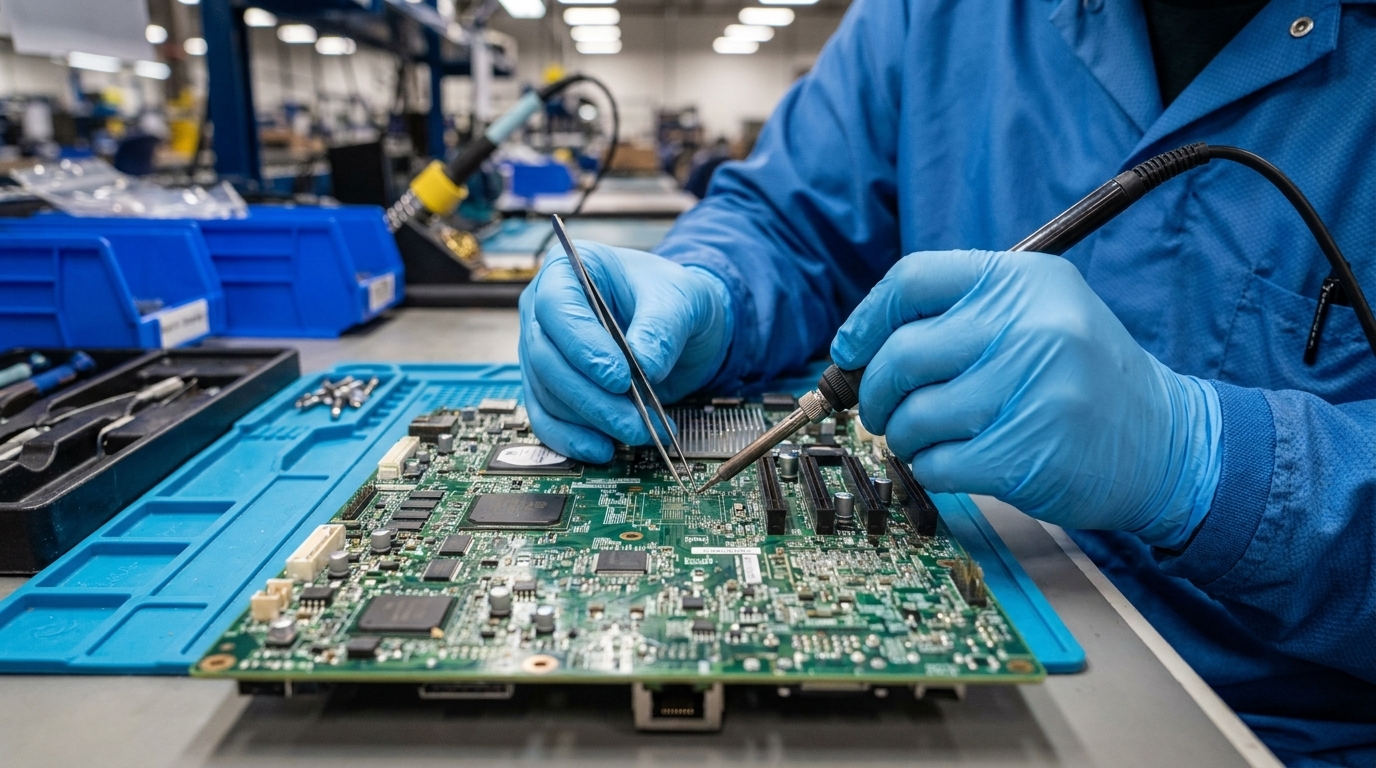
Depot repair service routes defective or end-of-use assets to a centralized facility instead of dispatching technicians to the asset location. In high-volume IT and electronics programs, the workflow follows a defined sequence: inbound receiving and logging, triage and diagnostic assessment, repair or refurbishment at the appropriate capability level, functional testing and quality verification, cosmetic grading and outbound fulfillment or disposition.
Centralization supports consistent tooling, trained technicians, parts inventory and audit trails. Distributed field-service networks struggle to maintain that level of standardization. For OEMs, enterprises and government agencies processing large volumes of returned devices, depot repair service provides the throughput and traceability that program-level accountability requires.
What Depot Repair Covers Beyond Break-Fix
Depot repair consolidates asset repair and recovery operations into a controlled facility environment. The scope extends beyond simple break-fix work. A full-service depot handles warranty claim processing, in-warranty and out-of-warranty repair, cosmetic refurbishment, parts reclamation and harvesting, secure data destruction, grading for secondary market channels and responsible recycling or disposal.
For OEMs, depot repair supports warranty fulfillment and brand protection. For enterprises, it reduces the cost and complexity of managing multiple repair vendors. For government agencies, it provides the documented chain of custody and compliance posture required under federal procurement and data-security frameworks.
Depot Repair vs. Field Service Models
Depot repair and field service address different operational needs. Field service dispatches technicians to the asset location, which suits low-volume, high-urgency situations where downtime cost outweighs logistics cost. Depot repair routes assets to a centralized facility, which suits high-volume programs where quality consistency, parts harvesting, compliance documentation and asset-recovery value are priorities.
Key distinctions between the two models:
- Quality control: Depot facilities apply standardized diagnostics, tooling and testing protocols across every unit. Field service quality depends on individual technician skill and available parts at the point of dispatch.
- Parts harvesting: Depot environments support systematic component reclamation from non-repairable units, recovering value that field service cannot capture.
- Compliance documentation: Centralized processing produces consistent audit trails for warranty claims, data destruction and regulatory reporting. Field service documentation is harder to standardize at scale.
- Scalability: Depot capacity scales with facility investment and staffing. Field service scales with technician headcount and geographic coverage, which introduces coordination complexity.
- Asset recovery: Depot facilities support grading, refurbishment and secondary market preparation. Field service typically ends at repair or replacement.
Organizations managing thousands of units per week gain structural advantages from depot repair in cost efficiency, compliance posture and recovered asset value. Field service models do not address those high-volume requirements.
L1–L4 Repair Capability Levels
Repair capability levels define the scope of technical intervention a depot facility can perform. These levels help operations and supply chain leaders match program requirements to partner capabilities and support later evaluation of service scope and OEM authorization.
- Level 1 (L1) basic diagnostics and software: Device-level triage, software reloads, firmware updates, configuration resets and functional verification. No hardware disassembly required.
- Level 2 (L2) component replacement: Swap of field-replaceable units such as batteries, displays, keyboards, ports and storage modules. This work requires OEM-authorized parts and procedures.
- Level 3 (L3) board-level repair: Subassembly replacement, connector repair and module-level diagnostics. This level requires specialized tooling and trained technicians operating under OEM authorization.
- Level 4 (L4) deep component and PCB repair: BGA rework, PCB-level diagnostics, SMT component replacement and electromechanical assembly. This level requires advanced equipment and engineering expertise.
Not every depot facility holds authorization to perform all four levels. OEM authorization is required for L2 through L4 work on branded equipment. Verification of a partner authorization scope before program launch prevents warranty voidance and compliance gaps.
How to Evaluate an OEM-Authorized Depot Repair Partner
Partner selection depends on a structured assessment across six dimensions. These dimensions fall into three categories: capability verification, risk management and program economics.
- Service scope: Confirm that the partner covers the full range of services the program requires, including intake, repair, refurbishment, data destruction, grading and disposition. Partial coverage forces additional vendor relationships.
- OEM authorization: Verify Authorized Service Center status for each brand in the program. Authorization determines parts access, warranty claim eligibility and repair procedure compliance.
- Compliance posture: Confirm certifications relevant to the regulatory environment, including TAA compliance, ISO 9001 and 14001, NIST alignment, CMMC level and SOC 2 attestation.
- Scalability: Assess whether the partner facility footprint, staffing model and throughput capacity can absorb volume spikes without degrading quality or documentation standards.
- Visibility: Evaluate real-time tracking, inventory reporting and lifecycle analytics capabilities. Program managers need asset-level traceability from intake through disposition.
- Total cost of ownership: Account for parts reclamation value, secondary market recovery and vendor consolidation savings alongside direct repair costs.
Premier Logitech holds Authorized Service Center status for multiple OEM brands and processes high volumes of repairs across its DFW-area facilities, with nearshore operations in Laredo and Nuevo Laredo. Talk to a lifecycle expert to assess whether the Premier Logitech authorization scope and facility footprint align with specific program requirements.
TAA-Compliant Depot Repair Requirements
The Trade Agreements Act (TAA) restricts U.S. federal procurement to products manufactured or substantially transformed in designated countries. For depot repair programs serving government agencies, TAA compliance applies to replacement parts, refurbished units and the sourcing and handling practices of the repair facility.
TAA-compliant depot repair requires documented sourcing chains, parts traceability and disposition records that demonstrate compliance at the unit level. Facilities operating under NIST SP 800-171 and CMMC frameworks add data-security controls that government contracts increasingly require. ISO 9001 quality management certification provides the process documentation baseline that supports both TAA and security compliance claims.
Government agencies and their prime contractors should confirm that a depot partner holds a CAGE Code and has demonstrated compliance across all applicable frameworks before awarding repair program work. Premier Logitech CAGE Code is 4WAJ9.
Regional Coverage for Certified Depot Repair
Regional coverage affects transit time, customs handling and staffing flexibility for depot repair programs. Effective coverage depends on facility proximity to major logistics hubs, customs infrastructure for cross-border operations and labor market depth for scalable staffing.
Premier Logitech operates multiple facilities in the Dallas-Fort Worth area, adjacent to one of North America largest air freight and ground logistics hubs. Nearshore operations in Laredo and Nuevo Laredo extend capacity for cross-border programs and support national and regional repair requirements.
Certification Checklist for Government and Enterprise Contracts
The compliance dimension of the evaluation framework requires verification of specific certifications before contract award. This checklist helps confirm that a depot partner holds the credentials a program demands.
Key certifications and frameworks include Trade Agreements Act (TAA) for procurement compliance, ISO 9001 for quality management, ISO 14001 for environmental management, NIST SP 800-171 for controlled unclassified information protection, CMMC for defense-related contracts and SOC 2 for security and confidentiality controls.
Frequently Asked Questions
What is the difference between depot repair and field service?
Depot repair routes assets to a centralized facility for diagnosis, repair and refurbishment under standardized quality controls. Field service dispatches technicians to the asset location. Depot repair suits high-volume programs where consistency, compliance documentation and asset recovery value are priorities. Field service suits low-volume, high-urgency situations where on-site resolution reduces downtime cost.
Why does OEM authorization matter for depot repair?
OEM Authorized Service Center status grants access to genuine parts, proprietary repair procedures and warranty claim processing. Repairs performed outside Authorized Service Center status can void product warranties and create compliance gaps in government or enterprise programs. Authorized status also signals that the facility has met the OEM technical and quality standards for that product line.
What compliance frameworks apply to depot repair facilities handling government IT assets?
Applicable frameworks depend on the agency, contract type and asset sensitivity. TAA addresses procurement compliance. NIST SP 800-171 and CMMC cover data security for defense-related work. ISO 9001 and ISO 14001 address quality and environmental management, and SOC 2 addresses security and confidentiality controls. The TAA-Compliant Depot Repair Requirements section above explains how these frameworks interact in practice.
How is data security handled for devices processed at a depot facility?
Certified depot facilities perform secure data destruction using documented procedures aligned to NIST guidelines for media sanitization. Each device processed receives a chain-of-custody record from intake through disposition. For government and enterprise programs, compliance reporting documents the destruction event at the asset level and supports audit and regulatory requirements.
What are the advantages of nearshore depot operations compared to purely domestic facilities?
Nearshore operations in northern Mexico, structured under maquiladora frameworks, provide access to cost-competitive labor for high-touch refurbishment, cosmetic grading and kitting work. When operated under U.S. program management with documented TAA and trade-compliance controls, nearshore facilities extend throughput capacity without sacrificing compliance posture. The combination of a domestic hub and nearshore capacity supports programs that require both regulatory compliance and operational scale.
Can a single depot partner manage the full lifecycle from repair through secondary market disposition?
A full-service depot partner with Authorized Service Center status, refurbishment capabilities, grading infrastructure and remarketing channels can manage the complete flow from inbound return through secondary market resale or responsible recycling. Consolidating these functions with one partner reduces handoff complexity, improves asset traceability and captures more recovery value than a fragmented multi-vendor approach.
Conclusion: Applying the Depot Repair Evaluation Framework
Certified depot repair facilities deliver centralized quality control, compliance documentation, parts harvesting and asset-recovery value that distributed field-service models cannot match at scale. The evaluation framework spanning capability verification, risk management and program economics provides a structure for matching partner capabilities to program requirements.
Premier Logitech holds Authorized Service Center status for more than 20 OEM brands, operates across a Dallas-Fort Worth hub and nearshore Mexico footprint and supports TAA, ISO 9001 and 14001, NIST, CMMC and SOC 2 requirements. The company has delivered IT lifecycle and reverse logistics services since 2007 for OEMs, enterprises and government agencies managing complex, high-volume programs.
Talk to a lifecycle expert to evaluate how Premier Logitech certified depot repair capabilities align with specific compliance, scale and asset-recovery requirements.
