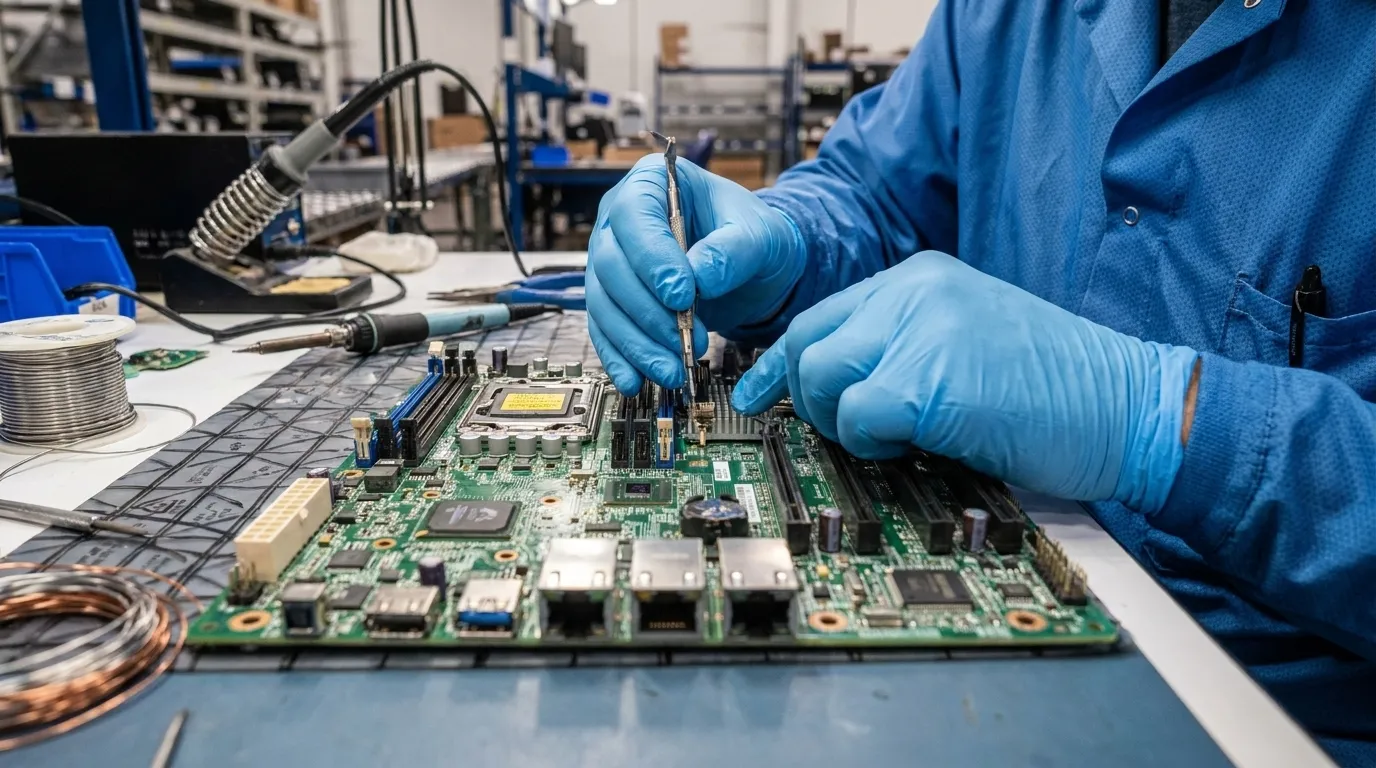
Key Takeaways for Configuration Programs
- IT infrastructure configuration services cover the lifecycle of designing, provisioning, securing and managing hardware, software, network and cloud environments for complex deployments.
- Common services include hardware provisioning with asset tagging, cloud and virtualization setup, network security tuning and CMDB population that supports traceability and compliance.
- Organizations configure four infrastructure types: physical, virtual, cloud and hybrid. Each type relies on seven components: hardware, software, network, data, processes, people and facilities.
- 2026 programs emphasize hybrid-cloud provisioning at scale, automation through zero-touch deployment and CMDB registration before shipment to support audits.
- Premier Logitech delivers compliant, end-to-end lifecycle services. Talk to a lifecycle expert to consolidate deployment work under one trusted partner.
Core Examples of IT Infrastructure Configuration Services
Configuration services span technical tasks and operational workflows that prepare assets for production. Common examples include the following categories.
- Hardware and device provisioning: Physical servers, endpoints, networking gear and peripherals are received, inspected, imaged and asset tagged before deployment. This asset tagging ties each unit to a bill of materials (BOM) record and enables serialization for traceability. Once serialized, provisioned devices flow into BOM-based kitting and pick-pack-ship fulfillment workflows.
- Cloud and virtualization setup: Virtual machines, cloud tenants and hybrid environments are configured to organizational standards. Typical tasks include identity policies, access controls and monitoring agents. Modern provisioning tools support zero-touch enrollment so devices self-configure on first boot.
- Network and security tuning: Switches, firewalls, wireless access points and SD-WAN appliances receive baseline security profiles aligned to NIST or CMMC control sets. Teams store version-controlled configuration files to support audits and rollback.
- CMDB implementation and population: Configuration management database records are created or updated for every asset touched during provisioning. Accurate CMDB data supports change management, incident response and lifecycle planning.
Each of these activities connects directly to fulfillment execution. A device that exits imaging without a corresponding asset tag and CMDB record creates a visibility gap that compounds through the deployment lifecycle.
Four Types of IT Infrastructure That Need Configuration
The configuration services described above must align with the infrastructure environment that supports the program. Enterprise and government deployments operate across four main infrastructure types, each with distinct requirements.
- Physical infrastructure: On-premises servers, storage arrays, networking hardware and end-user devices form this layer. Configuration covers BIOS settings, firmware updates, OS imaging, software installation and physical labeling. Physical infrastructure demands significant hands-on labor and drives kitting and staged fulfillment operations.
- Virtual infrastructure: Hypervisors, virtual machines and software-defined networking layers sit above the physical stack. Configuration focuses on resource allocation, template standardization and policy enforcement across virtual environments. Changes propagate at scale and require disciplined baseline management to control configuration drift.
- Cloud infrastructure: Public cloud platforms and SaaS environments are managed through APIs and infrastructure-as-code tooling. Configuration is largely automated but must align with organizational security policies and compliance frameworks such as FedRAMP for government workloads.
- Hybrid infrastructure: Combinations of physical, virtual and cloud layers operate under unified management. Hybrid environments now represent the dominant model for enterprise and government programs. Configuration complexity increases because policies, identity systems and monitoring tools must span every layer in a consistent way.
Seven Components That Shape IT Infrastructure Configuration
Across all infrastructure types, seven components require deliberate configuration at each deployment stage. Each component produces a specific operational deliverable.
- Hardware: Servers, endpoints, networking devices and peripherals form the physical base. Configuration tasks include imaging, BIOS hardening, firmware updates and the asset tagging described earlier. The deliverable is a provisioned, serialized device ready for kitting or direct shipment.
- Software: Operating systems, applications, security agents and management clients run on that hardware. Configuration tasks include license activation, policy application and update baseline enforcement. The deliverable is a software-compliant device image that teams can reproduce at scale.
- Network: Switches, routers, firewalls and wireless systems connect devices and applications. Configuration tasks include VLAN segmentation, access control lists and encrypted management channels. The deliverable is a network environment aligned to the organization security baseline.
- Data: Storage systems, backup targets and data classification controls protect information. Configuration tasks include encryption-at-rest settings, retention policies and access permissions. The deliverable is a data environment that meets regulatory requirements for the deployment context.
- Processes: Change management, incident response and configuration governance workflows guide operations. Configuration tasks include documenting runbooks, defining approval chains and integrating with ITSM platforms. The deliverable is a set of repeatable operational procedures tied to CMDB records.
- People: Administrators, end users and support staff operate and support the environment. Configuration tasks include role-based access provisioning, identity federation and training material preparation. The deliverable is a set of user accounts and permissions aligned to least-privilege principles.
- Facilities: Data centers, server rooms and edge locations host the infrastructure. Configuration tasks include power and cooling validation, physical security controls and rack documentation. The deliverable is a facility-level record that supports capacity planning and audit readiness.
Automation tooling now handles a growing share of configuration tasks across all seven components. Infrastructure-as-code platforms, zero-touch provisioning and CMDB auto-discovery reduce manual effort and limit configuration drift.
2026 Trends Reshaping IT Infrastructure Configuration
Recent advances in tooling and governance are changing how organizations structure configuration programs. Three trends stand out in 2026.
- Hybrid-cloud provisioning at scale: Organizations standardize on unified endpoint management platforms that configure physical devices and cloud workloads through a single policy engine. This shift requires configuration providers to support hands-on imaging and cloud-native enrollment workflows within one program.
- Automation and zero-touch deployment: Modern provisioning frameworks allow devices to self-configure when they connect to the network. Assets pull policies, software and identity settings automatically. Configuration providers now integrate with these frameworks instead of treating imaging as a manual, isolated step.
- CMDB integration as a program requirement: Buyers increasingly require that every configured asset be registered in a CMDB before shipment, elevating the data handoff described earlier from a best practice to a mandatory deliverable. Without structured CMDB integration workflows, providers create downstream gaps in change management and compliance reporting that surface after deployment.
How to Choose an IT Infrastructure Configuration Provider
Evolving requirements for hybrid-cloud support, automation and CMDB integration shape provider selection. The following checklist supports structured evaluations for enterprise and government programs.
- Service scope: Confirm the provider covers design-stage configuration through fulfillment, including imaging, asset tagging, BOM kitting and pick-pack-ship. As noted earlier, providers that handle only one stage create the visibility gaps and handoff risks that compound through deployment.
- Technical capabilities: Verify support for device imaging, BIOS configuration, SIM and IMEI pairing, software installation, zero-touch enrollment and CMDB data handoff.
- Compliance certifications: For government and regulated enterprise programs, require TAA compliance, NIST alignment, CMMC readiness, SOC 2 attestation and ISO quality certifications. Confirm that the provider holds a CAGE code for federal engagements and can produce documentation.
- Scalability: Assess whether the provider can handle large-volume deployments without subcontracting configuration work to uncertified facilities.
- Visibility tools: Require real-time inventory tracking, order management integration and lifecycle analytics. Providers that lack operational visibility tools cannot support audit or compliance reporting requirements.
- Reverse logistics and ITAD: Configuration programs generate returns, replacements and end-of-life assets. A provider that also handles depot repair, secure data destruction and responsible recycling removes the need for a separate vendor.
- Geographic coverage: Confirm that the provider operates nationally with a carrier network capable of supporting direct-to-site and white-glove delivery requirements.
Request a consultation to evaluate whether a single-source configuration and fulfillment model fits the program requirements.
Premier Logitech as a Lifecycle Configuration Partner
Premier Logitech consolidates IT infrastructure configuration, kitting, imaging, transportation and reverse logistics under one compliant operation. Founded in 2007, the company serves enterprises, OEMs, telecom providers and government agencies that manage large-scale technology deployments across the United States.
Service capabilities include device imaging and BIOS configuration, custom asset tagging and serialization, SIM and IMEI pairing, software installation and updates, BOM-based kitting, new hire kit assembly and direct-to-site distribution. These services connect directly to transportation management through a network of vetted North American LTL carriers, white-glove delivery and intermodal options.
Premier Logitech maintains the compliance credentials outlined in the selection criteria above, including CAGE Code 4WAJ9 for U.S. federal government programs. Three DFW facilities and nearshore operations in Laredo and Nuevo Laredo support national deployment programs with operational flexibility.
Reverse logistics and ITAD services close the lifecycle loop. RMA management, depot repair at L1 through L4, secure data destruction, responsible recycling and asset recovery programs operate as part of a full lifecycle program or as standalone services.
Organizations can engage Premier Logitech as a single-source lifecycle partner or select individual services such as configuration and fulfillment, transportation or reverse logistics on a modular basis. Start the conversation to build a lifecycle program aligned to deployment compliance, scale and visibility requirements.
Frequently Asked Questions
What is the difference between IT infrastructure configuration and IT infrastructure provisioning?
Provisioning refers to allocating and activating resources such as hardware, cloud instances or licenses. Configuration applies specific settings, policies and software to those resources so they meet operational and security requirements. In practice, the two activities often run together within a single deployment workflow.
What compliance standards apply to IT infrastructure configuration for U.S. government deployments?
Federal and defense-adjacent deployments commonly require Trade Agreements Act compliance for hardware sourcing, NIST SP 800-53 or 800-171 alignment for security controls, CMMC certification for defense industrial base programs and FedRAMP authorization for cloud services. Providers that support these programs should also hold a CAGE code and produce compliance documentation for audits.
How do configuration services connect to kitting and fulfillment?
Configuration typically represents the final technical step before a device enters a kitting workflow. A configured, imaged and asset-tagged device is matched to its BOM record, assembled into a kit with peripherals and accessories, packaged and routed through pick-pack-ship operations for direct-to-site or direct-to-user delivery. Providers that manage both configuration and fulfillment reduce the handoff risk that occurs when separate vendors control each stage.
What is a CMDB and why does it matter for configuration services?
A configuration management database is a centralized repository that stores records for every IT asset in an organization, including hardware specifications, software versions, relationships between assets and lifecycle status. Configuration service providers that populate CMDB records during provisioning give IT teams accurate data for change management, incident response and compliance reporting from the first day of deployment.
Can IT infrastructure configuration services support hybrid-cloud environments?
Modern configuration programs support physical device imaging and cloud-native zero-touch enrollment within the same deployment. Providers integrate with unified endpoint management platforms, apply cloud-based policy frameworks and hand off asset data to CMDB systems regardless of whether the device operates on premises, in the cloud or in a hybrid model.
