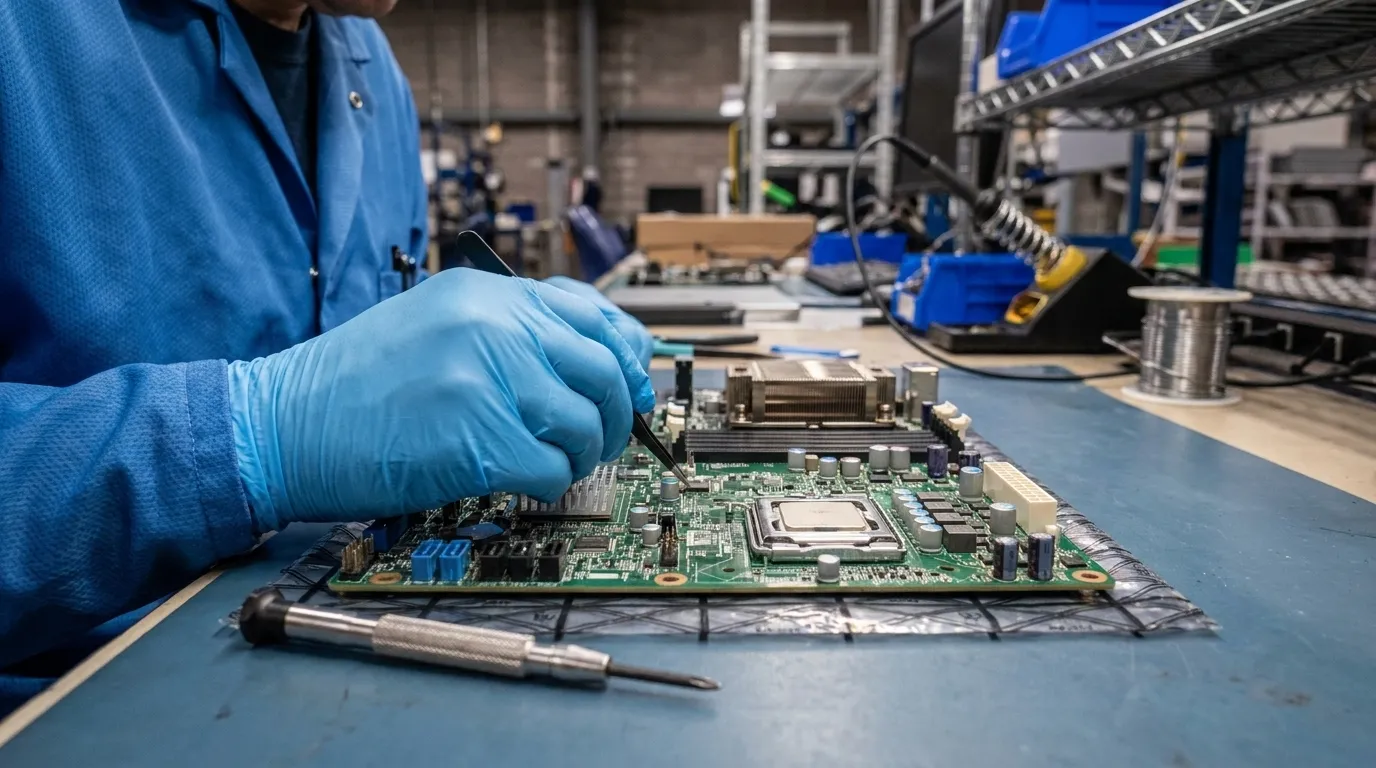
Key takeaways from the 8-stage IT lifecycle
- The IT lifecycle procurement process follows an 8-stage framework from needs assessment through secure disposal, which supports compliance and value recovery at every step.
- Each stage builds on the previous one, so early decisions directly shape compliance outcomes and operational efficiency later in the lifecycle.
- Fragmented vendor networks create cost, risk and audit exposure, while consolidating sourcing, configuration, repair and ITAD under one partner removes handoff gaps.
- Compliance frameworks including TAA, NIST SP 800-88, CMMC, ISO and SOC 2 must align with all stages to meet enterprise and government requirements.
- Premier Logitech delivers this complete framework as a single-source partner with certified compliance and real-time visibility; talk to a lifecycle expert to get started.
Stage 1: Needs assessment and planning
Needs assessment establishes the foundation for every downstream procurement decision. Teams document business requirements, evaluate security risks and identify budget parameters before any sourcing activity begins. Effective planning determines what new assets are required based on business needs, allocates funds through budgeting and selects vendors based on cost, quality and support criteria. Skipping or compressing this stage creates misaligned purchases and compliance gaps that compound across the lifecycle. Once requirements are documented, sourcing translates those needs into vendor and product decisions.
Stage 2: Sourcing and vendor selection
Sourcing defines which suppliers and products enter the procurement pipeline. For government and enterprise programs, Multiple Award Schedule IT contracts require contractors to sell to the U.S. government only products manufactured or substantially transformed in the U.S. or a TAA-designated country. RFPs must embed TAA compliance language, OEM authorization requirements and supply chain risk management criteria. Premier Logitech’s authorized service center network and trade-compliant sourcing capabilities address these requirements at the vendor selection stage.
Stage 3: Procurement and contracting controls
Procurement converts sourcing decisions into binding agreements. Contract negotiation must define scope of work, service level agreements, key performance indicators, inventory controls and standard operating procedures for receipt, testing, refurbishing, relabeling, repackaging and reshipping. SLA language that mandates compliance terms at contract execution prevents ambiguity during maintenance and disposal phases.
Stage 4: Configuration and deployment readiness
Configuration transforms procured hardware into deployment-ready assets. Activities include device imaging, BIOS configuration, SIM and IMEI pairing, software installation, asset tagging and kitting. Premier Logitech supports connected configuration and modern cloud-based provisioning alongside new hire kit assembly and direct distribution. Deployment records and serialization logs generated at this stage feed directly into the asset tracking infrastructure used in Stage 5.
Stage 5: Asset management and tracking
Asset tracking best practices require creating a full inventory by type, location and owner, classifying assets by data sensitivity and regulatory scope and tracking serials or batch IDs through pickup, transit and processing. Real-time visibility into asset status reduces inventory loss, supports audit readiness and enables proactive maintenance scheduling. Premier Logitech’s Transportation Management System and lifecycle analytics platform provide this operational visibility across distributed enterprise environments.
Stage 6: Maintenance and depot support
Maintenance sustains asset performance and extends usable life. Asset performance is monitored on an ongoing basis, technical support is provided as needed and patches and updates are applied to keep assets functional and secure. Premier Logitech operates as an authorized service center for more than 20 OEM brands, providing depot repair at Levels 1 through 4, warranty claim management and rapid exchange programs that reduce device downtime for enterprise and government fleets.
Stage 7: Retirement planning and license control
Retirement planning determines how assets exit active service. Disposition paths include redeployment, refurbishment, resale, recycling or destruction, and each path carries different risk and value recovery profiles. ISO 27001 Annex A control 7.14 requires irreversible removal of sensitive data and software from any device before it leaves the organization. License reclaim must be triggered at the same point as sanitization to close the software asset chain of custody.
Stage 8: Secure disposal and value recovery
Best practice for data sanitization follows NIST SP 800-88 guidelines using Clear for low-risk data, Purge for regulated workloads via cryptographic or block-level erasure or Destroy via physical shredding or degaussing for assets leaving organizational control. R2v3 and e-Stewards certifications ensure ITAD partners meet strict environmental protection, data security and worker safety standards while prohibiting illegal export of hazardous e-waste. Every disposal event must produce a tamper-proof, digitally signed Certificate of Destruction containing asset serial, storage capacity, method used, standard followed and outcome. Premier Logitech’s secure data destruction and asset recovery programs close the lifecycle loop while maximizing residual value through certified refurbishment and remarketing channels. These eight stages operate within a compliance architecture that varies by program type and data classification.
Government and enterprise compliance context
Compliance requirements span the full 8-stage framework and vary by program type, data classification and contracting vehicle. Each framework targets specific stages, so sourcing, operations and disposal must align with different controls. The following frameworks apply across enterprise and public-sector IT lifecycle programs:
- TAA: Applies at sourcing and procurement and governs trade-compliant products for MAS contracts (see Stage 2 for MAS contract requirements).
- NIST SP 800-88: Governs data sanitization methods at retirement and disposal (see Stage 8 for tier definitions).
- CMMC: Serves as a requirement for Department of Defense contracting opportunities and applies to contractors handling Federal Contract Information and Controlled Unclassified Information. Level 1 covers basic FCI safeguarding. Level 2 aligns with NIST SP 800-171 for CUI. Level 3 addresses advanced persistent threats.
- ISO 9001/14001: Governs quality management and environmental management across configuration, repair and disposal operations.
- SOC 2: Applies to data handling, access controls and operational security across asset management and tracking systems.
Premier Logitech holds TAA, TAPA, ISO, NIST, CMMC and SOC 2 compliance credentials and operates under CAGE Code 4WAJ9 as a pre-vetted partner for U.S. federal government programs.
Talk to a lifecycle expert about mapping compliance requirements to a procurement program.
Vendor consolidation and lifecycle visibility
Fragmented vendor networks are a primary source of cost inflation and compliance exposure in IT lifecycle programs. When organizations buy similar goods or services from too many suppliers, they dilute their volume leverage and fragment their pricing power. This fragmentation creates unnecessary complexity in supplier management and weakens audit trails. Consolidation reverses these effects by concentrating spend, reducing management overhead and improving negotiation power through common suppliers across business units.
Consolidating sourcing, configuration, repair and ITAD under one certified partner eliminates handoff gaps between vendors, establishes a single chain of custody and enables real-time tracking across the full asset lifecycle. Premier Logitech’s single-source model integrates procurement, depot repair, rapid exchange and secure disposal within one operational program supported by three DFW facilities and nearshore operations in Laredo and Nuevo Laredo.
Best practices for running the 8 stages
The following practices translate the 8-stage framework into operational controls that reduce compliance risk and increase asset recovery value:
- Conduct needs assessment with a concurrent security risk evaluation before issuing any RFP or purchase order.
- Embed TAA compliance language, CMMC level requirements and data-handling obligations directly into RFP templates and SLA documents.
- Apply asset tags at the point of configuration and connect serialization data to a real-time inventory system before deployment.
- Manage software license reclaim as part of the same approval chain that triggers data sanitization at retirement. Linking these processes ensures no asset exits service with active licenses still assigned.
- Require Certificates of Destruction for every disposal batch. These certificates, along with sanitization logs, chain-of-custody records and approval documentation, must be retained for the duration required by applicable data classification standards to support audit readiness.
- Select ITAD partners holding R2v3, e-Stewards or NAID certifications and verify ISO 27001 Annex A 7.14 compliance before contract execution.
- Define KPIs, escalation plans and root cause analysis procedures in reverse logistics contracts to align provider performance with program outcomes.
Common pitfalls in IT lifecycle programs
Several recurring failure patterns undermine IT lifecycle procurement programs at large enterprises and government agencies.
- Fragmented vendor networks: As noted earlier, splitting sourcing, repair and disposal across multiple vendors creates data silos and inconsistent compliance documentation. Consolidating to a single certified partner closes these gaps.
- Lack of supply chain visibility: Without real-time asset tracking from deployment through disposal, organizations lose inventory control and cannot produce audit-ready chain-of-custody records. Integrated TMS and lifecycle analytics platforms resolve this.
- Unclear data-security ownership: When sanitization responsibilities are split across vendors, accountability gaps emerge at the most sensitive stage of the lifecycle. A single-source ITAD program with documented chain of custody removes this ambiguity.
- Poorly defined SLAs: Effective administration of reverse logistics contracts requires ongoing monitoring of SLAs and KPIs, scheduled management meetings, escalation plans and root cause analysis. Contracts that omit these elements leave organizations without recourse when performance degrades.
- Deferred retirement planning: Organizations that treat disposal as an afterthought forfeit asset recovery value and accumulate compliance liability. Retirement planning belongs in Stage 7 as a structured process, not as a reactive response to hardware failure.
Talk to a lifecycle expert to assess internal readiness across all 8 stages.
Frequently asked questions
What stages of the IT lifecycle does Premier Logitech support?
Premier Logitech supports all 8 stages: needs assessment and sourcing, procurement and contracting, configuration and deployment, asset management and tracking, maintenance and depot repair, retirement planning and secure disposal. Clients can engage Premier Logitech for end-to-end program management or select individual services on a standalone basis.
What compliance certifications does Premier Logitech hold for government IT procurement?
Premier Logitech holds TAA, TAPA, ISO 9001/14001, NIST, CMMC and SOC 2 compliance credentials. The company operates under CAGE Code 4WAJ9, identifying it as a pre-vetted partner for U.S. federal government programs. These certifications apply across sourcing, configuration, repair and secure disposal operations.
How does Premier Logitech handle secure data destruction at end of life?
Premier Logitech performs secure data destruction aligned with NIST SP 800-88 methods, including Clear, Purge and Destroy, selected based on data sensitivity and intended disposition path. Every destruction event produces a tamper-proof Certificate of Destruction containing asset serial, method used, standard followed and outcome. Chain-of-custody documentation is maintained throughout pickup, transit and processing.
What repair capabilities does Premier Logitech provide for enterprise and government fleets?
Premier Logitech operates as an authorized service center for more than 20 OEM brands, providing depot repair at Levels 1 through 4. Services include in-warranty and out-of-warranty claim support, cosmetic refurbishment, rapid exchange and next-day replacement programs. These capabilities support both enterprise IT programs and government agency device fleets that require OEM-authorized repair.
How does vendor consolidation through Premier Logitech improve operational visibility?
Consolidating sourcing, configuration, repair and ITAD under Premier Logitech establishes a single chain of custody and a unified data stream across the full asset lifecycle. The company’s Transportation Management System, real-time inventory tracking and lifecycle analytics platform provide operational visibility from deployment through disposal and remove the data silos created by fragmented multi-vendor models.
Conclusion: Building a connected lifecycle program
The IT lifecycle procurement process functions as an integrated 8-stage framework where decisions made at needs assessment directly affect compliance outcomes at secure disposal. Fragmented vendor networks introduce cost, risk and audit exposure at every handoff point. A single certified partner that spans sourcing, configuration, repair and ITAD removes those gaps while delivering the real-time visibility and compliance documentation that enterprise and government programs require. Premier Logitech has provided end-to-end technology lifecycle and reverse logistics services since 2007, serving OEMs, large enterprises and government agencies across all 8 stages of this framework.
Talk to a lifecycle expert to build a consolidated, compliant IT lifecycle procurement program.
