Key Takeaways
-
A product kitting company assembles components into a single, ready-to-ship unit based on a defined bill of materials, which reduces complexity for enterprise IT and regulated industries.
-
Kitting differs from simple bundling because it uses sequential assembly, unique SKU creation and integration with imaging, serialization and asset tagging for IT hardware programs.
-
Industries such as enterprise IT, telecom, consumer electronics and government rely on kitting for compliant, scalable deployments that require traceability and documentation.
-
Specialized lifecycle providers outperform general 3PLs by embedding compliance frameworks into kitting operations and connecting those operations to reverse logistics.
-
Premier Logitech delivers end-to-end kitting integrated with sourcing, configuration, repair and asset recovery. Talk to a lifecycle expert to build a program that meets specific compliance and scale requirements.
How a Product Kitting Company Works Day to Day
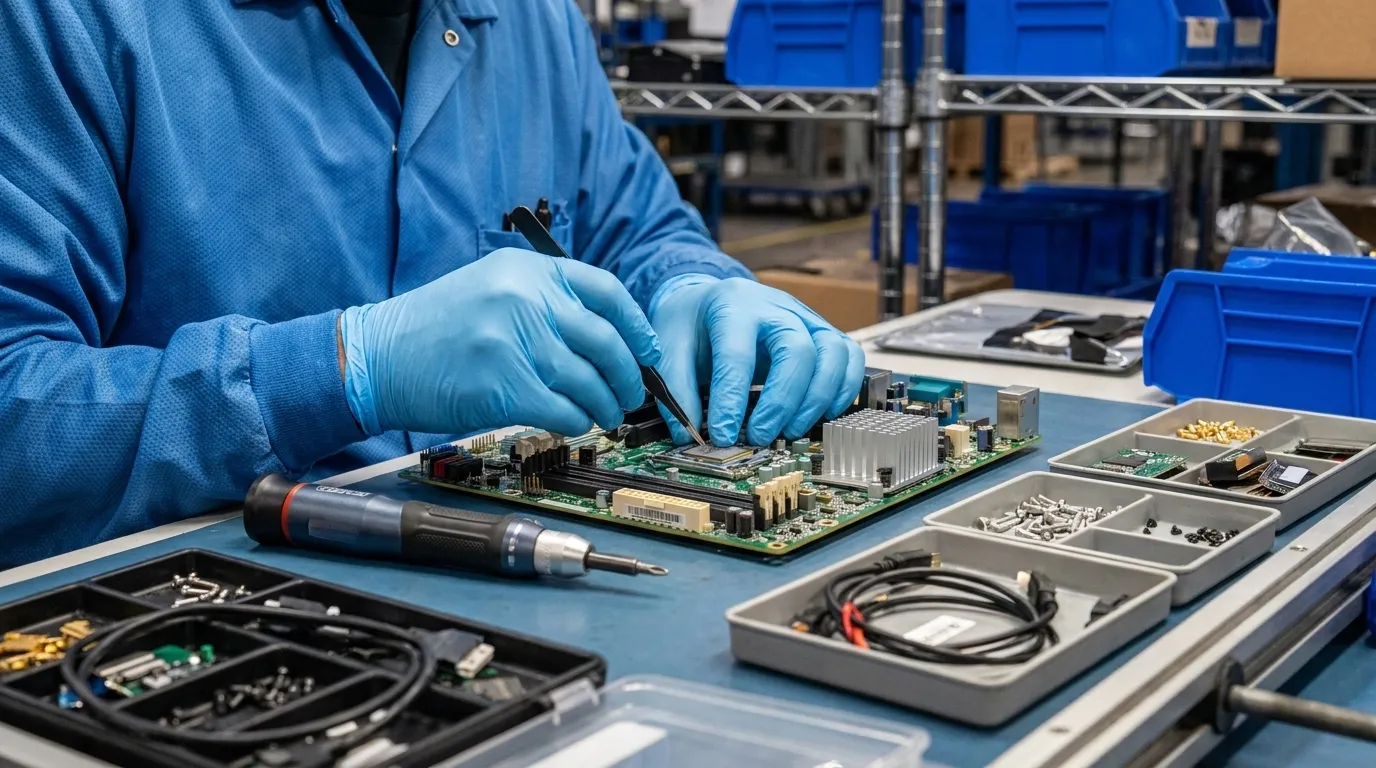
A kitting company receives individual components and verifies them against a bill of materials before assembly begins. At dedicated assembly stations, staff build each kit to specification and create a new SKU that represents the completed unit. Quality checks occur at receipt, assembly and audit stages, and packaging follows brand or program standards for consistency.
For IT hardware programs, kitting extends to imaging, serialization, asset tagging, software loads and SIM or IMEI pairing. The completed kit unit consumes component items from inventory during assembly, which keeps stock counts accurate and demand forecasting predictable.
Industries That Depend on Product Kitting
The processes described above support industries where compliance, traceability and scale matter most. Kitting is standard practice across enterprise IT, telecom, consumer electronics and government programs. Common use cases include:
-
Enterprise IT: New-hire and day-one device kits that bundle laptops, peripherals, cables and configuration documentation into a single deployable unit.
-
Telecom: Multi-vendor assembly of handsets, SIM cards, accessories and carrier documentation for large-scale activations.
-
Consumer electronics: Bundling charging cables, adapters and accessories with main products as part of e-commerce or B2B fulfillment operations.
-
Government and public sector: TAA-compliant kit assembly for agency deployments, field kits and program-specific hardware packages that must meet federal sourcing and security requirements.
-
Reverse logistics programs: Returns processing that disassembles, inspects and repackages components for redeployment or secondary market channels.
Each of these environments depends on traceability, compliance documentation and the ability to scale output without sacrificing accuracy.
Talk to a lifecycle expert about kitting for specific industry needs.
Kitting vs. Traditional Fulfillment in Regulated Programs
Traditional fulfillment picks individual SKUs per order at ship time. Kitting pre-assembles those SKUs into a single unit before an order arrives, which shifts labor and quality checks upstream. This approach saves space, reduces picking time and supports scalability in high-volume programs where warehouse staff pick one item instead of multiple components.
For regulated industries, the distinction extends beyond efficiency. General 3PLs typically focus on e-commerce throughput and speed. Specialized lifecycle providers design kitting operations around compliance documentation, serialization, chain-of-custody tracking and integration with repair and asset recovery workflows.
BOM-Based Kitting for Complex IT Hardware Deployments
BOM-based kitting for IT hardware requires more than picking and packing. Each kit must be assembled to an exact specification, verified against a component list and documented for downstream traceability. Premier Logitech executes this process across component verification, assembly, labeling, imaging and serialization.
A typical IT hardware kit may include a configured device, peripherals, power adapters, documentation and program-specific inserts. Each component is received and checked against the BOM before assembly begins. Finished kits receive unique identifiers that link the kit to its components, configuration state and destination.
This chain of custody supports deployment accuracy and returns processing when devices re-enter the reverse logistics stream. Premier Logitech kitting operations also support SIM and IMEI pairing, device imaging, BIOS configuration, custom asset tagging and modern cloud-based provisioning. These capabilities support large-scale enterprise deployments and government field programs.
Compliance Frameworks That Shape Kitting Programs
Regulated industries require kitting providers to operate within defined security and compliance frameworks. The primary frameworks affecting IT hardware kitting in government and enterprise contracts include:
-
TAA (Trade Agreements Act): Requires that products procured for federal contracts are manufactured or substantially transformed in TAA-designated countries. Kitting providers must source and document components to meet these rules.
-
CMMC (Cybersecurity Maturity Model Certification): Phase 1 implementation runs from November 2025 through November 2026 and requires defense supply chain participants to complete Level 1 and Level 2 self-assessments and submit affirmations in the Supplier Performance Risk System.
-
SOC 2: Establishes controls for security, availability and confidentiality of data processed by service providers, which affects kitting operations that involve device configuration, data loading or asset tracking systems.
Premier Logitech holds certifications across these frameworks, along with ISO quality standards and TAPA. The company CAGE Code 4WAJ9 identifies Premier Logitech as a pre-vetted partner for U.S. federal government programs. The NIST Cybersecurity Framework provides a risk-management structure that guides how Premier Logitech handles identification, protection, detection, response and recovery across its operations.
Talk to a lifecycle expert about compliance-ready kitting programs.
Connecting Kitting with Reverse Logistics and Asset Recovery
Kitting and reverse logistics operate as two stages of the same lifecycle. Devices assembled and deployed through kitting programs eventually return for repair, refurbishment, redeployment or recycling. Treating these as separate workflows creates gaps in traceability, increases handling costs and reduces asset recovery value.
Premier Logitech connects kitting directly to its reverse logistics operations. Returned devices enter a triage and grading process, move through depot repair at levels L1 through L4 and then move to redeployment, refurbishment for secondary market channels or responsible recycling. Automated inspection and AI-driven classification at returns intake now support immediate decisions on resale, repair or liquidation and capture return reasons and condition data that inform upstream program decisions.
This integration ensures that serialization and documentation created during kit assembly travel with the device through its entire lifecycle. That continuity supports warranty claims, OEM reporting and compliance audits at every stage.
How to Evaluate Product Kitting Providers
Operations and supply chain leaders evaluating kitting providers for regulated or high-volume programs can use the following criteria as a complete framework:
-
Compliance certifications: The certifications described earlier form the baseline for government and enterprise contracts and signal mature security and sourcing practices.
-
Authorized service center network: OEM authorization enables kitting providers to handle warranty-bearing devices, perform authorized configurations and support in-warranty repair without voiding coverage.
-
BOM-based IT kitting capability: Providers must support serialization, imaging, asset tagging and chain-of-custody documentation, not only pick-and-pack operations.
-
Real-time inventory visibility: Lifecycle analytics, inventory reporting and device traceability support programs that manage large asset populations across multiple locations.
-
Reverse logistics integration: Providers that also operate depot repair, grading and asset recovery programs reduce handoff gaps and vendor fragmentation.
-
Scalable U.S. operations: Nationwide facilities, a broad carrier network and nearshore capacity support programs with variable volume and geographic distribution requirements.
-
Vendor consolidation capability: A single partner that covers sourcing, kitting, configuration, fulfillment and recovery reduces coordination overhead and compliance risk across the supply chain.
Frequently Asked Questions
What is the difference between a general 3PL and a specialized lifecycle provider?
A general 3PL focuses on warehousing, picking, packing and shipping for commercial fulfillment programs. A specialized lifecycle provider builds those capabilities around compliance frameworks, OEM authorizations and integration with repair, refurbishment and asset recovery operations.
For enterprise IT and government programs, this distinction matters because regulated deployments require chain-of-custody documentation, TAA-compliant sourcing and secure data handling that general 3PLs often do not support. Premier Logitech operates as a lifecycle provider and covers every stage from sourcing and kitting through depot repair and responsible recycling.
How do certifications affect kitting operations in government contracts?
Government contracts increasingly require suppliers to demonstrate compliance with sourcing rules, security controls and cybersecurity requirements. For kitting providers, this requirement means maintaining documented processes for component sourcing, secure handling of data-bearing devices and recurring assessment readiness under CMMC Phase 1 requirements.
Providers without these certifications cannot participate in federal supply chains or support agencies that handle Controlled Unclassified Information. Premier Logitech maintains the certifications described earlier and carries the CAGE Code that enables federal contracting.
Can kitting support both forward deployment and returns processing?
Kitting supports both forward deployment and returns processing through the same operational infrastructure. Assembly, BOM management, serialization and quality inspection support outbound device kits for end users or field locations.
The same structure supports returns when devices re-enter the supply chain. Returned kits can be disassembled, inspected against original BOM specifications and routed to repair, repackaging or asset recovery workflows. Premier Logitech integrates both directions within a single program, so documentation created during kit assembly supports triage and disposition decisions when devices return.
What role does an authorized service center network play in kitting programs?
OEM authorized service center status allows a provider to perform warranty-covered repairs, authorized configurations and OEM-compliant refurbishment on specific device brands. In kitting programs, ASC authorization means the provider can configure, image and assemble devices without voiding warranties and can handle in-warranty returns that require OEM-approved repair before redeployment.
Providers without ASC status must route warranty devices to third parties, which creates handoff delays and chain-of-custody gaps. Premier Logitech holds ASC authorization for more than 20 OEM brands that cover major IT and telecom hardware categories common in enterprise and government programs.
Conclusion: Selecting a Product Kitting Partner for Regulated IT
A product kitting company adds measurable value to enterprise IT, telecom, electronics and government programs when its services connect to the full technology lifecycle. BOM-based assembly, compliance certifications, OEM authorizations, real-time visibility and reverse logistics integration separate specialized lifecycle providers from general fulfillment operators.
Premier Logitech has delivered end-to-end technology lifecycle services since 2007. Company kitting operations connect directly to sourcing, configuration, depot repair, asset recovery and responsible recycling, which gives operations and supply chain leaders a single certified partner from first deployment to final disposition.
Talk to a lifecycle expert to build a kitting program that fits compliance and scale requirements.
