Last updated: August 23, 2026
Key Takeaways for 2026 IT Asset Recovery
- Secure IT asset recovery works as a governed, end-to-end process that removes data risk, meets 2026 mandates and recovers residual value. Fragmented vendor models create compliance gaps and lost revenue.
- Enterprises verify R2v3 with Appendix B, NAID AAA, NIST SP 800-88 Rev. 2 and supporting ISO, TAA, TAPA, CMMC and SOC 2 certifications before engaging any ITAD provider.
- Serialized, tamper-evident chain-of-custody documentation from pickup through final disposition remains nonnegotiable for audit defense and regulatory compliance at scale.
- Value recovery improves when assets are sanitized to Purge standards, graded for condition and remarketed quickly. Delayed disposition or recycle-first defaults can forfeit 30% to 60% of potential returns.
- Premier Logitech delivers single-source lifecycle services with required certifications, national logistics reach and value-recovery expertise. Assess an existing ITAD program with Premier Logitech’s lifecycle team.
Core Certifications for Enterprise ITAD in 2026
Certification requirements for enterprise ITAD have tightened in 2026, and a clear baseline now guides provider selection.
R2v3, which fully replaced R2:2013 on June 30, 2023, requires Appendix B data sanitization to be explicitly in scope. It mandates NIST 800-88 alignment, per-device serial tracking and forensic verification sampling of at least 5% of logically sanitized media. Federal procurement teams most often cite R2v3 in government ITAD requirements.
E-Stewards imposes an absolute ban on exporting hazardous e-waste to developing nations and requires certified processors of data-bearing media to also hold NAID AAA. Healthcare, finance and ESG-focused enterprises frequently specify this standard to support environmental and social commitments.
NAID AAA verifies destruction security through unannounced audits that reconcile random chain-of-custody manifests against every serial number on the facility floor. This certification functions as a hard prerequisite in U.S. healthcare and government ITAD contracts.
NIST SP 800-88 Rev. 2, published September 26, 2025, is the current active media sanitization standard and the governing framework for data destruction method selection. It delegates technical execution to IEEE 2883-2022 for device-specific commands.
ISO 9001, ISO 14001 and ISO 45001 provide quality, environmental and worker-safety attestations that support operational credibility. Federal procurement then adds TAA compliance as a mandatory layer. Physical security in transit falls under TAPA, while defense contractors and organizations handling controlled data must also demonstrate CMMC and SOC 2 compliance. Premier Logitech holds TAA, TAPA, ISO, NIST, CMMC and SOC 2 posture alongside its CAGE Code 4WAJ9 for pre-vetted federal engagement.
Certifications establish provider capability, and serialized documentation proves that certified processes actually occurred on each asset.
Serialized Chain-of-Custody for Enterprise Programs
Serialized chain-of-custody forms the backbone of a defensible ITAD program.
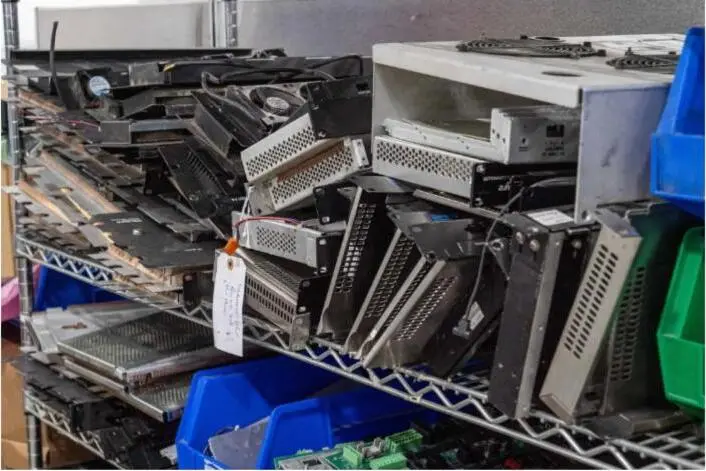
A defensible chain-of-custody record ties the manufacturer serial number to every transfer of possession, with a timestamp and named responsible party at each step. This record creates a clear, auditable trail for every device.
For Fortune 1000 and government contractor clients, documentation requirements remain specific and strict. An unbroken, serialized chain-of-custody log tracks every asset from intake through pickup, transport and the destruction event, with each handoff signed and timestamped under tamper-evident seal. This serialized tracking must extend across all handoffs under tamper-evident seal, as described above.
Serialized asset tagging must be applied at the staging facility before outbound shipment, not after delivery, so every handoff has a scannable record. Any break in the chain of custody must trigger a documented exception process disclosed to the receiving program office before delivery is accepted.
Enterprise ITAD projects require a serialized inventory, chain-of-custody log, data sanitization report, Certificate of Data Destruction and disposition and recovery report. Together, these records create defensible compliance packages for security, finance and sustainability teams.
Multi-site programs add further complexity. Common gaps include waiting until pickup day to locate missing serial numbers and keeping certificates separate from manifests and exception notes. A single accountable partner with documented handoff rules at every site closes these gaps.
Data Destruction Protocols That Meet 2026 Mandates
NIST SP 800-88 Rev. 2 maintains the Clear, Purge and Destroy categories but shifts decision-making to begin with confidentiality classification and reuse intent rather than device tables. Purge serves as the mandatory minimum for medium- and high-sensitivity data on assets leaving organizational control. Destroy applies to highly sensitive data.
IEEE 2883-2022 serves as the technical implementation standard under NIST 800-88, defining exact device- and interface-specific commands for NVMe and SSD drives. NIST SP 800-88 Rev. 2 demotes degaussing so it no longer qualifies as a standalone Destroy method for many modern magnetic media types.
NIST SP 800-88 Rev. 2 formally separates verification from validation and requires structured, tamper-evident digital audit trails plus an updated Certificate of Sanitization. These changes strengthen evidence quality for audits.
On-site destruction works best for data centers and sensitive assets that cannot leave secure facilities. For high-volume or multi-site programs, off-site processing at certified ITAD facilities is often more economically scalable because centralized industrial systems reduce per-unit costs and enable higher revenue recovery through broader buyer networks.
A Certificate of Data Destruction must include the asset identifier, sanitization or destruction method applied, device-level result, exception status and final disposition path. This detail supports clear audit defense.
Value Recovery Strategies That Protect Compliance
Timing drives value recovery outcomes more than any other factor.
Enterprise equipment retains roughly 35% to 43% of its original value after two years according to 2025 residual-value estimates. After that point, assets continue to shed value, though the rate varies by asset class and market conditions.
Remarketing programs can offset 40% to 60% of total disposition costs compared with recycling-only programs. Recycle-first defaults forfeit value in the 30% to 50% range relative to a fair-market-value-graded remarketing pass on the same assets.
Grading discipline shapes resale results. A Grade A device sells for more than a Grade B or C unit, and consistent identical-model batches command roughly 30% higher average returns than mixed pallets. A three-year refresh cycle consistently recovers multiples of the value obtained from a six-year cycle.
Value recovery and compliance align when programs route assets by data risk. Certified sanitization enables remarketing, and assets that pass Purge-level sanitization with serialized certificates can enter secondary markets. Assets requiring Destroy, particularly those that have touched CUI or classified data, do not qualify for resale. Disposition routing by data risk classification at intake protects both compliance and recovery outcomes.
Multi-Site Logistics Capabilities for National Rollouts
Electronics held during unscheduled or delayed pickups can lose a double-digit percentage of market value, and multi-site coordination across time zones and building-access rules is required to prevent assets from sitting untracked in storage.

A single accountable provider with local execution capability reduces vendor fragmentation and closes chain-of-custody blind spots between locations. Vendor fragmentation across pickup, transport, intake and triage creates documentation gaps that no individual vendor can reconcile after the fact.
Multi-site ITAD logistics require documented operational handoff rules specifying who stages assets, who approves exceptions, who handles pickup timing and packing details and who receives confirmation. Clear rules keep programs predictable.
Premier Logitech operates three DFW facilities with nearshore operations in Laredo and Nuevo Laredo, Mexico, supported by a network of more than 120 vetted LTL carriers across North America. This hub-and-nearshore model supports national rollouts with consistent chain-of-custody from first pickup through final disposition. Structured box programs with prepaid logistics and portal-based inbound tracking maintain documentation integrity across remote and branch locations.

Enterprise RFP Checklist for Secure IT Asset Recovery Partners
The following checklist maps standard enterprise requirements to provider capabilities and supports structured vendor evaluations and RFP responses.
- Certifications:
- R2v3 with Appendix B in scope
- E-Stewards
- NAID AAA
- ISO 9001/14001/45001
- TAA
- TAPA
- CMMC
- SOC 2
- Serialized per-device tracking from pickup through final disposition
- Signed handoffs at each transfer
- Tamper-evident seals
- Exception disclosure protocols
- NIST SP 800-88 Rev. 2 alignment
- IEEE 2883-2022 technical execution
- Clear, Purge and Destroy method selection by data classification
- On-site and off-site options
- Per-device serialized certificates issued within 24 to 48 hours of destruction
- Asset identifier and method applied
- Technician ID and verification record
- Documented disposition path
- Audit-ready documentation package
- Asset inventory and chain-of-custody log
- Sanitization report and downstream recovery record
- All records linked by serial number
- Fair-market-value grading process
- Remarketing capability
- Disposition routing by data risk and asset condition
- Access to secondary markets
- Pickup coordination across locations
- Structured box programs
- Serialized inbound tracking
- Exception handling protocols and single-vendor accountability
- ASC status for relevant OEM brands
- Repair and refurbishment capability
- Warranty support
- CAGE Code
- ITAR handling capability
- CUI protocols
- DCSA-compatible documentation
- Zero-landfill commitment
- Basel Convention-compliant export controls
- CERCLA due diligence documentation
Decision Framework for Selecting an ITAD Partner in 2026
The right ITAD partner for a large enterprise or government contractor demonstrates compliance across every evaluation pillar above. Certifications remain current and verifiable. Chain-of-custody documentation stays serialized and audit-ready. Data destruction aligns to NIST SP 800-88 Rev. 2 with IEEE 2883-2022 technical execution. Value recovery follows grading and timing, not recycling defaults.
National-scale providers offer broad coverage but often lack the flexibility and direct accountability that complex programs require. Nimble ASC-authorized providers with multi-site logistics infrastructure, government compliance posture and end-to-end lifecycle capability close the gaps that fragmented vendor relationships leave open.
Premier Logitech has operated as a single-source lifecycle partner since 2007, serving enterprises, OEMs, telecom providers and government agencies. The company holds ASC authorization for more than 20 OEM brands, operates under TAA, TAPA, ISO, NIST, CMMC and SOC 2 frameworks and maintains a CAGE Code for federal engagement. Its DFW hub and nearshore operations support national rollouts with consistent chain-of-custody and value recovery capability.
Connect with Premier Logitech to evaluate an ITAD program against 2026 compliance requirements.
Frequently Asked Questions
What stages of the technology lifecycle does a secure IT asset recovery partner support?
A full-service IT asset recovery partner supports the complete technology lifecycle, not just end-of-life disposition. This coverage includes asset inventory and tracking during active use, staging and configuration for deployment, depot repair and refurbishment for in-service assets and secure decommissioning when assets retire. At the recovery stage, the partner manages pickup coordination, serialized chain-of-custody documentation, data sanitization or destruction, grading and remarketing for assets with residual value and responsible recycling for assets that cannot be resold. Premier Logitech covers all of these stages, from sourcing and fulfillment through reverse logistics and recycling, under a single program or as modular services.
Which compliance frameworks are required for government and enterprise ITAD contracts?
Requirements vary by sector and data sensitivity, yet several frameworks appear consistently in 2026 contracts. R2v3 supports responsible processing and downstream chain-of-custody. NAID AAA verifies data destruction security. NIST SP 800-88 Rev. 2 governs media sanitization method selection and documentation, while ISO 9001 and ISO 14001 cover quality and environmental management. Government and defense contractors typically add TAA compliance for procurement, CMMC for controlled unclassified information handling, SOC 2 for data security controls and TAPA for physical security in transit. Organizations with DCSA facility clearances require ITAR-compatible handling and NISPOM-aligned documentation. Premier Logitech maintains compliance posture across TAA, TAPA, ISO, NIST, CMMC and SOC 2, with a CAGE Code for pre-vetted federal engagement.
How is value recovered from retired enterprise assets without compromising data security?
Value recovery and data security operate in sequence, not in conflict. At intake, assets are classified by data sensitivity and condition. Assets cleared for remarketing undergo NIST SP 800-88 Rev. 2-aligned sanitization, typically Purge-level, with serialized Certificates of Sanitization issued per device. Only after sanitization is verified does the asset enter the grading and remarketing workflow. Grading assesses cosmetic condition, component completeness and functional status, which directly determines resale value. Assets that cannot be sanitized to a standard that permits remarketing, such as those that have handled classified or CUI data, route to destruction. This disposition routing by data risk classification protects compliance while ensuring that assets with residual value are not unnecessarily destroyed or recycled.
What documentation should be expected after each recovery project?
A complete post-project documentation package for a secure IT asset recovery engagement includes several linked records. A serialized asset inventory lists every device by serial number, model and condition at intake. A chain-of-custody log records every handoff from pickup through final disposition with timestamps and responsible parties. A data sanitization report documents the method applied to each device and the verification result. A Certificate of Sanitization or Certificate of Destruction issues per device. A disposition and recovery report confirms the final outcome, whether remarketed, recycled or destroyed, with downstream documentation for audit purposes. All records link by serial number and arrive in a structured, machine-readable format to support programmatic reconciliation against property records. This package supports audit readiness under NIST, HIPAA, GLBA, PCI DSS and applicable state privacy regulations.
