Last updated: June 29, 2026
Key Takeaways
- Returns management in enterprise IT relies on structured workflows that combine secure data handling, OEM-authorized repair, regulatory compliance and value recovery beyond generic e-commerce practices.
- An eight-step process covering RMA authorization, chain-of-custody logistics, grading, L1–L4 triage, NIST-aligned sanitization, disposition routing, compliance documentation and analytics improves cycle time and recovery value.
- Key performance indicators such as receiving cycle time, first-pass yield, net recovery rate, sanitization verification and documentation completeness give operations teams clear visibility for continuous program improvement.
- Compliance with TAA, NIST SP 800-88, CMMC, SOC 2 and IRS Publication 1075 is mandatory for government and regulated enterprise returns programs and requires documented audit trails at every stage.
- Premier Logitech delivers this complete workflow as a single ASC-authorized partner; talk to a lifecycle expert to design a compliant, high-volume returns program.
Eight-Step Return Handling Workflow for Enterprise IT
The eight steps below form a repeatable workflow for enterprise IT returns programs. Each step lists a core objective, enterprise tactics, a measurable KPI and how Premier Logitech capabilities support that stage.
Step 1 — Returns Authorization and Intake
Objective: Gate every return before it enters the facility.
Tactics: Deploy an automated RMA portal that validates eligibility, assigns a case number and routes the unit to the correct processing lane. Require serial number capture at intake.
KPI: RMA portal self-service rate, with most authorizations completed without manual intervention.
Premier Logitech operates RMA management and returns processing programs that capture device data at intake and feed it directly into inventory tracking systems.
Step 2 — Inbound Logistics and Chain-of-Custody
Objective: Move units from the customer site to the depot without data exposure or loss.
Tactics: Use tamper-evident packaging and serialized manifests. Log every handoff in a transportation management system.
KPI: Inbound manifest accuracy rate, measured as discrepancies between shipped and received units.
Step 3 — Receiving, Sorting and Grading
Objective: Classify every unit by condition within hours of arrival.
Tactics: Apply a standardized cosmetic and functional grading rubric from Grade A through Scrap. Use barcode scanning to link physical units to digital records.
KPI: Receiving cycle time, defined as elapsed hours from dock arrival to graded status in the system.
Step 4 — L1–L4 Repair Triage
Objective: Route each unit to the lowest-cost repair level that restores full function.
Tactics: L1 covers software resets and firmware updates. L2 addresses component-level swap. L3 involves board-level repair. L4 handles full depot rebuild or OEM escalation. First-pass yield at each level determines escalation.
KPI: First-pass yield by repair level, measured as the percentage of units passing functional test without rework.
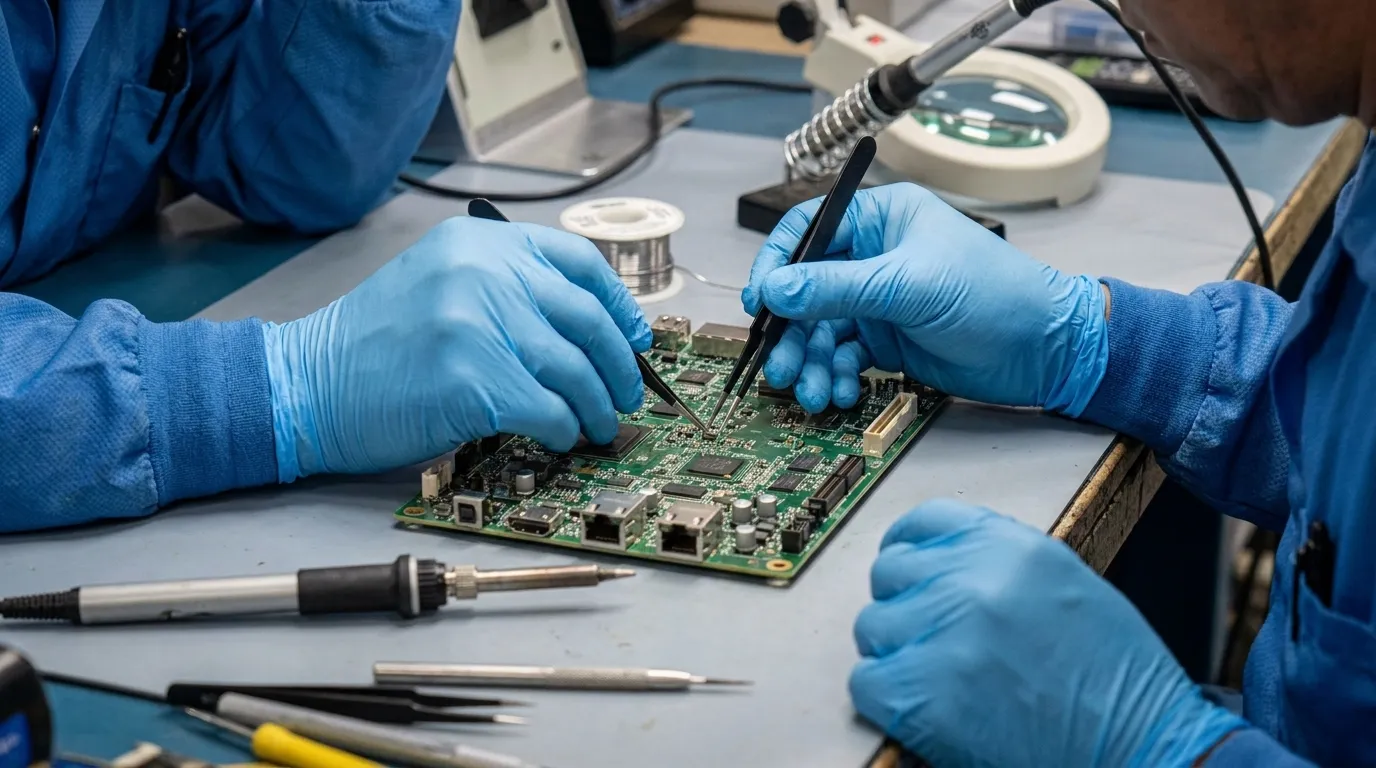
As an ASC-authorized partner for multiple OEM brands, Premier Logitech performs L1–L4 depot repair within OEM warranty and quality frameworks.
Step 5 — Data Sanitization
Objective: Remove all data before any unit leaves organizational control.
Tactics: Apply NIST SP 800-88 Rev. 1 sanitization methods: Clear for internal redeployment, Purge for units leaving the organization, Destroy for end-of-life or defective media. Purge methods include cryptographic erasure on self-encrypting drives, ATA Secure Erase for HDDs and NVMe secure format commands for SSDs.
KPI: Sanitization verification rate, defined as the percentage of units with completed, documented verification records.
Premier Logitech secure data destruction service produces certificates of sanitization with full audit trails aligned to NIST 800-88.
Step 6 — Disposition Decision and Value Recovery
Objective: Route each unit to the channel that maximizes net recovery value.
Tactics: Use condition grade and compliance status to select among redeployment, certified refurbishment, secondary market resale, parts harvesting or responsible recycling. See the disposition table in the next section.
KPI: Net recovery rate, measured as recovered value as a percentage of original asset cost.
Step 7 — Compliance Documentation and Reporting
Objective: Produce auditable records for every unit processed.
Tactics: Generate certificates of data destruction, repair records, chain-of-custody logs and disposition reports. Align documentation to TAA, NIST 800-88, CMMC and SOC 2 requirements.
KPI: Documentation completeness rate, defined as the percentage of processed units with a full compliance record.
Premier Logitech compliance reporting covers ISO, NIST, CMMC and SOC 2 frameworks and is available to government and enterprise clients.
Step 8 — Program Analytics and Continuous Improvement
Objective: Use KPI data to reduce cycle time and raise recovery value over successive periods.
Tactics: Publish a monthly dashboard covering the metrics in the KPI table below. Set improvement targets each quarter.
KPI: Dashboard review cadence and quarter-over-quarter improvement on at least two primary metrics.
Across these eight steps, Premier Logitech provides RMA intake, ASC-authorized repair, NIST-aligned data destruction and compliance reporting within a single, integrated workflow.
Build this eight-step workflow for an enterprise IT returns program.
Reverse Logistics Frameworks for Routing and Measurement
Effective reverse logistics relies on clear disposition rules and consistent performance measurement. The following tables define grade-based routing decisions and the KPI dashboard that supports continuous improvement.
Table 1 — Disposition Decision Rules
| Condition Grade | Recommended Action | Recovery Channel | Compliance Note |
|---|---|---|---|
| Grade A — Fully functional, minimal cosmetic wear | Certify and redeploy or resell | Internal redeployment or certified refurbished secondary market | NIST 800-88 Purge required before transfer; TAA origin verification for government resale |
| Grade B — Functional with cosmetic defects | Cosmetic refurbishment, then resell | Secondary market or OEM-authorized refurbished channel | NIST 800-88 Purge; SOC 2 chain-of-custody documentation |
| Grade C — Functional defects, repairable | L2–L3 depot repair, then regrade | Repair-to-resell or warranty replacement pool | OEM ASC authorization required for warranty-eligible repairs; NIST 800-88 Purge before repair handoff |
| Grade D — Non-functional or beyond economic repair | Parts harvesting or responsible recycling | Parts reclamation or certified e-waste recycler | NIST 800-88 Destroy for storage media; ISO 14001-aligned recycling documentation |
Program performance also depends on tracking a focused set of metrics that reflect speed, quality, value and compliance. The next table defines those KPIs and their primary data sources.
Table 2 — Recommended KPI Dashboard
| Metric | Definition | Target Benchmark | Data Source |
|---|---|---|---|
| Receiving Cycle Time | Hours from dock arrival to graded status in system | Program-defined SLA; minimize quarter over quarter | WMS / depot intake system |
| First-Pass Yield | Percentage of units passing functional test without rework at each repair level | Maximize at L1 before escalating to L2+ | Repair management system |
| Net Recovery Rate | Recovered value as a percentage of original asset cost | Increase through grade-appropriate disposition routing | Asset recovery and remarketing records |
| Sanitization Verification Rate | Percentage of processed units with completed NIST 800-88 verification records | 100% for units leaving organizational control | Data destruction certificates and audit log |
| Documentation Completeness Rate | Percentage of processed units with a full compliance record | 100% for government and regulated enterprise programs | Compliance reporting system |
The disposition rules and KPIs above assume that every step in the returns workflow meets regulatory requirements. The next section outlines those requirements.
Compliance Requirements for Government and Enterprise Returns
Enterprise and government IT returns programs operate under overlapping regulatory frameworks. Each framework defines obligations for how returned assets are handled, sanitized and documented.
Trade Agreements Act (TAA). GSA Multiple Award Schedule contracts require contractors to sell to the U.S. Government only products manufactured or substantially transformed in the U.S. or a TAA-designated country. Because refurbished units reenter government supply chains as new sales under GSA contracts, returns programs supporting federal agencies must verify TAA origin before routing those units back into circulation.
NIST SP 800-88 Rev. 1. NIST 800-88 defines three sanitization categories, Clear, Purge and Destroy, for permanently removing data from electronic storage media. Purge is the required method for any device leaving organizational control through RMA returns, resale, donation or third-party maintenance. Audit trail requirements include asset tag or serial number, media type, sanitization method, operator identity, date and time, verification method and final disposition.
CMMC. Contractors handling Controlled Unclassified Information must meet Cybersecurity Maturity Model Certification requirements, which include media protection controls aligned to NIST 800-88 and documented sanitization procedures for all returned devices.
SOC 2. SOC 2 Type II audits assess whether a service organization controls security, availability and confidentiality effectively over time. Returns programs that process assets containing customer data must demonstrate consistent chain-of-custody and sanitization controls to satisfy SOC 2 requirements.
Premier Logitech holds TAA compliance, CMMC alignment, SOC 2 certification and NIST-aligned data destruction capabilities, and operates under CAGE Code 4WAJ9 as a pre-vetted federal partner.
Design a TAA- and NIST-compliant returns workflow with an ASC-authorized partner.
How Real-Time Visibility and Single-Partner Consolidation Reduce Cost and Risk
Fragmented vendor relationships introduce handoff gaps, inconsistent documentation and duplicated overhead. A single ASC-authorized partner that covers intake, repair, data destruction, refurbishment and recycling eliminates those gaps by consolidating all workflow steps under one audit trail. That consolidation enables real-time tracking through a unified TMS, which gives operations directors a single source of truth for inventory status, repair progress and disposition outcomes. With that visibility, teams can make faster decisions, manage SLAs more tightly and produce cleaner compliance reports across the full returns cycle.
Frequently Asked Questions
What is returns management in supply chain?
Returns management in supply chain is the end-to-end process of receiving products moving backward from customers or field locations, evaluating their condition, routing them through repair or refurbishment and recovering value through redeployment, resale or recycling. In enterprise IT supply chains, it also includes secure data handling, OEM-authorized repair and regulatory compliance documentation.
What is the return handling process for remanufacturing?
The return handling process for remanufacturing begins with intake and grading, followed by disassembly, component inspection and replacement of worn or failed parts. Units are then reassembled, tested to original functional specifications and cosmetically refurbished before entering a certified refurbished or secondary market channel. OEM ASC authorization is required to perform remanufacturing within warranty and quality frameworks.
What are the best practices for product returns processing in high-volume tech programs?
Best practices include automated RMA authorization, standardized condition grading, L1–L4 repair triage, NIST SP 800-88-aligned data sanitization, grade-based disposition routing and a KPI dashboard covering cycle time, first-pass yield, net recovery rate and documentation completeness. Single-vendor consolidation with an ASC-authorized partner reduces handoff risk and simplifies compliance reporting.
What compliance frameworks apply to enterprise IT returns?
The primary frameworks are the Trade Agreements Act for government supply chain eligibility, NIST SP 800-88 Rev. 1 for media sanitization, CMMC for programs involving Controlled Unclassified Information, SOC 2 for service organization controls and IRS Publication 1075 for programs touching Federal Tax Information. Each framework imposes specific documentation and verification requirements.
How does a single-vendor model improve returns program performance?
A single-vendor model eliminates the coordination overhead and documentation gaps that arise when separate providers handle intake, repair, data destruction and disposition. It creates a unified audit trail, consistent SLA accountability and a single point of contact for escalations. For government programs, it also simplifies TAA and CMMC compliance verification across the full returns workflow.
Conclusion
High-volume enterprise IT returns programs benefit from a structured workflow rather than generic returns advice. An eight-step process that integrates automated intake, L1–L4 repair triage, NIST-aligned data sanitization, grade-based disposition and real-time visibility shortens processing time, raises recovery value and satisfies TAA, NIST, CMMC and SOC 2 requirements. Premier Logitech ASC-authorized network, single-vendor model and compliance certifications deliver that workflow at scale for OEMs, enterprises, telecom providers and government agencies.
Build a high-volume, compliant returns program with Premier Logitech.
