
Last updated: July 28, 2026
Key Takeaways for Secure Data Destruction
- Compliant data destruction follows NIST SP 800-88 Rev. 2 standards with Clear, Purge or Destroy methods matched to media type and sensitivity.
- NAID AAA certification and R2v3 credentials confirm that vendors maintain audited destruction processes, employee screening and zero-landfill downstream tracking.
- Serialized chain-of-custody logs and per-device Certificates of Destruction are mandatory for HIPAA, PCI-DSS, GDPR and CMMC audits; batch certificates are unacceptable.
- Enterprises must balance on-site witnessed destruction for high-sensitivity assets with off-site processing for cost-effective recovery and large-scale refresh projects.
- Premier Logitech delivers national-scale, NAID-aligned destruction services with per-device documentation and hybrid on-site/off-site capabilities; request a consultation to design a compliant program.
NIST SP 800-88 Data Destruction Standards in Practice
NIST SP 800-88 Rev. 2 defines three sanitization categories that apply differently to HDDs and SSDs.
For enterprise HDDs, Clear uses a single verified overwrite pass for internal reuse at low sensitivity levels. Purge uses ATA Secure Erase or degaussing when drives leave organizational control. Destroy uses shredding, crushing or disintegration for highest-sensitivity data or when Purge cannot be verified.
For enterprise SSDs and NVMe drives, Rev. 2 retires multi-pass overwriting because wear leveling and over-provisioned regions remain untouched by standard write commands. Clear uses the device sanitize command. Purge requires cryptographic erase when the drive encrypted all data from first use with a validated implementation and key destruction can be verified. When those conditions are not confirmed, NIST requires physical destruction. Degaussing has no sanitization effect on SSDs because data resides as electrical charge in NAND cells, not magnetic orientation.
Rev. 2 defers per-device technique details to IEEE 2883-2022 and NSA/CSS Policy Manual 9-12. Sanitization is defensible only when paired with verification and a serialized Certificate of Sanitization that records media type, method, result, performer and date for each serial number.

Premier Logitech bases secure data destruction services on this methodology, with per-device documentation for every engagement. Request a Certificate of Destruction template to see the documentation structure.
NAID AAA Certified E-Waste Shredding Standards
Following the correct NIST sanitization method addresses what must happen to the data. NAID AAA Certification confirms that a vendor can execute those methods consistently and securely at scale.
NAID AAA Certification, administered by i-SIGMA, is the industry benchmark for physical destruction vendors. Certified providers undergo unannounced audits that review destruction methods, employee background screening, physical security controls and chain-of-custody procedures. Certification numbers are independently verifiable and appear on Certificates of Destruction.
Physical destruction standards require shredding to particle sizes that meet NSA/CSS specifications. For SSDs, mechanical disintegration to small particles is required because degaussing does not affect flash media. NAID AAA audits confirm that equipment meets those specifications under production conditions.
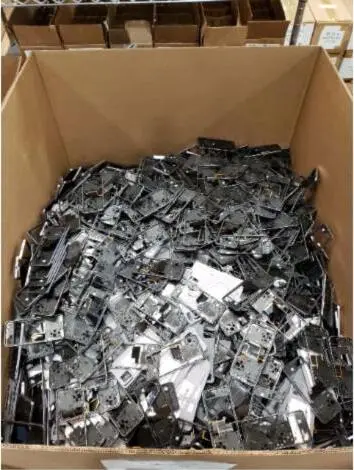
Premier Logitech operates across multiple OEM-authorized service centers and anchors logistics operations at a DFW hub, one of the most connected freight corridors in North America. That infrastructure supports national-scale pickup, transport and certified destruction for enterprise refresh projects of any size. Nearshore operations in Laredo/Nuevo Laredo extend capacity for cross-border programs that require compliant disposition.

Chain-of-Custody and Certificate of Destruction Essentials
A serialized chain of custody must record every handoff from the moment an asset leaves service. Each entry must include the originating location, destination, transfer method, authorizing personnel and a verification reference. Sealed containers, barcode or serial tracking and dual-control transfers create an audit-ready trail.

A compliant Certificate of Destruction must include, for every individual device:
- Serial number and asset tag
- Make, model and media type
- NIST SP 800-88 sanitization level (Clear, Purge or Destroy) and specific method applied
- Verification outcome (pass, fail, destroyed or exception)
- Date, time and facility address of destruction
- Technician identity and signature
- Applicable compliance framework reference (HIPAA, PCI-DSS, CMMC or FISMA)
- Vendor name, address and NAID AAA certification number
Lot-level or batch certificates are not acceptable for HIPAA, PCI-DSS or CMMC compliance because they cannot tie destruction to a specific physical asset. Per-device certificates referenced by serial number are required.
Retention periods vary by framework. HIPAA requires retention of certain records for six years. PCI-DSS requires at least one year for audit trails. SOX requires seven years for records that support financial reporting controls. CMMC includes record retention requirements tied to contract obligations.
For GDPR, Article 5 requires a documented chain of custody under the accountability principle, with penalties reaching 4% of global annual revenue for violations. HIPAA penalties for improper PHI disposal reach up to $2,190,294 per incident category annually under the 2026 inflation-adjusted tiers.
Premier Logitech provides serialized chain-of-custody logs and per-device Certificates of Destruction for every engagement. Review a sample chain-of-custody log to see how serialized tracking works.
On-Site and Off-Site Destruction Choices
On-site destruction occurs at the client premises using mobile shredding equipment. Data never leaves the facility intact. Authorized personnel witness every event and sign the Certificate of Destruction at the moment of shredding. This approach is standard for defense contractors, healthcare environments and organizations with policies that prohibit intact media from crossing the property line.
Off-site destruction routes assets to a certified processing facility under documented chain of custody. Sealed, GPS-tracked transport and background-screened personnel maintain security during transit. Certified facilities support higher throughput, better material segregation for downstream recovery and stronger ESG documentation. For large enterprise refresh projects, off-site processing delivers better per-unit economics by centralizing operations.
Several decision factors guide the on-site versus off-site choice:
- Data sensitivity: PHI, CUI and cardholder data on media that cannot be verified for cryptographic erase require Destroy-level methods regardless of location.
- Volume: Large-scale decommissions benefit from off-site economies of scale. Small high-sensitivity batches favor on-site witnessed destruction.
- Compliance documentation: Both methods satisfy HIPAA and PCI-DSS when a NIST 800-88-aligned provider supplies proper serialized documentation.
- Asset recovery: Off-site facilities enable testing, remarketing, parts harvesting and commodity recovery that on-site shredding removes from consideration.
Premier Logitech operates a hybrid model. Highly sensitive media is destroyed on-site under witnessed conditions. Remaining equipment moves off-site to DFW facilities for testing, recovery, recycling or certified destruction under facility controls. Nearshore operations in Mexico extend capacity for distributed enterprise programs. This structure preserves asset recovery value while meeting strict destruction requirements.
Multi-Regulation Compliance Requirements for E-Waste
Enterprise e-waste programs must satisfy overlapping federal and state requirements. Several core frameworks share common expectations around secure destruction and documentation.
HIPAA Security Rule (45 CFR §164.310(d)(2)(i)): Covered entities and business associates must dispose of ePHI so it cannot be read or reconstructed. Per-device NIST-referenced certificates satisfy the documentation requirement. A signed Business Associate Agreement is required before PHI transfers to a destruction vendor. Retention is six years.
Financial services organizations face similar documentation expectations under the FACTA Disposal Rule (16 CFR Part 682). The rule requires reasonable measures to protect against unauthorized access when discarding consumer report information. NIST Purge or Destroy methods with documented verification satisfy this standard.
GDPR (Article 5, Accountability Principle): Requires a documented chain of custody for all personal data through final disposition. A GDPR Article 28 processor agreement with the destruction vendor is required. Penalties can reach 4% of global annual revenue.
PCI-DSS v4.0.1 Requirement 9.4: Media containing cardholder data must be destroyed so data cannot be reconstructed. NIST certificates that document method, level, serial number and destruction date serve as QSA audit evidence. Nonconformant disposal is treated as an audit failure.
CMMC 2.0 MP.L2-3.8.3: All digital and non-digital media containing CUI must be sanitized or destroyed before disposal or reuse, with documentation aligned to NIST SP 800-88 Rev. 2. Each subcontractor in the Defense Industrial Base supply chain must maintain serialized destruction records. Failure blocks participation in DoD contracts that contain CUI.
State-level obligations layer on top of federal requirements. California’s Cal. Civ. Code § 1798.81 requires shredding, erasing or otherwise modifying personal information to make it unreadable before disposal. Twenty-five states maintain e-waste recycling mandates. EPA RCRA enforcement allows fines for improper hazardous e-waste disposal.
Vendor Selection Scorecard for Data Destruction
Operations and compliance leaders evaluating destruction vendors can use the following criteria as a practical scorecard.
- NAID AAA Certification: Confirms unannounced audits, employee background screening and documented destruction methods. Premier Logitech’s program aligns to NAID AAA standards with independently verifiable certification documentation.
- R2v3 Certification: Ensures zero-landfill policies, downstream tracking of electronic components and prevention of illegal hazardous waste exports. Premier Logitech’s compliance reporting covers ISO, NIST and CMMC frameworks.
- NIST SP 800-88 Rev. 2 alignment: Vendor must apply the correct sanitization level by media type and data sensitivity, not a single shred approach. Premier Logitech applies Clear, Purge and Destroy methods matched to each asset class.
- Per-device Certificates of Destruction: Batch certificates are not acceptable for regulated data. Premier Logitech issues serialized, per-device certificates for every engagement.
- National coverage: Distributed enterprises need one partner that can execute consistently across all sites. Premier Logitech’s DFW hub, multiple OEM-authorized service centers and nearshore operations provide national reach.
- Asset recovery capability: A destruction-only vendor forfeits recoverable value. Premier Logitech’s ITAD program integrates testing, grading, refurbishment and remarketing to maximize return on retired assets.
- Government and enterprise compliance credentials: TAA compliance, CAGE Code 4WAJ9, SOC 2, ISO quality frameworks, NIST and CMMC alignment form a baseline for federal and regulated-industry programs. Premier Logitech holds all of these.
- Hybrid on-site/off-site capability: Programs with mixed sensitivity levels need both options from a single partner. Premier Logitech’s hybrid model covers both without separate vendor relationships.
Premier Logitech has served enterprises, OEMs, telecom providers and government agencies since 2007. The company operates as a single-source lifecycle partner from sourcing through certified recycling, which reduces fragmented vendor relationships and related audit exposure. Build a destruction program that addresses every requirement on this scorecard.
Frequently Asked Questions
Clear, Purge and Destroy Under NIST SP 800-88 Rev. 2
Clear applies overwrite or sanitize commands to media that will remain within the organization at low sensitivity levels. Purge uses cryptographic erase, block erase or ATA Secure Erase for media leaving organizational control or containing regulated data. Destroy renders media permanently unusable through shredding, disintegration, incineration or pulverization and is required for PHI, CUI and cardholder data when Purge cannot be verified. NIST SP 800-88 Rev. 2 prefers Purge over Clear whenever possible and mandates Destroy for highest-sensitivity assets exiting the organization.
Degaussing and SSD Destruction Limits
SSDs store data as electrical charge in NAND flash memory cells, not as magnetic orientation on a platter. Degaussing disrupts magnetic fields and has no effect on flash media. NIST SP 800-88 Rev. 2 does not recognize degaussing as an approved Destroy method for SSDs or any flash-based storage. Physical shredding to the particle size specified by NSA/CSS standards is required for SSD Destroy-level sanitization.
Certificate of Destruction Requirements for HIPAA and CMMC
A compliant certificate must include all elements listed in the Chain-of-Custody section above. The critical distinction for auditors is that batch certificates covering multiple devices under a single job number are not acceptable for HIPAA or CMMC audits because they cannot confirm what happened to any specific device. Each serial number must have its own documented outcome.
Choosing On-Site or Off-Site Destruction
On-site destruction fits when internal policy prohibits intact media from leaving a secure facility, when the data classification requires witnessed destruction or when an organization operates in a defense, healthcare or intelligence environment with strict physical control requirements. Off-site destruction is more practical for large-scale refresh projects, distributed campus cleanouts and mixed asset loads where certified facilities can support testing, remarketing and material recovery alongside destruction. Many mature enterprise programs use a hybrid approach, with on-site services for the highest-sensitivity media and off-site processing for routine fleet retirement.
R2v3 Certification and Data Destruction Compliance
R2v3 certification requires destruction vendors to provide proof of sanitization for every data-bearing device and mandates a minimum 5% independent sampling of logically sanitized media to confirm data cannot be recovered. R2v3 also enforces downstream tracking of electronic components, zero-landfill policies and prevention of illegal hazardous waste exports. For enterprises subject to RCRA, state e-waste mandates or federal procurement rules, R2v3 certification from the destruction vendor provides documented evidence that the full disposition chain, not just the destruction event, meets environmental and data security requirements.
