Last updated: July 1, 2026
Key Takeaways for Depot Repair Programs
- Depot repair quality control uses structured inspection, testing and documentation to protect IT and telecom assets from warranty leakage and repeat repairs.
- The 5-stage framework of Receipt and Inspection, Pre-Repair Triage, Repair Execution, Post-Repair Testing and Final Audit defines clear KPIs and reduces SLA penalties.
- Device-specific checklists for laptops, smartphones and telecom hardware close gaps that generic processes create and improve first-time fix rates.
- Real-time traceability tools, ESD protocols and standards such as ISO 9001, CMMC and SOC 2 turn anecdotal performance into audit-ready data.
- Premier Logitech operates authorized service centers for more than 20 OEM brands and delivers device-level traceability across its repair network; request a program audit to identify gaps in the current quality control process.
The 5-Stage Depot Repair Quality Control Framework
The 5-stage framework defines the purpose, key activities, common failure modes and target KPI for each stage. It applies to laptops, smartphones, telecom hardware and related IT assets processed at an authorized service center.
- Stage 1: Receipt and Inspection. Verify device identity, document cosmetic and functional condition, confirm RMA data and flag discrepancies before any work begins. Common failure modes include mismatched serial numbers, undocumented damage and missing accessories.
- Stage 2: Pre-Repair Triage. Diagnose root cause, classify repair level (L1–L4), confirm parts availability and assign to the appropriate technician tier. Common failure modes include misdiagnosis, incorrect repair-level routing and parts shortages that stall workflow.
- Stage 3: Repair Execution. Perform OEM-approved repairs using certified parts, follow ESD and cleanroom protocols and document every component replaced. Common failure modes include use of non-OEM parts, ESD damage from improper handling and incomplete repair records.
- Stage 4: Post-Repair Testing. Run functional, burn-in and software validation tests against OEM specifications before the device leaves the bench. Common failure modes include skipped test steps, software misconfigurations and unreported marginal failures.
- Stage 5: Final Audit and QA. Conduct an independent quality audit, verify documentation completeness, confirm cosmetic grade and release the device with a full audit trail. Common failure modes include audit bypass under volume pressure and incomplete chain-of-custody records.
Device-Type Quality Control Checklists Aligned to the 5 Stages
The 5-stage framework provides the structure, and each device category requires specific inspection criteria within those stages. Different asset categories need distinct inspection and test criteria, and a single generic checklist introduces gaps that drive repeat repairs.
Laptops and notebooks:
- Verify chassis integrity, hinge torque and display panel for dead pixels or backlight bleed.
- Test keyboard, trackpad, ports and battery cycle count against OEM thresholds.
- Confirm BIOS version, imaging integrity and secure data wipe on replaced storage.
- Validate thermal performance under load to rule out cooling system degradation.
Smartphones and mobile devices:
- Inspect display assembly for touch sensitivity, color accuracy and adhesive seal integrity.
- Test cellular, Wi-Fi, Bluetooth and GPS radio performance.
- Verify IMEI, SIM tray, camera modules and biometric sensors.
- Confirm factory reset, MDM unenrollment and cosmetic grade assignment.
Telecom and network hardware (routers, switches, access points):
- Inspect port integrity, power supply rails and fan operation.
- Run throughput and latency tests against OEM baseline specifications.
- Verify firmware version and configuration wipe.
- Confirm compliance labeling and regulatory markings remain intact.
KPIs and Tracking Methods for Continuous Improvement
Clear KPIs at each stage turn depot repair performance into measurable trends. Real-time visibility tools, including warehouse management systems with device-level traceability and lifecycle analytics dashboards, allow operations leaders to monitor KPI trends across facilities instead of relying on lagging batch reports. Premier Logitech’s platform provides that inventory reporting and device traceability across its repair network, giving clients audit-ready data at every stage.
See how device-level traceability integrates with existing depot repair operations.
ESD Safety, Cleanroom Protocols and Compliance Requirements
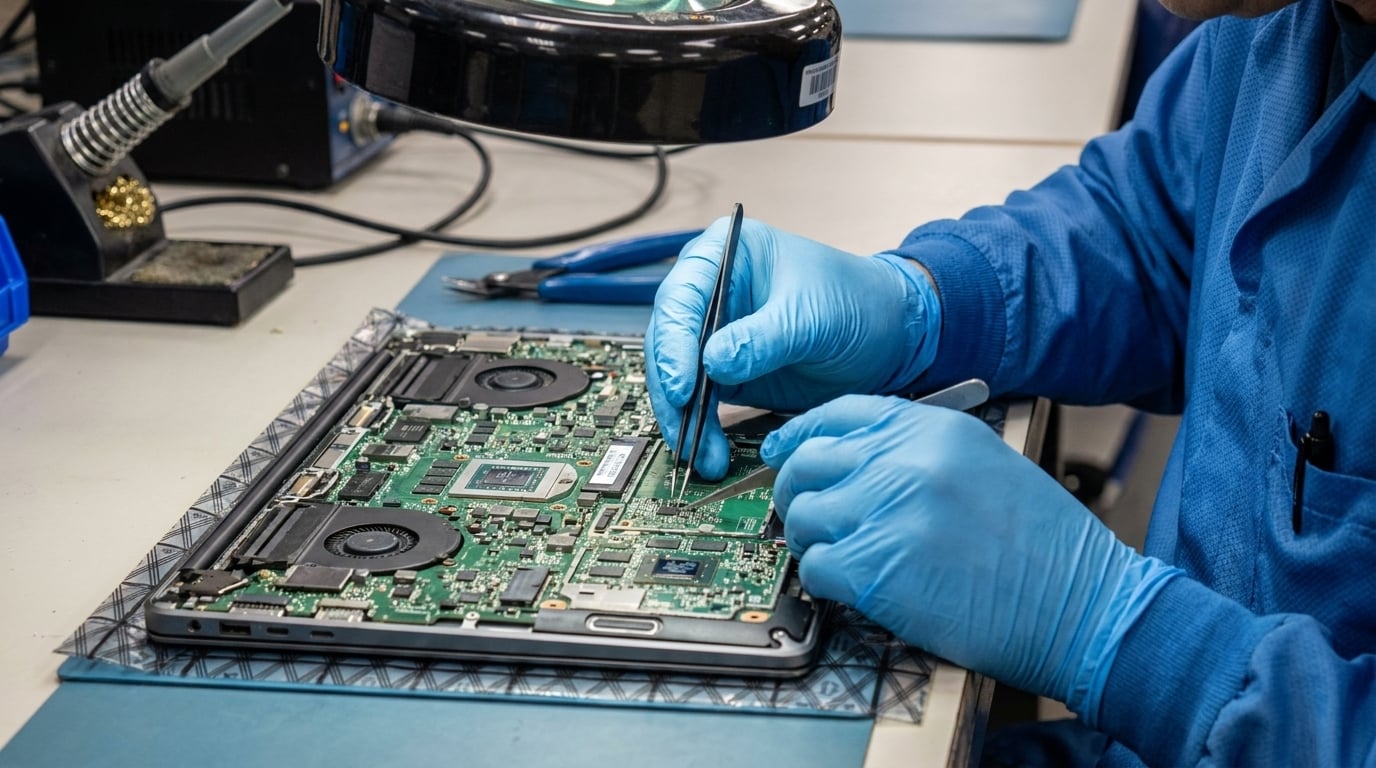
Tracking KPIs reveals performance trends, and protecting those metrics requires operational controls that prevent the failures those KPIs measure. Electrostatic discharge is one of the leading causes of latent device failures in depot repair. Effective ESD control uses grounded workstations, wrist straps, ESD-safe packaging and controlled humidity levels throughout the repair floor. Technicians handling PCBs, storage drives and sensitive radio components follow documented ESD procedures at every step.
Cleanroom protocols support repairs involving optical components, display assemblies and precision connectors. Controlled environments reduce particulate contamination that causes post-repair failures not visible during bench testing.
Compliance requirements for U.S. depot repair operations span multiple frameworks, and each framework addresses a specific dimension of operational risk. ISO 9001 governs process consistency and continual improvement, and ISO 14001 extends those controls to environmental management and e-waste handling. Data security introduces additional requirements, so NIST SP 800-88 defines media sanitization standards for replaced storage, CMMC applies to facilities handling defense contractor assets and SOC 2 covers security and availability controls during repair workflows. Government contracts add a final layer through TAA, which governs country-of-origin requirements for replacement parts.
Authorized service center status acts as the compliance multiplier that ties these frameworks together. ASC authorization means OEM-approved parts, OEM-certified technician training and documented repair procedures that satisfy both OEM warranty terms and government audit requirements. Premier Logitech holds ASC authorization for more than 20 OEM brands, which provides a compliance foundation that nonauthorized facilities cannot match.
Frequently Asked Questions
What is depot repair?
Depot repair is a centralized repair model in which defective or returned devices ship to a dedicated facility for diagnosis, repair and testing rather than being serviced on-site. The depot model supports specialized tooling, certified technicians and controlled environments that field repair cannot provide. It serves as the standard approach for high-volume IT and telecom asset programs managed by OEMs, enterprises and government agencies.
What does depot level repair mean?
Depot level repair refers to the depth of repair performed at a centralized facility. Repair levels typically range from L1, which covers cosmetic and basic functional restoration, through L4, which covers board-level component repair and advanced diagnostics. Triage determines the appropriate level based on failure mode, asset value and OEM authorization scope. Higher repair levels require greater technician certification and more specialized equipment.
How is first-time fix rate measured in depot repair?
First-time fix rate is calculated by dividing the number of devices that pass post-repair testing and do not return for the same failure within a defined window, typically 90 days, by the total number of devices repaired in that period. A low first-time fix rate signals problems in triage accuracy, parts quality or technician execution. Tracking this KPI at the technician and device-category level reveals where corrective action is needed.
What compliance standards apply to IT depot repair in the U.S.?
The applicable standards depend on the asset type and end customer. ISO 9001 and ISO 14001 apply broadly to quality and environmental management. NIST SP 800-88 governs data sanitization on storage media. CMMC applies to facilities supporting defense contractors. SOC 2 is relevant where data handling forms part of the repair workflow. TAA compliance is required for parts used in federal government programs. Facilities serving government or regulated enterprise clients typically demonstrate compliance across several of these frameworks at the same time.
Next Step: Build or Audit a Depot Repair Quality Control Program
A 5-stage depot repair quality control program reduces repeat repairs, protects OEM SLAs and produces the audit-ready documentation that government and enterprise clients require. Building or auditing that program relies on certified processes, OEM-authorized parts and real-time visibility across every stage.
Premier Logitech processes repairs across three DFW facilities with nearshore capacity and maintains the traceability and compliance controls described throughout this framework, using the ASC authorization mentioned earlier. The program scales to high-volume environments without sacrificing the compliance controls that protect client budgets and brand relationships.
Get a structured assessment of the current depot repair quality control program.
