Key Takeaways
- Fragmented return workflows create bottlenecks, compliance risks and lost asset value in high-volume IT, telecom and electronics operations.
- A structured six-step RMA process, from authorization through disposition, removes bottlenecks and improves warranty-eligible recovery.
- Automation at validation checkpoints cuts cycle time from days to hours while increasing documentation accuracy and claim success rates.
- U.S. government and regulated enterprise programs require TAA, NIST, CMMC, SOC 2 and secure data destruction compliance throughout the RMA lifecycle.
- Premier Logitech serves as a single-source, ASC-authorized partner delivering end-to-end RMA management; talk to a lifecycle expert to consolidate reverse logistics operations.
RMA in Logistics and Why It Matters
A Return Merchandise Authorization (RMA) is the formal control mechanism inside reverse logistics that authorizes, tracks and routes a returned product from the end user back through inspection, repair or disposition. In high-volume IT, telecom and electronics operations, the RMA process governs every touchpoint between return initiation and final asset outcome. Without a structured RMA process, reverse logistics operations accumulate bottlenecks, compliance gaps and unrecovered asset value. The following six-step workflow provides a practical framework that prevents these gaps and supports consistent asset recovery.
Six-Step RMA Workflow for Reverse Logistics Teams
- Return Authorization and Structured Intake. The workflow starts with structured data capture at the point of failure. Technicians record a failure code, scan the serial number and attach diagnostic results in a mobile app before any manual approval steps occur. The system validates warranty status, checks customer entitlements and auto-generates a pre-approved RMA number with return instructions.
- Physical Receipt and Verification. Returned units are inducted and verified against RMA data. High-volume returns centers use upfront validation tools to confirm the expected device before processing, which prevents fraud and protects intake accuracy.
- Inspection and Triage. Upon depot receipt, the system auto-assigns returns to technicians based on device expertise and workload. Inspection follows manufacturer-specific test procedures, captures failure evidence photos and syncs results to warranty claim documentation.
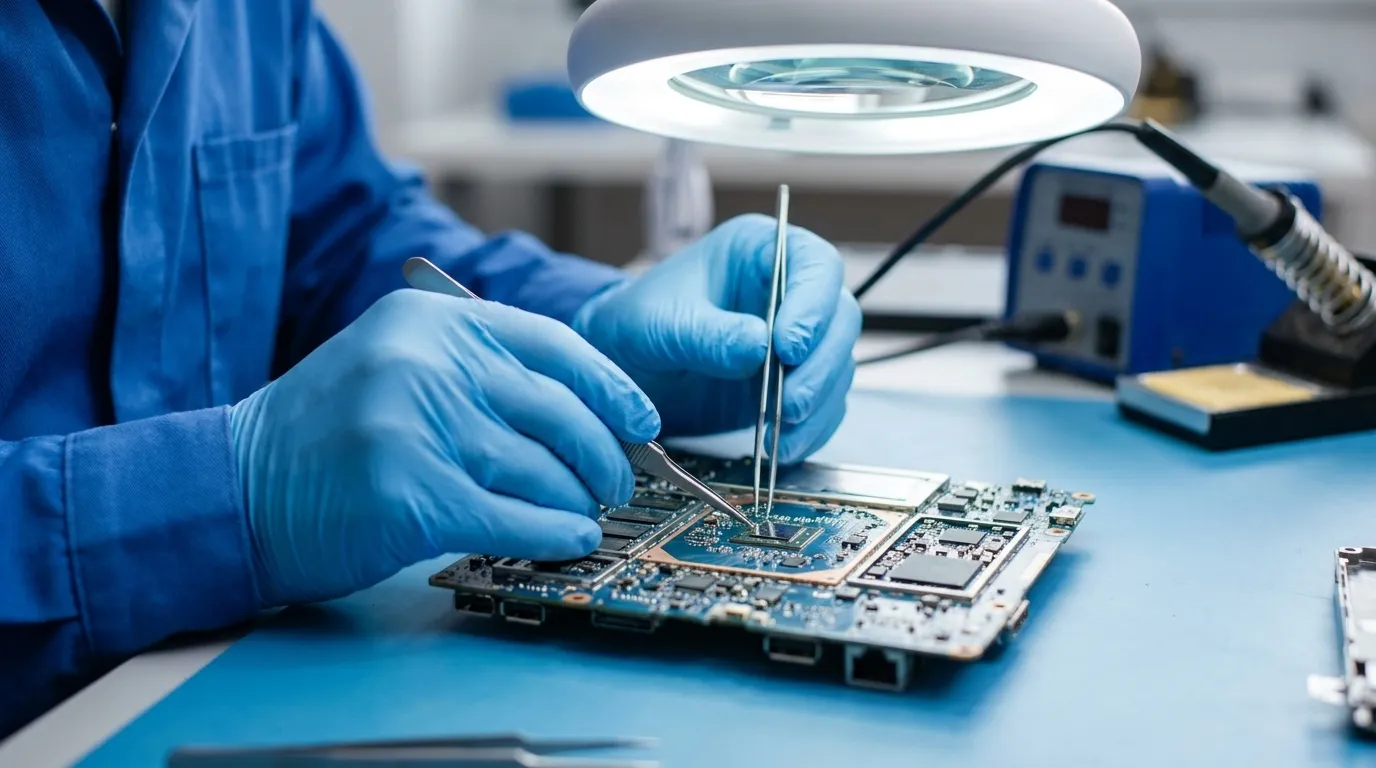
- L1–L4 Depot Repair. Triaged units route to the appropriate repair level, from basic diagnostics and software reloads (L1–L2) through board-level and component repair (L3–L4). Teams document repair outcomes and connect them to warranty claim submissions through API connections to manufacturer portals.
- Grading and Cosmetic Refurbishment. Repaired and returned units are graded against condition standards for secondary market eligibility. Cosmetic refurbishment prepares devices for redeployment, certified resale or channel redistribution.
- Disposition and Asset Recovery. Flexible disposition outcomes include return to a facility, reshipping, responsible recycling or donation. Asset recovery programs capture remaining value through remarketing, parts reclamation or compliant e-waste disposal.
Three RMA Request Types and When Each Fits
The three core RMA request types are refund, replacement and repair. Each supports a specific scenario in IT and electronics returns programs.
Refund RMA applies when a returned unit cannot be repaired or replaced within program terms and the customer receives financial credit. Benefits include:
- Resolves warranty disputes without repair cycle delays
- Supports credit issuance tied to automated validation workflows
- Automation reduces average credit issuance time in B2B claims and RMA processes from multi-day delays to under 60 seconds
Replacement RMA applies when a defective unit requires a like-for-like swap, common in rapid exchange programs for telecom and enterprise IT. Benefits include:
- Minimizes end-user downtime through next-day or advance exchange
- Supports high-volume swap programs with depot inventory management
- Enables real-time inventory queries across depots and technician vehicles
Repair RMA covers fixing broken items returned under warranty after inspection confirms the need, using new, salvaged or third-party parts followed by re-testing for full functionality. Benefits include:
- Maximizes asset recovery value versus replacement or write-off
- Supports OEM warranty claim reimbursement through documented repair evidence
- Extends product lifecycle and reduces e-waste volume
Managing these three RMA types at scale requires automation to maintain speed and accuracy across thousands of concurrent returns.
Automation and Tracking for High-Volume RMA Programs
Manual RMA workflows create bottlenecks that erode cycle time and asset recovery. Automation addresses the root cause because validation and policy checks, not physical transport, often form the primary bottleneck in reverse logistics and RMA closure.
Automated RMA systems track returns through eight checkpoints: shipped, in-transit, received at depot, inspection queued, failure analysis complete, manufacturer claim submitted, reimbursement approved and inventory reconciled. This checkpoint visibility enables the system to escalate cases stalled beyond 48 hours and keeps returns from disappearing into processing queues.
Key automation outcomes from industry deployments include:
- RMA processing time reduced from days to hours with stronger warranty-eligible cost recovery
- Improved return documentation accuracy and higher automated claim submission rates
- Shorter return-to-credit cycles using automated validation tied to receipt events
- Fewer customer escalation tickets related to returns after automating validation-to-credit workflows
Compliance and Security for IT and Government Returns
U.S. government and enterprise IT programs operate under layered compliance obligations that extend into reverse logistics and RMA handling. Noncompliance during the return and disposition phase creates audit exposure and contract risk.
Operations leaders managing IT returns for federal, defense or regulated enterprise clients focus on the following requirements:
- TAA (Trade Agreements Act): Covers country-of-origin requirements for government-procured IT assets through their full lifecycle, including disposition
- NIST SP 800-88: Sets media sanitization guidelines for data-bearing devices processed through RMA and ITAD workflows
- CMMC (Cybersecurity Maturity Model Certification): Required for defense contractors handling controlled unclassified information on returned or repaired assets
- SOC 2 Type II: Confirms that a service provider’s data handling controls meet security, availability and confidentiality standards across the return lifecycle
- ISO 9001 / ISO 14001: Quality management and environmental management standards that apply to repair operations and e-waste disposition
- Secure Data Destruction: Chain-of-custody documentation and certified data wipe or physical destruction for all data-bearing returned assets
- E-Waste Compliance: Responsible recycling and disposal programs aligned with state and federal regulations to reduce landfill liability
RMA Performance Metrics Operations Leaders Track
Operations leaders rely on quantifiable benchmarks to evaluate RMA program performance. The following metrics reflect outcomes from automated, high-volume reverse logistics deployments:
- Warranty-eligible cost recovery increases when structured automation replaces manual triage and claim submission
- Repeat failure rates can drop through proactive pattern detection built into automated inspection workflows
- Credit issuance cycles compress when validation is automated at the point of receipt
- Documentation accuracy improves with automated capture, which reduces claim rejection rates and dispute resolution costs
- Asset recovery rates rise when grading and refurbishment sit inside the RMA workflow rather than a separate downstream process
When an ASC-Authorized Partner Becomes Essential
Internal RMA operations reach a ceiling when return volumes exceed repair capacity, compliance requirements multiply or OEM authorization gaps limit warranty claim eligibility. The decision to outsource to an ASC-authorized partner often follows four signals: volume growth that outpaces internal headcount, fragmented vendor relationships across repair and recycling, compliance requirements that demand certified handling and the need for real-time visibility across the return lifecycle.
Premier Logitech operates as a single-source reverse logistics RMA partner with the scale, authorizations and compliance certifications that fragmented vendor networks cannot match. Key differentiators include:
- Multiple OEM Authorized Service Center authorizations that support warranty-compliant repair across major IT and telecom brands
- High-volume repair capacity across three DFW facilities with nearshore operations in Laredo and Nuevo Laredo
- L1–L4 depot repair from software reloads through board-level component repair
- TAA, NIST, CMMC and SOC 2 certifications for government and regulated enterprise programs
- Real-time tracking and lifecycle analytics through an integrated TMS and operational visibility platform
- End-to-end program management from RMA intake through grading, remarketing and compliant recycling
For operations leaders evaluating vendor consolidation, Premier Logitech replaces fragmented repair, fulfillment and recycling providers with one accountable partner across the full return lifecycle.
Talk to a lifecycle expert about consolidating reverse logistics RMA operations.
Frequently Asked Questions
What is the difference between RMA and reverse logistics?
Reverse logistics is the broader operational framework for moving products back through the supply chain after sale. RMA is the specific authorization and tracking mechanism within reverse logistics that controls return eligibility, routing and disposition. Every RMA sits inside a reverse logistics program, and reverse logistics also covers grading, refurbishment, remarketing and recycling that occur after the RMA is processed.
What are the main types of RMA requests in IT and electronics?
The three primary RMA types are refund, replacement and repair. Refund RMAs resolve warranty claims through credit issuance. Replacement RMAs support rapid exchange programs where a defective unit is swapped for a functioning one. Repair RMAs route the returned device through depot inspection and repair before return or redeployment. Some programs also use store credit or advance exchange as alternate outcomes depending on contract terms and device condition.
How does automation improve RMA processing at scale?
Automation addresses the primary bottleneck in RMA operations, which is validation and policy checks that delay closure even after physical receipt. Automated systems validate warranty status, generate RMA numbers, assign depot technicians, track returns through multiple checkpoints and submit warranty claims through API connections to manufacturer portals. The result is faster cycle times, stronger documentation accuracy and less manual intervention across high-volume return programs.
What compliance certifications should an RMA partner hold for government IT programs?
Partners that support U.S. government or defense IT programs hold TAA compliance, NIST SP 800-88 alignment for data sanitization, CMMC certification for defense-related programs and SOC 2 Type II for data handling controls. ISO 9001 and ISO 14001 certifications demonstrate quality and environmental management standards that apply to repair and e-waste operations. Partners also maintain a CAGE Code for federal procurement eligibility.
How does an ASC authorization affect RMA and warranty claim outcomes?
An Authorized Service Center designation from an OEM grants the repair partner access to manufacturer-approved parts, repair procedures and warranty claim portals. Without ASC status, repairs may void device warranties and warranty reimbursement claims may face rejection. For high-volume IT and telecom programs, working with an ASC-authorized partner directly affects warranty cost recovery rates and the eligibility of repaired units for certified resale or redeployment.
Conclusion: Consolidated RMA Programs with Premier Logitech
A structured reverse logistics RMA program, built on a six-step workflow, automation at validation checkpoints, layered compliance certifications and ASC-authorized repair, converts high-volume returns from a cost center into a recoverable asset stream. The operational gap between fragmented vendor networks and a single-source partner appears in cycle time, compliance exposure and asset recovery value.
Premier Logitech delivers end-to-end RMA management with more than 20 OEM authorizations, depot repair capacity at scale, government-grade compliance certifications and real-time visibility across the full return lifecycle. Operations leaders that manage IT, telecom and electronics returns gain one partner that covers intake through compliant disposition.
