Last updated: July 30, 2026
AI-Driven Inventory and Returns: Key Outcomes
-
AI-native demand forecasting and automated replenishment cut forecast error, out-of-stock rates and inventory carrying costs by fusing external signals with daily model resets.
-
Real-time visibility layers and exception management algorithms reduce reactive logistics spend by flagging anomalies and triggering automated rerouting or carrier reallocation.
-
Return prediction models and automated RMA authorization forecast volumes before arrival, validate compliant requests without manual review and reduce processing costs when integrated with OMS, WMS and ERP systems.
-
Computer-vision inspection improves grading consistency compared with manual methods, while agentic disposition systems route units to refurbish, resale, liquidation or recycling to increase recovery value.
-
Premier Logitech provides a certified repair network, compliance credentials and TMS-enabled infrastructure that support AI-driven inventory and reverse logistics programs at enterprise scale, with a single partner accountable for execution.
AI Demand Forecasting and Automated Replenishment
AI-native demand forecasting improves accuracy by combining historical sales with external drivers such as weather, macroeconomic indicators, promotional calendars and supplier lead times. Models re-baseline daily so forecasts reflect the latest signals instead of static averages. Machine learning demand forecasting consistently reduces forecast error compared with traditional statistical methods.
Better forecasts reduce out-of-stock events and dead-stock liquidation compared with statistical baselines. Those gains flow directly to financial performance because stock levels align more closely with actual demand. As slow-moving inventory shrinks, inventory carrying costs decline and capital shifts from excess stock to productive uses.
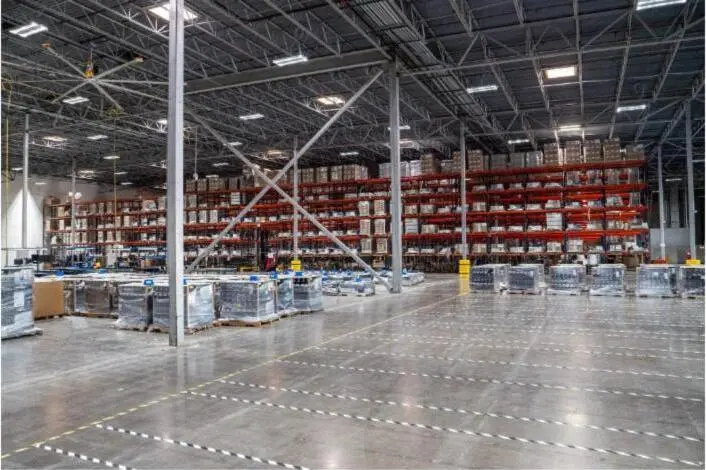
Premier Logitech connects AI-generated demand signals directly to fulfillment execution across its logistics network. That connection shortens the gap between forecast and action, so replenishment, allocation and transfer orders update in step with changing demand patterns.
Explore AI demand forecasting that ties directly into replenishment operations.
Real-Time Visibility and Exception Management Across the Network
Accurate demand forecasts lose value when inventory data lags behind physical movement. AI-enabled visibility layers address that gap by ingesting sensor data, carrier feeds and warehouse management system events to create a continuous operational picture. Exception management algorithms then flag anomalies such as delayed shipments, inventory discrepancies and capacity constraints and route them for automated resolution or human review.
Reactive exception handling consumes a measurable share of logistics spend through expediting, manual tracing and last-minute carrier changes. AI orchestration with real-time reoptimization reduces this cost layer by triggering automated rerouting and carrier reallocation when risk indicators appear. Operations teams focus on the exceptions that matter instead of chasing every shipment.
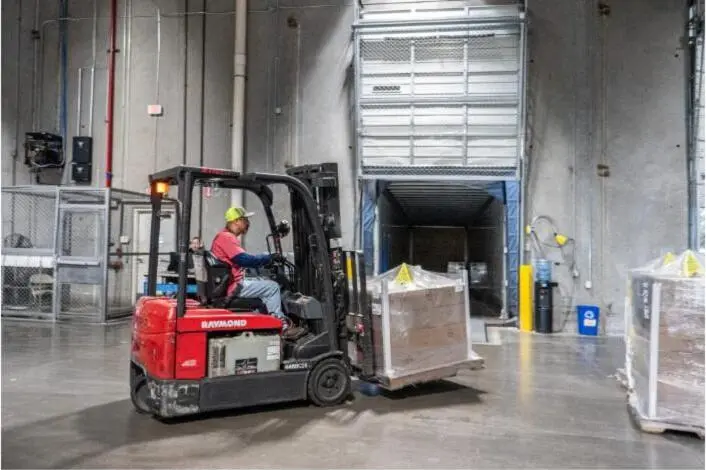
Premier Logitech uses a TMS that tracks inventory and shipments across vetted North American LTL carriers and international freight channels. Operations leaders gain a unified view of assets in transit, at depot and in staging without reconciling data from disconnected systems, which supports faster and more confident decisions.
Return Prediction and Intelligent RMA Authorization
High return volumes without predictive infrastructure create labor spikes, dock congestion and delayed refurbishment cycles. AI return prediction models analyze order history, campaign calendars, SKU category, geography and customer behavior to forecast return volume before it reaches the warehouse. Predictive systems that evaluate many data points per transaction improve accuracy in return prediction and lower reverse logistics costs by aligning staffing and capacity with expected volume.
Automated RMA authorization validates return requests against policy rules, order history and fraud signals without manual review for compliant cases. When a return falls outside standard policy, such as late submissions, missing packaging or high-value items, the system escalates it to human review. AI agents still reduce effort by assembling structured recommendations and supporting data instead of requiring staff to gather information manually.
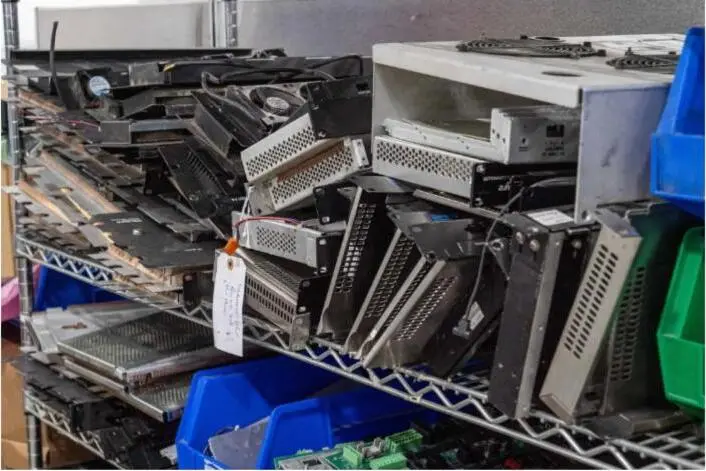
AI-powered reverse logistics systems reduce processing costs when fully integrated with OMS, WMS and ERP platforms. Premier Logitech operates scalable reverse logistics programs, including RMA management, triage and depot repair, that absorb high return volumes without proportional headcount increases.
Computer-Vision Inspection and Smart Disposition Decisions
Once returns clear authorization and arrive at the depot, the next bottleneck appears at inspection. Manual grading introduces variance between operators and creates queues at inspection stations. Computer vision models trained on returned devices grade condition across categories such as new, like-new, excellent, good, fair and poor from images. These models improve grading consistency compared with manual inspection and shorten inspection time per unit.
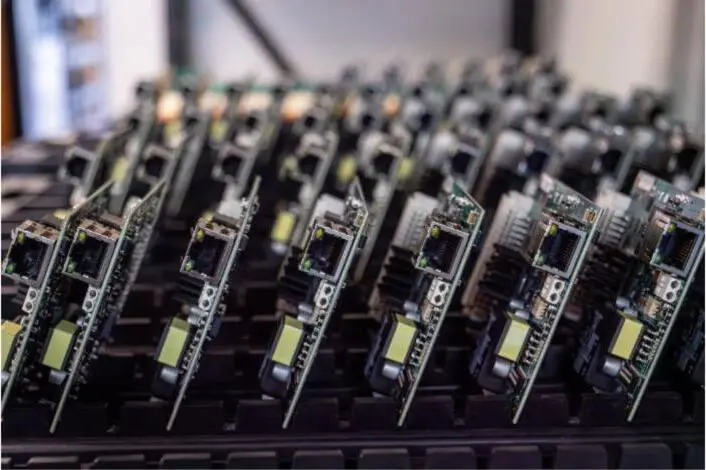
Each graded unit receives a condition score, confidence rating and fraud flag. Those structured outputs feed agentic disposition systems that solve an optimization problem across thousands of items simultaneously. The system routes each unit to refurbish, resale, liquidation, donation or recycling based on real-time refurbishment capacity, market value and time-to-market windows. As disposition logic aligns with accurate grades and live constraints, recovery value on returned inventory increases and cycle times shorten.
Premier Logitech operates an ASC-authorized repair network that spans multiple OEM brands with L1-L4 depot repair capacity. That authorization structure directs disposition decisions to certified repair channels instead of generic handlers, which preserves OEM warranty integrity and supports stronger secondary market pricing.
Connect computer-vision grading to a certified repair and resale network that protects OEM value.
Root-Cause Analysis and Sustainability Outcomes
Return volume signals deeper issues in product design, fulfillment or customer experience. AI root-cause analysis identifies those drivers by correlating return reasons, product reviews, customer feedback and SKU-level defect patterns. Operations leaders then adjust packaging, instructions, product specifications or channel policies to reduce future return rates instead of processing the same failure modes repeatedly.
E-waste regulation is tightening in 2026, which raises expectations for data destruction, material recovery and recycling documentation. Organizations managing high volumes of returned IT assets face growing scrutiny of downstream partners and reporting. Premier Logitech operates ISO 14001-aligned programs and responsible recycling operations that provide a documented, auditable path from return intake through certified disposal, which reduces landfill exposure and supports ESG reporting requirements.
System Integration and Agentic AI in Operations
AI delivers operational value when it connects directly to the systems that execute decisions. Isolated models that generate forecasts without ERP write-back or WMS updates create a manual bridge that operations teams must manage. Enterprises that achieve logistics cost reduction use AI as an orchestration layer that connects order intake, carrier management, dispatch, real-time visibility and settlement into one decision system integrated with ERP, OMS and WMS platforms.
Agentic AI extends this orchestration. Instead of only generating recommendations, agentic systems execute decisions autonomously within defined boundaries and update WMS records, issue RMAs, route carriers and post inventory adjustments. Enterprise applications increasingly embed task-specific agents, which enables specialized agents for grading, triage and exception routing in returns processing workflows.
A phased integration approach reduces implementation risk and builds confidence. A typical rollout for AI returns logistics spans several weeks, beginning with data integration and visibility, progressing through model training and decision-layer pilots and concluding with full execution-layer integration. Premier Logitech supports this approach with modular services, so organizations can start with transportation, depot repair or returns processing as standalone capabilities and then expand to full lifecycle integration.
Compliance and Security for AI-Enabled Logistics
AI implementations in enterprise IT lifecycle and reverse logistics programs carry compliance obligations that extend beyond the models. Data processed by AI systems, including device identifiers, customer records and asset histories, must follow frameworks that govern collection, storage, access and destruction.
For government and regulated enterprise programs, relevant frameworks include TAA for product sourcing, the NIST AI Risk Management Framework for AI governance, CMMC for defense contractor environments and SOC 2 for data handling controls. Joint guidance from the NSA and partner agencies recommends that organizations deploying AI systems understand what data those systems process, store and communicate, who has access and whether data may be transmitted or stored in foreign locations.
AI used in asset disposition, returns triage or recovery routing should be inventoried, classified by risk, monitored at runtime and fully documented for audit readiness. Premier Logitech holds TAA, TAPA, ISO 9001/14001, NIST, CMMC and SOC 2 certifications and operates under CAGE Code 4WAJ9 as a pre-vetted federal government partner. Those credentials apply across the full lifecycle, from intake through final disposition.
Implementation Checklist for AI Inventory and Reverse Logistics
Operations leaders evaluating AI integration across inventory management and reverse logistics can use the following sequence to structure an engagement:
-
Audit current data infrastructure and identify ERP, WMS and TMS systems, data quality gaps and integration points.
-
Define priority use cases and rank demand forecasting, return prediction, computer-vision grading and disposition routing by potential impact and data readiness.
-
Assess compliance requirements and map applicable frameworks such as TAA, NIST, CMMC and SOC 2 to AI data handling and decision documentation obligations.
-
Select a certified partner and confirm ASC authorizations, repair network depth and compliance credentials before finalizing a platform or program.
-
Execute a phased pilot with that partner, starting with a defined SKU set or return category, measuring accuracy and cost outcomes and validating integration before expansion.
-
Establish governance and monitoring with audit trails, exception escalation paths and performance dashboards for ongoing oversight.
-
Scale and refine AI orchestration across additional functions using feedback loops from pilot performance data.
Frequently Asked Questions
What types of AI support enterprise reverse logistics?
Three AI categories deliver the strongest impact in enterprise reverse logistics. Machine learning models handle return volume prediction, fraud detection and demand forecasting by finding patterns across large transaction datasets. Computer vision systems automate condition grading of returned devices, replacing manual inspection with consistent, high-accuracy assessments. Agentic AI systems execute disposition decisions by routing items to refurbishment, resale or recycling and balancing real-time constraints such as refurbishment capacity, market value and storage costs. These layers work together so prediction informs labor allocation, vision grading feeds disposition logic and agentic systems execute routing without manual intervention for policy-compliant cases.
How does AI integration with ERP and WMS systems improve inventory control?
AI improves inventory control when its outputs connect directly to the systems that execute replenishment, fulfillment and receiving decisions. When AI demand forecasts write back to ERP systems, safety stock parameters and purchase orders update automatically instead of waiting for planner intervention. When computer vision grading results post to WMS records in real time, restocking decisions happen faster and with greater accuracy.
The integration layer also supports exception-based planning, where planners focus on anomalies flagged by AI rather than reviewing every SKU manually. Organizations that connect AI orchestration across ERP, WMS and TMS platforms report stronger logistics cost efficiency than those running AI as a standalone analytics layer.
What compliance frameworks apply to AI used in government IT asset lifecycle programs?
Government IT asset lifecycle programs operate under several overlapping frameworks, including TAA, the NIST AI Risk Management Framework, CMMC and SOC 2, which appear in detail in the Compliance and Security section above. Organizations should also maintain an AI bill of materials that documents the models, training data and integration points used in any AI system that touches government asset data. Premier Logitech holds TAA, NIST, CMMC and SOC 2 certifications and operates under CAGE Code 4WAJ9, which provides a pre-vetted compliance foundation for government lifecycle programs.
How does computer vision grading support secondary market resale of returned IT assets?
Secondary market resale depends on consistent, credible condition grading. Buyers in refurbished IT channels require standardized grades, often A, B, C or scrap, with documented inspection criteria. Manual grading introduces operator variance that undermines buyer confidence and reduces realized resale prices. Computer vision systems trained on returned device images produce consistent grades with confidence scores and fraud flags, which creates an auditable inspection record for each unit.
That documentation supports pricing decisions, channel selection and buyer transparency. When grading integrates with an authorized refurbishment network such as Premier Logitech’s ASC-authorized L1-L4 repair operations, the disposition path from grade to certified refurbishment to secondary market channel remains connected, which maximizes recovery value per unit.
What role does agentic AI play in 2026 reverse logistics operations?
Agentic AI represents the operational frontier of reverse logistics automation in 2026. Earlier AI systems generated recommendations for human action, while agentic systems execute decisions autonomously within defined boundaries. In a returns workflow, an agentic system reads the condition grade from computer vision, checks real-time refurbishment capacity and market pricing, evaluates storage and time-to-market constraints and routes the item to the highest-value disposition path without manual intervention for standard cases.
Multiagent architectures extend this model with specialized agents that handle compliance validation, fraud escalation and carrier selection in parallel. Governance requirements for agentic systems include full decision traces, defined scope boundaries, action approval gates and audit-ready logs, which matter in regulated environments such as government agency programs or telecom provider operations.
Conclusion and Next Steps for AI-Enabled Logistics
The shift from reactive to predictive inventory and reverse logistics now operates in live programs, not only in pilots. Organizations that integrate AI across forecasting, visibility, return prediction, computer vision grading and agentic disposition achieve cost structures and recovery rates that manual processes cannot match. Competitive advantage in 2026 favors enterprises that absorb return volume spikes without proportional labor increases, grade and route assets in hours instead of days and maintain compliance documentation automatically.
The implementation path starts with data infrastructure, moves through phased pilots and scales through certified partners that execute AI-driven decisions within regulated frameworks. Premier Logitech delivers end-to-end lifecycle and reverse logistics services with ASC authorization across many OEM brands, government-grade compliance certifications and TMS-enabled visibility across U.S. and nearshore facilities.
