Key Takeaways for Mobile Repair Depots
-
A mobile repair depot is a fixed facility with trained technicians, diagnostic equipment and on-site parts inventory that often delivers same-day service for common phone repairs.
-
Depots differ from mall kiosks, carrier stores and mail-in services in capability, cost structure and turnaround speed, which makes them a reliable option for most consumers.
-
Screen and battery repairs are the most predictable in cost and time, while water damage and board-level repairs require diagnostics that affect final pricing and duration.
-
Choosing an OEM-authorized service center (ASC) supports warranty compliance, higher-grade parts and stronger repair coverage compared to independent or non-authorized shops.
-
Premier Logitech operates this depot model at enterprise scale as an Authorized Service Center. Connect with a lifecycle expert to explore consumer or enterprise repair programs.
How Mobile Repair Depots Compare to Other Repair Options
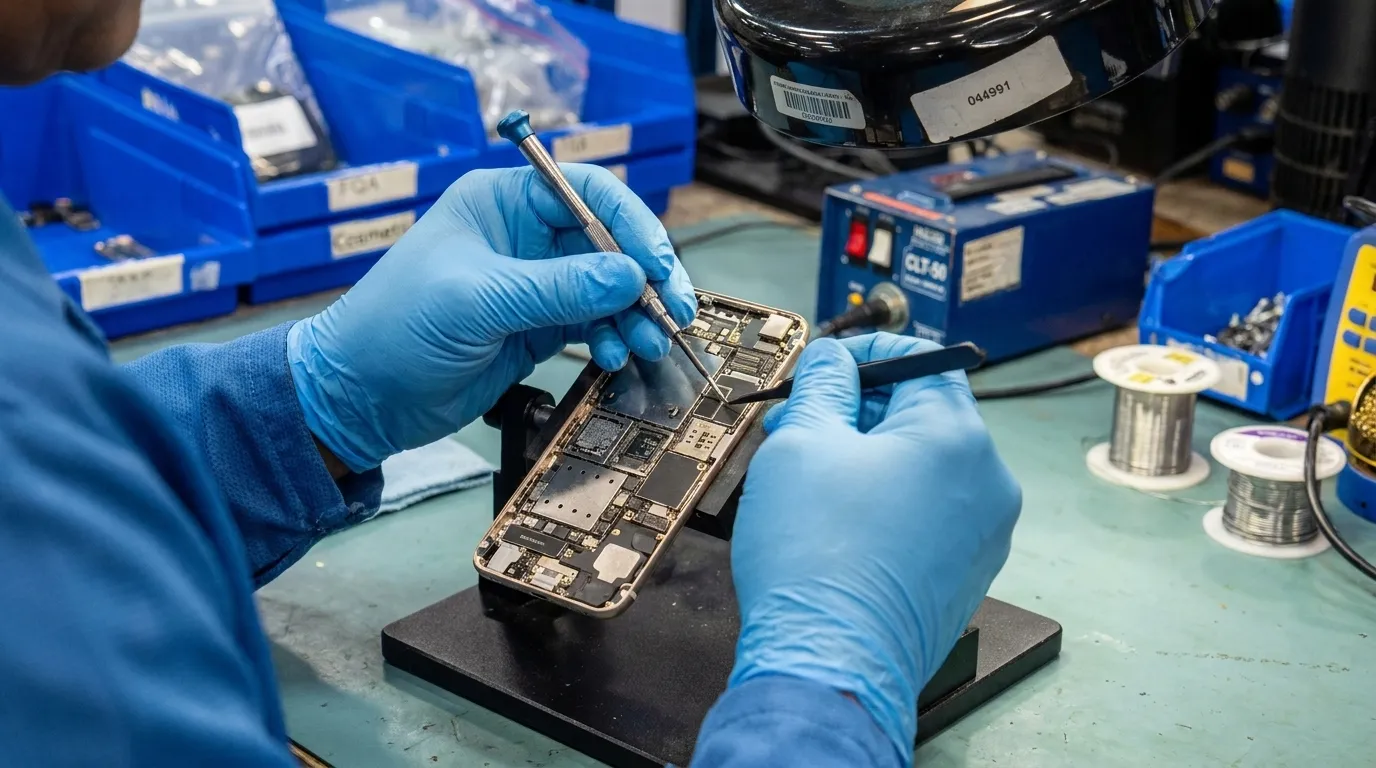
A mobile repair depot is a fixed facility with dedicated workstations, parts inventory, diagnostic equipment and trained technicians. It operates differently from a mall kiosk, a carrier store or a mail-in repair service in both capability and process.
Clear differences between these options help consumers make faster, safer decisions.
A mobile repair depot is a physical facility purpose-built for device repair. Depot repair programs track each unit by serial number from intake through quality assurance to return shipment. This approach supports consistent quality and a complete repair history per device. Many depots accept walk-ins for common repairs and perform the work on-site. Parts quality depends on the depot’s authorization status and ranges from OEM to high-grade aftermarket. Repair warranties are standard practice. Because data handling policies vary, consumers should ask about them directly.
A mall kiosk is a semi-permanent retail unit positioned in high-traffic corridors. Mall kiosks function as front-end retail points focused on product display, impulse sales and customer transactions rather than as centralized diagnostic and restoration facilities. Limited space restricts diagnostic equipment and parts inventory. Mall-based kiosks often charge a small premium for foot traffic and rent. Repair warranties at kiosks vary widely and are not always provided in writing.
A carrier or retail store such as Verizon, AT&T, T-Mobile or Best Buy handles repairs but operates primarily as a branded sales and service counter. Big-box alternatives including carrier stores are generally the most expensive repair option, marking up labor significantly because customers pay for the brand name and the guarantee of genuine parts. Carrier stores often route complex repairs off-site, which extends turnaround.
A mail-in repair service accepts devices shipped by the customer, performs the repair at a centralized facility and ships the device back. Mail-in repairs through Apple typically take five to seven business days from the date Apple receives the device. Mail-in services eliminate the need for a local facility. However, they add transit time and remove the option for same-day service.
Two comparison themes appear frequently in consumer searches: “phone repair depot vs. mall kiosk” and “authorized service center vs. independent repair shop.”
A depot differs from a kiosk in facility depth. Depots use dedicated workstations, bench diagnostic equipment and on-site parts inventory. Kiosks operate from a compact counter with limited tooling. An Authorized Service Center (ASC) is a repair facility authorized by a device manufacturer (OEM) to perform warranty and out-of-warranty repairs to that brand’s standards. ASC status is the key vetting signal when deciding whether a repair provider is factory-backed versus independent, because it implies manufacturer authorization and brand-aligned service handling. An independent repair shop may offer competitive pricing and fast turnaround but cannot perform in-warranty repairs for most OEM brands without ASC authorization and often uses aftermarket rather than OEM parts.
Core Services Offered by Mobile Repair Depots
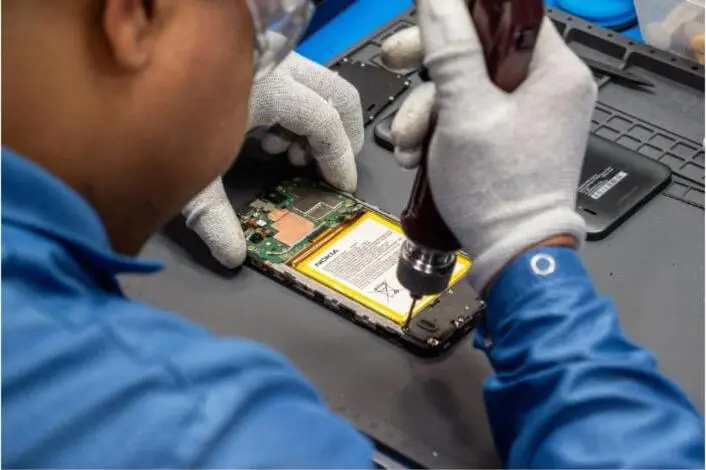
Most mobile repair depots provide a core set of walk-in services for phones and other mobile devices.
-
Screen and glass repair
-
Battery replacement
-
Charging port repair
-
Diagnostics
-
Water damage treatment
-
Camera repair
-
Speaker and microphone repair
-
Software troubleshooting
-
Repair for tablets, smartwatches and other mobile devices
Walk-in repairs for standard screen and battery issues often finish the same day. Repairs that require parts ordering or off-site service take longer. Consumers benefit from asking about turnaround before leaving a device.
Many depots support both in-warranty and out-of-warranty repair. OEM-authorized depots can perform warranty work that non-authorized shops cannot. For devices still under manufacturer warranty, an ASC-authorized depot preserves coverage.

Explore depot repair services and OEM warranty programs with a lifecycle expert.
Typical Mobile Repair Costs and What Drives Them
Several factors drive the cost of a mobile repair: device brand and model, type of repair, parts quality, warranty status and the type of facility performing the work.
Screen and battery replacements are the most common repairs and tend to be the most predictable in cost. Water damage and board-level repairs are more variable because the scope of damage remains unknown until the device is opened. Repair shops may charge diagnostic fees, board-level cleaning or data recovery fees before they can estimate the full scope of water damage, and in some cases may recommend replacement after opening the device because corrosion has spread.
Parts quality affects both price and outcome. Third-party repair shops typically charge less than Apple for common fixes like screen replacements and battery swaps, but they use aftermarket or refurbished parts and often offer shorter warranties. In contrast, OEM-authorized repairs may cost more upfront but preserve warranty coverage and use higher-grade parts.
Depot repairs are generally more predictable and warranty-backed than kiosk repairs. Consumers should get two to three repair quotes before committing, as prices for the same repair can vary between shops. Checking whether a device is covered by insurance or a carrier protection plan before paying out of pocket also helps control cost. Asurion cell phone insurance plans offered by most carriers carry cracked-screen deductibles that may be cheaper or more expensive than local repair quotes depending on the device.
Typical Phone Repair Turnaround Times
Many standard screen and battery repairs at a depot finish the same day. More complex repairs such as water damage, charging port issues, camera work or board-level work often take longer because of parts availability and repair complexity.
Several factors affect turnaround. These include whether the depot stocks the required parts on-site, the complexity of the fault, whether the device needs to be sent to a specialized facility and whether the depot holds OEM authorization for that brand. Depot repair programs track each unit by serial number from intake through quality assurance to return shipment. This tracking supports consistent turnaround management.
Depots with on-site parts inventory and OEM authorization tend to have faster turnaround than shops that outsource repairs or order parts per job. Same-day turnaround is one of the biggest advantages local walk-in shops hold over mail-in services and carrier stores, since customers avoid loaner-device costs and time without their phone.
When Repair Makes More Sense Than Replacement
The repair-versus-replace decision rests on four variables: the device’s age, its current resale or trade-in value, the cost of the repair relative to that value and whether the device still receives software updates.
A phone’s original purchase price is almost never the right number to use when weighing repair versus replacement; the repair quote should be compared to what the phone is actually worth today. A repair costing under roughly 30% of the phone’s current value is a clear-cut repair, 30–50% is usually still rational if the phone passes the failure-count and software-support checks, and over 50% shifts the burden of proof to justify repairing rather than replacing.
Software support plays a central role in this decision. A phone with two or more years of software updates remaining is a confident repair candidate; once support has ended, the money is better put toward a replacement. A phone that is five or more years old and no longer receives security updates is a strong replacement candidate because it poses a security risk regardless of its physical condition.
Multiple simultaneous faults change the math. A phone accumulating multiple faults should be evaluated on the combined repair quote, since individually each repair might pass the 50% test but together they often exceed 50% of residual value.
Repairing a Three-Year-Old Phone
For many users, a battery or screen repair on a three-year-old phone remains worthwhile if the device is otherwise functional and still supported by the manufacturer. Battery degradation below 80% capacity is the most common smartphone fault and the highest-ROI repair, and is almost always worth doing if the phone is under five years old and still receives security updates.
Replacement makes more sense when multiple issues compound, the device is no longer supported or the combined repair cost approaches or exceeds the phone’s current resale value. For devices more than three to four years old, repair costs may exceed 50% of the current value of the device, making a new or certified refurbished device the better investment.
Discuss device lifecycle decisions and refurbishment programs with a lifecycle expert.
Brands Commonly Serviced by Phone Depots
Most mobile repair depots service the major brands consumers ask about, including Apple, Samsung, Google, Motorola and other leading Android manufacturers.
Not every depot is authorized for every brand. An OEM-authorized depot can perform warranty repairs for specific brands, while a non-authorized shop may only offer aftermarket parts. ASC authorization is brand-specific. A depot authorized for Samsung is not automatically authorized for Apple, and the reverse also applies. Consumers benefit from confirming authorization for their specific device brand before leaving a device for in-warranty repair.
Premier Logitech operates as an Authorized Service Center for multiple OEM brands at the enterprise level. That same authorization concept, with manufacturer-verified technicians, processes and parts, is what consumers should look for in a local depot.
Checklist for Choosing a Mobile Repair Depot Near Me
A practical vetting checklist helps consumers evaluate any mobile repair depot.
-
Look for OEM or ASC authorization for the device brand.
-
Ask about the warranty on the repair itself. A reputable depot offers a written warranty on parts and labor.
-
Ask whether the depot uses OEM or aftermarket parts and whether that choice affects the device warranty.
-
Ask how data is handled, whether the device will be wiped and who has access to it during repair.
-
Look for a physical facility with diagnostic equipment, not just a counter.
-
Check whether the depot handles both in-warranty and out-of-warranty repairs.
-
Ask about turnaround expectations before leaving the device.
ASC authorization serves as the strongest single quality signal. OEM authorization means the manufacturer has audited the facility’s technicians, processes and parts, and it represents a working relationship the manufacturer can audit. Consumers should ask repair providers whether the shop is OEM certified for the device’s make or model, whether it follows manufacturer repair procedures, what training and quality credentials its technicians have, what parts will be used and what warranty comes with the work.
Data handling deserves special attention. Repair shops should access only what is strictly necessary to diagnose and test the device, and should retain only service data such as device make and model, fault description, IMEI or serial number and parts used, never customer photos, messages, backups or credentials after the repair. Samsung Galaxy devices include a Maintenance Mode feature that isolates personal data from technician access during repair. Consumers should back up their device before any repair that carries a risk of data loss.
This checklist applies whether the search term is “mobile repair depot near me” or “cell phone repair near me.” The vetting criteria stay the same.
Consult a lifecycle expert about depot vetting, OEM authorization and enterprise repair programs.
The Enterprise Layer: How the Same Depot Model Scales for OEMs
While this guide focuses on consumer repair choices, the same depot model also supports OEMs and enterprises that manage device lifecycles at scale. The capabilities a consumer relies on at a mobile repair depot, including diagnostics, repair, refurbishment, parts management and quality control, match the capabilities OEMs and enterprises need for warranty programs and reverse logistics.
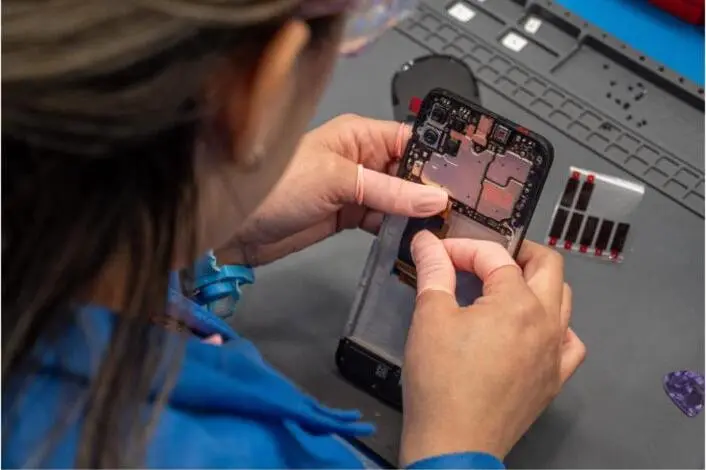
Premier Logitech operates this model at enterprise scale. Founded in 2007, Premier Logitech is an Authorized Service Center for multiple OEM brands, with depot repair capabilities spanning L1 through L4, rapid exchange programs, certified refurbishment and grading and secure data destruction. Premier Logitech maintains NIST-aligned compliance and audit-ready data destruction, with its data destruction processes operationally aligned to the NIST SP 800-88 media sanitization standard’s Clear, Purge and Destroy categories. The company delivers end-to-end lifecycle services from sourcing to recycling, with scalable reverse logistics, real-time operational visibility and compliance frameworks including TAA, ISO, NIST, CMMC and SOC 2.
Operations, supply chain and lifecycle leaders managing high return volumes, OEM warranty programs or fragmented repair and fulfillment vendors can consolidate with Premier Logitech across the full device lifecycle. The same depot infrastructure that handles consumer-level repair scales to enterprise programs without adding complexity for the client.
Frequently Asked Questions
What Is a Mobile Repair Depot?
A mobile repair depot is a dedicated facility where phones, tablets and other mobile devices are diagnosed, repaired, refurbished and returned. It operates with trained technicians, on-site parts inventory and diagnostic equipment, which sets it apart from a mall kiosk or carrier store counter.
How Is a Mobile Repair Depot Different from a Mall Kiosk?
A depot is a fixed facility with dedicated workstations, bench diagnostic tools and parts inventory. A mall kiosk is a compact retail unit in a high-traffic corridor with limited space for equipment and inventory. Depots typically offer more repair types, deeper diagnostic capability and more consistent warranty coverage than kiosks.
How Much Does Mobile Repair Cost?
Cost depends on device brand and model, repair type, parts quality and whether the device is under warranty. Screen and battery replacements are the most common and most predictable repairs. Water damage and board-level repairs are more variable. OEM-authorized repairs may cost more upfront but preserve warranty coverage and use higher-grade parts.
Can a Phone Be Fixed in One Day?
As noted earlier, many standard screen and battery repairs at a depot can be completed the same day. More complex repairs or repairs requiring parts orders take longer. Depots with on-site parts inventory and OEM authorization tend to have faster turnaround than shops that outsource repairs.
Is It Cheaper to Repair or Replace a Phone?
The decision depends on the repair cost relative to the phone’s current resale value, the device’s age and how long it will continue to receive software updates. A repair costing less than roughly half the phone’s current value is generally worth doing if the device is otherwise healthy and still supported. Multiple simultaneous faults or end-of-support status shifts the math toward replacement.
Is It Worth Repairing a 3-Year-Old Phone?
For many users, a three-year-old phone remains a good repair candidate, especially for battery or screen work on a device that is otherwise functional and still receiving software updates. Replacement makes more sense when multiple issues compound, the device is no longer supported or the combined repair cost approaches the phone’s current resale value.
What Brands Do Phone Depots Repair?
Most depots service Apple, Samsung, Google, Motorola and other leading Android manufacturers. ASC authorization is brand-specific, so consumers should confirm authorization for their device brand before leaving a device for in-warranty repair.
What Is an Authorized Service Center (ASC)?
An Authorized Service Center is a repair facility that a device manufacturer has formally approved to perform warranty and out-of-warranty repairs to the brand’s standards. ASC authorization means the manufacturer has audited the facility’s technicians, processes and parts. It serves as the strongest single quality signal consumers can use when vetting a repair provider.
Conclusion and Next Steps
A mobile repair depot is a real repair facility with trained technicians, diagnostic equipment and parts inventory on site. It differs from a kiosk in depth of capability, from a carrier store in cost structure and from a mail-in service in turnaround speed. ASC authorization, a written repair warranty and clear data-handling practices matter most when choosing one.
The next step is simple. Use the vetting checklist above, confirm OEM or ASC authorization for the specific device brand and ask about repair warranty and data handling before handing over the device. For the repair-versus-replace decision, compare the repair quote to the phone’s current resale value and factor in remaining software support.
The same depot model that serves consumers also supports OEM warranty and enterprise reverse-logistics programs. Operations, supply chain and lifecycle leaders managing high return volumes or fragmented repair vendors can connect with Premier Logitech to see how that model works at enterprise scale.
