Key Takeaways
- Mobile repair depot compliance standards combine process controls across sourcing, sanitization, cybersecurity, quality, environmental management and operational safety.
- Key frameworks include TAA for government sourcing, NIST SP 800-88 for data sanitization, NIST SP 800-171 and CMMC 2.0 for defense cybersecurity, SOC 2 for enterprise data security and ISO 9001/14001 for quality and environmental management.
- Evidence requirements span certificates of origin, sanitization logs, System Security Plans, Type 2 audit reports, waste transfer documentation and chain-of-custody records.
- Operational controls such as ESD prevention, lithium-ion battery handling and HIPAA safeguards generate critical audit evidence on the depot floor as well as in documentation.
- Premier Logitech delivers evidence-ready depot operations through TAA-compliant sourcing, ISO frameworks, NIST and CMMC-aligned controls, SOC 2 practices, OEM ASC authorizations for more than 20 brands and CAGE Code 4WAJ9 for government programs. Review depot compliance requirements with a lifecycle specialist.
Mobile Repair Depot Compliance Standards: Framework-To-Process Mapping
The frameworks below cover the compliance surface of a mobile repair depot, from sourcing and data protection to safety and licensing. Each entry follows the same pattern: Framework, Governs, Applies To, Evidence Required.
- TAA (Trade Agreements Act) governs country-of-origin sourcing for parts and devices. Applies to depots serving U.S. government contracts. Evidence: certificates of origin, supplier attestations, substantial transformation documentation per GSA MAS TAA requirements.
- NIST SP 800-88 Rev. 2 governs media sanitization outcomes Clear, Purge and Destroy. Applies to depots processing devices that contain sensitive data. Evidence: sanitization logs, certificates of destruction, chain-of-custody records.
- NIST SP 800-171 Rev. 2 governs protection of Controlled Unclassified Information across defined security requirements. Applies to depots in the defense supply chain. Evidence: System Security Plan, SPRS score, access control records, incident response logs.
- CMMC 2.0 governs cybersecurity assessment and certification for defense contractors. Applies to depots that handle FCI or CUI. Evidence: System Security Plan, POA&M records, SPRS affirmation, C3PAO assessment results where required.
- SOC 2 governs data security process controls across Trust Services Criteria. Applies to depots that handle enterprise customer data. Evidence: Type 2 audit report, control matrix, access review logs, incident records.
- ISO 9001 governs quality management across depot workflow stages. Applies to all repair depot operations. Evidence: triage records, functional test results, serialized tracking logs, corrective action records.
- ISO 14001 governs environmental management including e-waste and battery disposal. Applies to depots that manage end-of-life devices and parts. Evidence: waste transfer documentation, approved recycler records, aspects and impacts register.
- WISE Level 2 governs mobile device repair quality and technician competency. Applies to depots that perform OEM-grade repairs. Evidence: technician certification records, repair quality audit results.
- OSHA (General Duty Clause / 29 CFR 1910) governs workplace safety including lithium-ion battery handling. Applies to all depot facilities. Evidence: safety training logs, battery inspection checklists, emergency action plan documentation.
- ESD Controls (ANSI/ESD S20.20) govern electrostatic discharge prevention in electronics repair environments. Applies to all bench-level repair operations. Evidence: daily wrist strap test logs, monthly surface resistance records, annual audit reports.
- HIPAA Security Rule governs safeguards for devices that contain electronic protected health information. Applies to depots that service healthcare sector devices. Evidence: business associate agreements, safeguard documentation, sanitization records.
- Right-To-Repair And State Licensing govern repair authorization and parts access at the state level. Applies to depots that operate across multiple U.S. jurisdictions. Evidence: state repair licenses, OEM authorization letters, parts provenance records.
The frameworks above apply differently by customer type and contract profile. The next sections group them by government and defense, enterprise data security, quality and environmental expectations, operational controls and parts traceability.
Government And Defense Compliance Frameworks
TAA compliance for mobile device repair depots requires that every end product delivered on a covered federal contract originate in the United States or a TAA-designated country. The compliance test relies on substantial transformation as defined by regulation. Because countries including China, India, Vietnam and Malaysia are absent from the TAA designated-country list, a depot must document the country of origin for every part and device it sources. Supplier attestations and certificates of origin become critical audit artifacts. Delivering noncompliant products while certifying compliance exposes the contractor to False Claims Act liability.
NIST SP 800-88 Rev. 2 defines three sanitization outcomes for mobile devices processed in a repair depot. Clear uses logical techniques through the device standard interface. It is appropriate when the risk of laboratory-grade recovery is low and the device remains within the organization. Purge, including cryptographic erase, makes recovery infeasible using state-of-the-art laboratory techniques and serves as the standard for devices that leave organizational control. Destroy applies to highest-sensitivity cases or media that failed sanitization. For flash storage in smartphones and tablets, wear leveling prevents interface-level overwrites from reaching every physical cell. Cryptographic erase therefore provides the practical purge method. Auditors request sanitization logs, certificates of destruction and chain-of-custody records for every processed device.
NIST SP 800-171 Rev. 2 and CMMC 2.0 apply to depots that process, store or transmit CUI for defense contracts. CMMC Level 2 aligns with the NIST SP 800-171 requirements, organized across control families that include access control, incident response and media protection. A depot that handles CUI maintains a documented System Security Plan, an SPRS score and annual affirmations of compliance. As of July 2026, CMMC Phase II requirements remain suspended pending program review, while DFARS 252.204-7012 obligations and Phase I self-assessment requirements remain in effect.
Premier Logitech holds CAGE Code 4WAJ9, which identifies it as a pre-vetted partner for U.S. federal government programs. TAA-compliant sourcing practices and experience with government and enterprise compliance requirements position Premier Logitech as an evidence-ready depot partner for defense and public sector programs.
Assess government and defense depot compliance needs.
Enterprise Data Security Frameworks
SOC 2 governs data security process controls through five Trust Services Criteria: security, availability, processing integrity, confidentiality and privacy. For a mobile repair depot, security and confidentiality carry the greatest weight. A SOC 2 Type 2 report covers operating effectiveness across a defined review window and requires timestamped access logs, incident records, change management histories and vendor risk assessments for the full period. Enterprise customers request the Type 2 report, the control matrix and evidence of continuous monitoring.
Chain of custody forms the operational backbone of enterprise data security in a repair depot. Every device must be intake-scanned at receipt, assigned a serialized tracking record, stored in a secure area with documented access controls and handed off with a timestamped record at each transfer point. Enterprise auditors examine gaps in the chain of custody early in a depot assessment.
Encryption and secure wipe procedures must generate an audit trail. When a device arrives that contains sensitive data, the depot documents when the wipe was initiated, which sanitization method was applied, whether verification confirmed completion and who authorized disposition. A sanitization log must connect to a specific device serial number and a specific technician to satisfy enterprise or government evidence requirements.
Premier Logitech designs secure data destruction and compliance reporting to produce the evidence artifacts enterprise customers and auditors request, alongside the process outcomes.
Quality And Environmental Frameworks For Depot Operations
ISO 9001 maps to every stage of the depot workflow. At triage, auditors look for documented intake criteria and condition grading records. At functional testing, they examine test procedures, pass-fail criteria and calibration records for test equipment. At repair, they review work instructions, technician qualifications and nonconformance records. At serialized tracking, they verify that every device can be traced from intake through disposition with a complete record. Corrective action records demonstrate that quality failures are identified, root-caused and resolved in a structured way.
ISO 14001 governs the environmental dimension of depot operations. For a mobile device repair depot, significant environmental aspects include battery disposal, e-waste from unrepairable devices, packaging waste and parts reclamation. ISO 14001 Clause 8.1 requires documented operational controls for each significant aspect, including approved waste carrier records, waste transfer documentation and evidence that outsourced disposal partners meet environmental criteria. Auditors follow the process from the aspects and impacts register to the controls on the floor and then to the records that prove those controls operated as planned.
ISO 9001 and ISO 14001 share the Annex SL high-level structure. A depot certified to both standards can run integrated management reviews, internal audits and corrective action processes instead of duplicating effort across separate systems. Enterprise RFP scorecards increasingly require both certifications, and the integrated audit approach reduces documentation effort while maintaining evidence standards.
Premier Logitech operates under ISO quality frameworks and responsible recycling programs that address both quality and environmental dimensions of depot compliance. Discuss quality and environmental expectations for depot programs.
Operational Compliance Layer On The Depot Floor
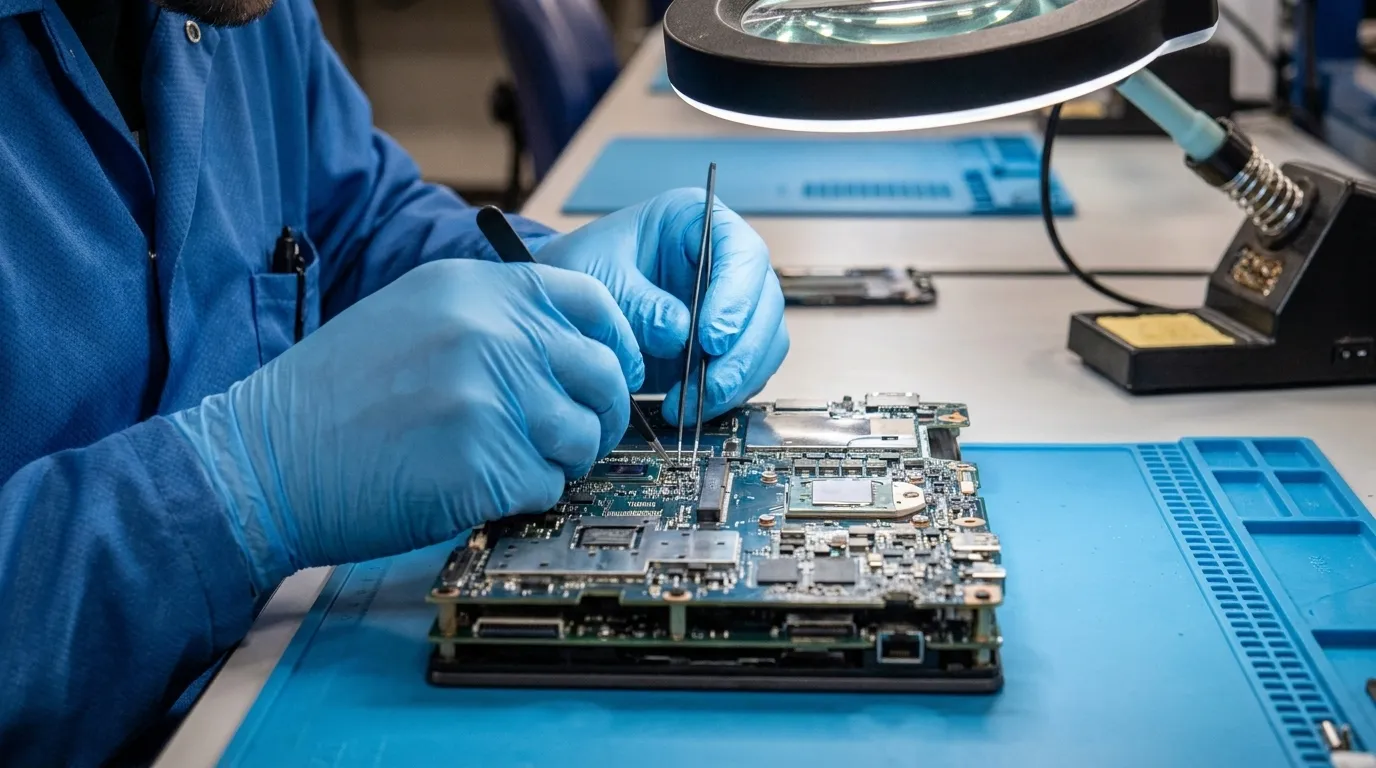
ANSI/ESD S20.20 governs ESD controls in repair environments. It requires grounded ESD-dissipative work surfaces, wrist straps with current-limiting resistors, heel grounders, dissipative flooring and ionizers at repair benches. The standard mandates daily wrist strap verification before use, monthly surface resistance testing and annual comprehensive audits by certified personnel. ESD damage often remains invisible at inspection, and industry research attributes a significant share of component failures in electronics manufacturing to ESD. Documented verification records therefore provide the primary evidence that controls operate as designed.
OSHA General Duty requirements, combined with 29 CFR 1910.1200 on hazard communication and 29 CFR 1910.38 on emergency action plans, govern lithium-ion battery handling in repair depots. Practical controls include designated charging areas with noncombustible surfaces, pre-use inspection for swelling or leakage, immediate removal of damaged batteries from service and segregation in labeled noncombustible containers. Training documentation and inspection checklists form the evidence auditors and enterprise customers request. Lithium-ion batteries also qualify as regulated hazardous waste under RCRA and must be disposed of through a licensed recycler, with disposal records retained for at least three years.
The HIPAA Security Rule, codified at 45 CFR Parts 160 and 164, requires administrative, physical and technical safeguards for devices that contain electronic protected health information. For a repair depot that services healthcare sector devices, this includes a signed business associate agreement with the covered entity, documented access controls for the repair area, technical safeguards such as encryption and secure wipe and records that show ePHI was sanitized before any repair technician accessed the device. ESD controls, battery handling and HIPAA safeguards form an operational layer that auditors examine directly on the depot floor.
Parts Control, Traceability And Licensing Requirements
Parts traceability requires documentation of provenance at every level: OEM original, OEM authorized, certified refurbished or aftermarket. For government and enterprise programs, the provenance chain must be documented from supplier to depot to device, with supplier attestations and receiving inspection records available for audit. Aftermarket parts without documented provenance create exposure for TAA compliance on government contracts and for warranty compliance on OEM programs.
OEM Authorized Service Center authorization and WISE Level 2 certification interact directly. WISE Level 2 establishes the quality and competency baseline for mobile device repair technicians and processes. OEM ASC authorization adds OEM requirements for parts, tools, procedures and documentation on top of that baseline. Together, they define the evidence standard for warranty-eligible repairs and appear frequently in enterprise RFPs as proof that a depot can perform OEM-grade work at scale.
State-level licensing and right-to-repair laws shape repair authorization and parts access. Several states, including California, Colorado, Minnesota and New York, have enacted right-to-repair legislation that requires OEMs to make parts, tools and documentation available to independent repair providers. For a depot that operates nationally, compliance involves tracking applicable state requirements, maintaining current licenses where required and documenting OEM authorization status for each serviced brand. Right-to-repair legislation expands parts and documentation access for authorized depots and strengthens provenance documentation.
Premier Logitech holds ASC status for more than 20 OEM brands and performs certified refurbishment and grading across its depot operations, providing parts provenance and OEM authorization documentation that enterprise and government customers require. Evaluate parts traceability and OEM authorization for specific programs.
Conclusion And Next Steps For Depot Compliance
Mobile repair depot compliance standards consist of a connected set of process controls that span sourcing, sanitization, cybersecurity, quality, environmental management and operational safety. Organizations must evidence these controls at every workflow stage.
Premier Logitech combines TAA-compliant sourcing, ISO quality and environmental frameworks, NIST and CMMC-aligned cybersecurity controls and SOC 2 data security practices with OEM ASC authorizations for more than 20 brands and CAGE Code 4WAJ9 for government programs. This combination produces verifiable, evidence-ready depot operations that support enterprise and government RFP scorecards and audit preparation.
Effective next steps include mapping current depot processes against the frameworks above, identifying evidence gaps at each workflow stage and engaging a partner that can demonstrate those controls in practice. Start a structured depot compliance review with Premier Logitech.
