Key Takeaways
- Mobile repair depot quality standards span five domains: certifications, parts grading, data security, post-repair testing and warranty terms.
- WISE Level 2 and ISO 9001 certifications verify technician competence and standardized quality management processes.
- Display grades lack universal standards. Written specifications for dead pixels, brightness and warranty coverage carry more weight than labels.
- NIST 800-88 governs data sanitization. TAA, SOC 2 and CMMC support compliance for government and enterprise contracts.
- A quality depot documents certifications, test results, sanitization certificates and warranty terms for every device.
- Premier Logitech meets these standards with ASC authorizations and a broad certification stack. Connect with the Premier Logitech team to align program requirements.
Enterprises, OEMs and government agencies depend on repair depots that protect brand reputation, support regulatory compliance and preserve asset value. A depot that meets clear standards reduces risk from data exposure, repeat failures and customer churn.
Certifications That Define A Quality Depot
Certifications provide verifiable evidence of depot quality. They show that a facility completes external audits and meets recognized benchmarks.
WISE Certification As The Technician Standard
The Wireless Industry Service Excellence (WISE) program was developed by carriers, manufacturers, insurers, independent repair shops and reverse logistics leaders. It serves as the industry standard for technician repair competence.
- WISE Level 1 certifies technicians to perform diagnostics and resolve common issues without opening the device. Competence is validated through an online knowledge exam for smartphones, tablets and Chromebooks.
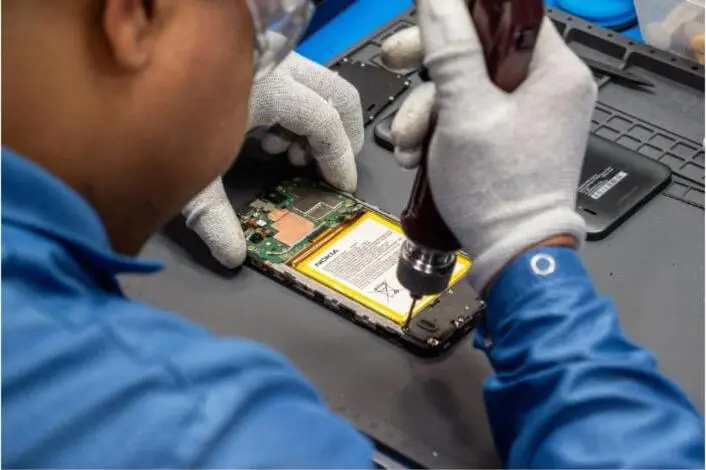
- WISE Level 2 certifies technicians to open devices and replace modular components. The hands-on exam uses two live devices with pre-set defects. The technician diagnoses issues and checks for additional problems before a pass or fail result.
- WISE Authorized Service Center (ASC) status requires ISO 9001 compliance and WISE-certified line managers at the matching authorization level.
WISE certification gives procurement leaders confidence that technicians hold proven skills. Premier Logitech holds ASC authorizations for multiple OEM brands and applies these standards at scale.
ISO 9001 For Quality Management Systems
ISO data from 2022 shows 1,265,216 ISO 9001:2015 certificates worldwide, across more than 170 countries. ISO 9001 certifies process quality through documented workflows, controlled operations, risk-based thinking and continual improvement verified by annual audits.
For a repair depot, ISO 9001 certification delivers:
- Standardized, documented repair processes
- Traceable quality records
- External audit verification by an accredited body
- A framework for continuous improvement
Additional Certifications For Enterprise And Government Work
ISO 9001 sets the foundation for process quality. Government and large enterprise contracts often extend requirements to environmental, security and sourcing controls. Procurement leaders should verify these additional credentials when contracts demand them:
- ISO 14001 for environmental management and responsible e-waste handling
- TAA (Trade Agreements Act) for U.S. government contracts that require sourcing from approved countries
- SOC 2 for documented data security controls
- CMMC (Cybersecurity Maturity Model Certification) for Department of Defense supply chain work
- CAGE Code for identification as a pre-vetted federal partner
Premier Logitech holds TAA, ISO 9001/14001, NIST, CMMC and SOC 2 certifications and maintains CAGE Code 4WAJ9. These credentials support participation in federal and enterprise programs.
Review Premier Logitech certifications with the team to confirm alignment with specific contract needs.
Component And Display Quality Grades
Parts grading often lacks clarity. No governing body or ISO standard defines grades for aftermarket screens, batteries or small parts. Grade labels such as “Grade A” function as comparison tools within a supplier catalog, not across suppliers.
Common Display Grade Tiers
Most depots use letter-based systems for screens. Industry grading practices generally describe these tiers:
- Grade A+ / Premium aligns with ISO 9241-307 Class 0 zero-defect criteria. Panels have no dead or bright pixels and match OEM specifications within normal tolerances.
- Grade A typically allows a small number of dead pixels and minor, hard-to-see defects. Exact tolerances vary by manufacturer.
- Grade B allows more dead pixels and visible defects under close inspection.
- Grade C / Economy includes visible cosmetic wear such as scratches. Underlying display technology remains functional with no dead pixels or internal damage.
Manufacturing origin also affects grading. Korean, Japanese and Taiwanese panel makers may apply different pixel thresholds under the same grade label.
Why Written Specifications Matter More Than Labels
A grade label without written specifications functions as marketing. Quality assurance requires documented criteria. Buyers benefit from written specifications that define dead pixel tolerance, brightness in nits, color gamut coverage, refresh rate and warranty terms.
During depot evaluations, procurement leaders can request:
- Written specifications for each grade tier
- Clarification on OEM-grade versus aftermarket sourcing
- Warranty coverage by grade tier
A functional grade should reflect a documented test pass that covers battery health, display and touch, cameras, sensors, wireless radios and ports. Visual inspection alone does not meet that standard. Premier Logitech ASC status for multiple OEM brands supports access to OEM-grade parts and adherence to manufacturer requirements, which reduces grading uncertainty.
Data Security And Compliance Standards
Enterprise and government fleets require strong data protection. A repair depot handles devices with sensitive corporate, personal or classified information. It must follow documented protocols for sanitization and chain of custody.
NIST 800-88 For Data Sanitization
NIST SP 800-88 defines three sanitization categories:
- Clear uses logical techniques such as factory reset for low-sensitivity data in controlled environments.
- Purge uses logical or physical techniques that prevent recovery with advanced lab methods. Purge serves as the recommended minimum for most devices that will be reused.
- Destroy relies on physical destruction for the highest sensitivity media.
NIST SP 800-88 Rev. 2 separates verification from validation and requires a Certificate of Sanitization for each event. Standards such as R2v3 Annex B treat undocumented sanitization as an audit failure.
Single-pass software overwrite on solid-state drives often misses data cells because of wear-leveling. Auditors increasingly flag SSD sanitization programs that rely only on software overwrite.
Compliance Frameworks For Government And Enterprise Contracts
- TAA compliance confirms sourcing from approved trade partners.
- SOC 2 verifies security controls for customer data.
- CMMC validates cybersecurity practices for defense supply chains.
Premier Logitech follows NIST guidance and holds the certifications listed above, supported by CAGE Code 4WAJ9 registration. Government and enterprise clients receive documented, auditable data security throughout the device lifecycle.
Discuss data sanitization and reporting with Premier Logitech to align with internal compliance programs.
Post-Repair Testing And Diagnostics
A quality depot proves that each repair works as intended. Comprehensive post-repair testing should include:

- Functional checks for touch response, display quality, buttons and ports
- Diagnostic software for battery health, cameras and sensors
- Connectivity verification for Wi-Fi, Bluetooth and cellular radios
- Cosmetic inspection to confirm no new damage occurred during repair
Device grading and post-repair testing combine manual inspection, diagnostic software and scan-based tracking for traceability. Quality depots document testing protocols and provide test reports with each repaired device. Premier Logitech follows this model. Its L1–L4 repair capabilities, supported by significant weekly capacity, rely on rigorous testing at every level.
Warranties And Service Guarantees
Warranty terms reveal depot confidence in its work. Industry guidance places reputable repair warranties in three tiers: Baseline coverage of 30 to 90 days, Standard coverage of 6 to 12 months and Best-in-Class lifetime coverage for defective parts that fail without new damage.
A quality depot warranty should:
- Cover both parts and labor
- Appear in writing with clear terms
- Specify exclusions such as new accidental damage
- Identify the part quality grade covered
Warranty length signals confidence because every claim consumes parts and labor. That is why procurement leaders should ask what the warranty covers, how long coverage lasts and how the claims process works. A depot that stands behind its work provides clear written answers.
How To Evaluate A Depot
This checklist supports structured evaluation of any mobile repair depot:
- Certifications and proof such as WISE, ISO 9001, ISO 14001, TAA, SOC 2 and CMMC
- Parts grading methods and written specifications for each tier
- Data sanitization standards including NIST 800-88 Clear, Purge or Destroy
- Post-repair testing scope and availability of test reports
- Warranty coverage for parts and labor with clear terms
- Compliance reporting and chain of custody documentation
- Scalability to handle high volumes without quality loss
- Turnaround times and handling of rush orders
Making The Confident Choice
Mobile repair depot quality standards function as practical benchmarks. They cover certifications, parts grading, data security, testing and warranties. Applying this framework during vendor selection supports compliance, data protection and consistent repair outcomes.
Premier Logitech exemplifies these standards. The company holds ASC authorizations for multiple OEM brands, maintains the certifications described above, carries a federal CAGE Code and operates with documented quality protocols at every stage.
Schedule a conversation with Premier Logitech to review mobile repair depot requirements and align them with certified, scalable services.
Frequently Asked Questions
What Is The Difference Between WISE Level 1 And WISE Level 2 Certification?
WISE Level 1 certifies technicians to diagnose and resolve common device issues without opening the device, validated through an online knowledge exam. WISE Level 2 certifies technicians to open devices and replace modular components, validated through a practical hands-on exam on live devices with pre-determined defects. WISE Level 1 certification serves as a prerequisite for Level 2, and a facility seeking WISE ASC status must have line managers certified to the requested authorization level. ASC status also requires ISO 9001 compliance and WISE-certified line managers, which makes it the highest WISE recognition tier for repair facilities.
Why Do Display Grade Labels Vary So Much Between Suppliers?
No universal governing body or ISO standard defines aftermarket parts grading. Grade labels such as “Grade A” or “Grade B” are set by individual suppliers and applied at multiple points in the supply chain, including panel factories, assemblers and distributors. Criteria differ at each step, so one supplier’s Grade A may match another supplier’s Grade B. Procurement leaders benefit from written specifications that cover dead pixel tolerance, brightness in nits, color gamut and warranty terms for each grade tier. A depot that cannot provide written specifications beyond a grade name and a price presents a reliability risk.
What Does NIST 800-88 Compliance Require From A Repair Depot?
NIST SP 800-88 requires a documented media sanitization program, not just a selected wipe method. The standard defines Clear, Purge and Destroy categories, with method selection driven by data sensitivity. For most enterprise and government devices that will be repaired or remarketed, Purge-level sanitization serves as the expected minimum. The standard treats verification, validation and documentation as separate steps and requires a Certificate of Sanitization for every event that records the method, operator and verification outcome. A depot that cannot produce per-device sanitization certificates does not meet NIST 800-88 expectations in practice.
What Certifications Support U.S. Government Contract Work?
Government contract work requires credentials beyond standard commercial certifications. TAA compliance is mandatory for most federal procurements above defined thresholds and for all GSA Schedule contracts. CMMC certification verifies cybersecurity practices for Department of Defense supply chains. SOC 2 certification documents security controls for handling sensitive data. A CAGE Code identifies the facility as a pre-vetted partner registered with the U.S. federal government. ISO 9001 and ISO 14001 certifications complete the quality and environmental management profile that program officers often review.
How Should Procurement Leaders Evaluate Depot Warranty Terms?
Warranty evaluation rests on scope, duration, documentation and exclusions. Scope should include both the replacement part and workmanship. Duration signals confidence, with norms ranging from 30 days to 12 months and longer terms reflecting stronger confidence in parts and labor. Documentation should arrive in writing before work begins and use specific, enforceable language. Exclusions should appear clearly and focus on reasonable carveouts such as new accidental damage, liquid ingress after repair and unrelated faults. Procurement leaders can request written warranty terms and confirm the claims process before selecting a depot partner.
